

Cause célèbre - a French phrase still unnaturalized in English, meaning “famous (legal) case" - is used more broadly to refer to any controversy that attracts great public attention
Fortuitously, the natural gas pipeline under construction between Russia and Germany fell into the part with the outrage surrounding Mr. Navalny's fate
Nord Stream 2, in planning stage since the early 2010's, more than 90% completed and launched as a commercial enterprise between the Russian energy exporter Gazprom
Russian gas exports became an influential factor of Chancelor Willy Brandt's 'Ost Politik' during the 1970's, signaling a loosening of the Cold War between East and West, but also the emergence of a confident democratic Germany on the European stage
However, European dependence on Russian gas deliveries have remained a perennial bugbear of American foreign policy, depriving sanction regimes on Russsia (excluding energy exports), of much of their effectiveness
While there is some truth to the American objections, with Russian gas deliveries at approx. 40% of European consumption, the accident of geography (location of the gas fields) and the preeminence of Germany in Central Europe could well turn out to be linchpins of European stability
As for Nord Stream 2, while there may be a technical argument to doubt the merits of the new pipe line (maturing European demand, surge of renewable energy sources, climate change and warmer winters), the project has earned rounds of condemnation of a very different order, assembling opponents brought together in their rejection of Russia's regime itself
Well publicized, the assault on the physical integrity of Mr Navalny, and his arrest on flimsy charges following his return to Russia, have fired up public protest, in Russia and abroad
As a result of Mr. Putin's miscalculation, and with the momentum of moral indignation, opposition to Nord Stream may prove difficult to resist, even by its most steadfast European supporters
Mr. Navalny, however, made his wishes clear, and rightly so, by appealing to Russian public opinion and to no one else – making a foreign show of goodwill essentially unwelcome
The final leg of the Nord Stream 2 pipeline, some 150 km (less than 100 miles) in Danish and German waters (out of total length of 1230 km (760 miles), has been subject to a series of American sanctions since Dec. 2019, reviewed most recently in ‘the End Game’ and in ‘Gas pipelines, ties that bind’
Security concerns remain the main focus of American legislation blocking the involvement of international companies on the project, which led to costly delays in bringing Russian pipe-laying ships on site in the Baltic
Both because gas delivery to the European market is channelled over many routes besides Nord Stream and because Russia's gas exporter Gazprom
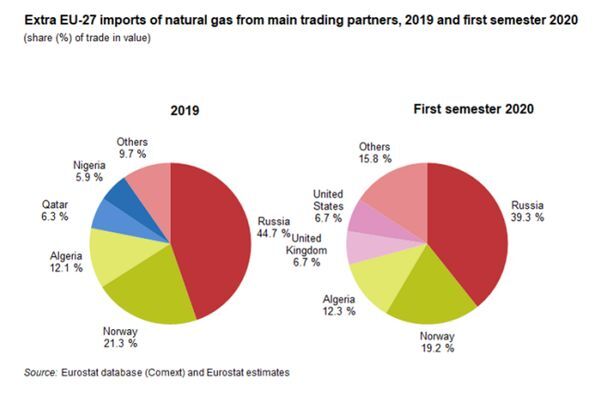
As discussed in ‘Russia’s Rattenfänger’, the project initiated by Gazprom
Opposition in many shades
Poland has declared its opposition based on security concerns of excessive dependence on Russian energy supplies – a pertinent concern following the invasion(s) which Poles have suffered up to recent history (reducing the country to satellite status under Soviet regime after WWII and until 1991 - date of the first free Polish parliamentary elections)
- … if it is true, the new pipeline, which doubles an existing pipeline on the Baltic Sea bottom, should demonstrably affect Poland’s security
Greens in Germany and across Europe have been vocally opposed to the project since its launch, presumably because of principled opposition to excess dependency on natural gas
- … if it is true, it implies that, by quashing Nord Stream 2, the gas deliveries on which Europe depends for its energy needs can be replaced – or at least significantly reduced
The European Parliament – which has no direct say in the matter – is strongly opposed, though the reasons are difficult to apprehend, except as a show of ‘Green’ concern at no cost
- …if it is true, Europe shows cavalier ignorance of the complex network of pipelines connecting Russian gas fields to Europe, North and South, and of the diversification of energy sources accessed by Europe
Ukraine, which is potentially exposed to big losses in transit fees currently paid by the Russian gas giant Gazprom, would have many reasons to oppose the project and the protection of Ukrainian interests has been very popular in non-Ukrainian circles, especially in America
- …if it is true, it happens to be entirely inconsistent with the agreement signed between Russia and Ukraine in December ’19, precisely to clear the way for the pipeline completion
France has expressed opposition without formal arguments (perhaps again to earn goodwill from the Greens?), while hedging its critic with the innocuous and non-committal statement referring to German responsibility
- …if it is true, it stretches the reality of France’s Engie 9% stake
in the project since 2010 (alongside the Dutch and of course the German investors) – Gazprom holding on to a 51% controlling interest
And then, of course, the previous American Administration, the US Congress in a bipartisan show of strength and President Biden have dismissed the project from the start in the belief that 'Nord Stream 2 is a bad deal for Europe’
- …if it is true, American assertions have been to some extent self-serving (in the hope of selling American LNG), difficult to demonstrate (supposed danger to European and NATO security) or baseless (following Ukrainian agreement with Russia)
Mr. Navalny's appeal
The heavy-handed conduct of Russian authorities upon the return in Russia of a key opponent to the authoritarian regime, Mr. Navalny, to say nothing of his assassination attempt, has galvanized the various strands of opposition to the pipeline
In the absence of any new facts to vindicate the rejection of Nord Stream 2, momentum fueled by Russian political abuse has taken on the crusading tinge of Right against Wrong, a posture resisted steadfastly by the German government
While worthy in their own right, none of the arguments invoked to call for a halt of Nord Stream has direct relevance in the framework of German and European energy policy
Poland’s reticence is probably one of the most respectable, in the light of its perennial angst of Russia’s long reach, which has been pressing west for centuries to buttress Russian security
Green opposition, especially voiced by European parliamentarians, looks self-serving and of little consequence on the fundamentals of European energy provisions, bound by geographical reality to the Eurasian landmass and the location of its energy resources
American interference with European energy policy, of which the new pipeline is part, appears most out of step of all the forces banded in opposition, making a weak case of NATO security, ignoring the strong guarantees of European energy policy and relying on claims supported by Ukrainian individuals (not the government) – with unambiguous business interests in selling American LNG looming in the background
The case regarding violation of human rights should be made forcefully in its own right, not as convenient justification for ‘punishment’ of countries erring at the wrong side of international opinion
Mr. Navalny, for one, made his wishes clear, and rightly so, by appealing to Russian public opinion and to no one else – making a foreign show of goodwill essentially unwelcome
Germany steel
If the confrontation over the pipeline is resolved, and gas starts flowing, Germany’s unflinching determination will have brought about an unexpected update of 2021 geopolitical reality
Western Europe is linked to Russian and Central European gas fields by a vast network of pipelines built since the 1970’s to guarantee energy provision across Europe, to energy-poor countries and Germany is not alone...
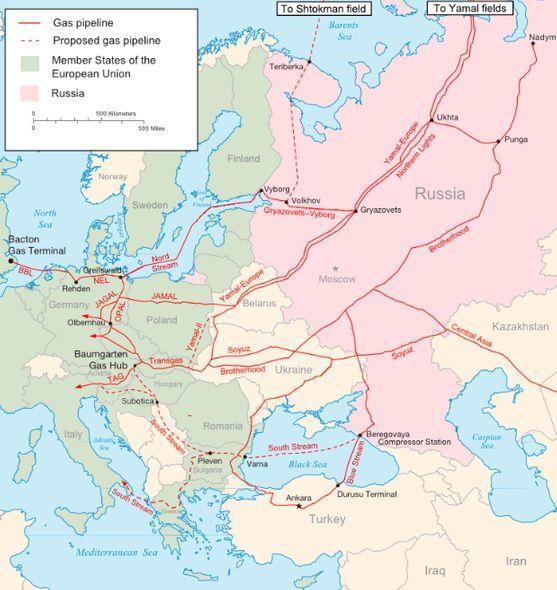
As reported by Deutsche Welle, the German broadcaster,
Green party politician Jürgen Trittin, a former German environment minister, believed cancellation of the pipeline would be futile. The pipeline's Russian developers would receive legal damages from Germany while still being able to export their gas by other means.
"I have never been a friend of this pipeline, but to stop it at this point in time would possibly have a very high price, without achieving any real effect," he said. "After all, Russia has plenty of opportunities to export its gas via other routes."
Geography – and energy needs - have a way of bringing political engagement down to earth
Diktats fall flat
For lack of a compelling argument and all the more perplexing, American determination to override what Germany believes to be its national interest looks more like overreach by the day
Powerful allies with real influence on the world stage should be nurtured, not bullied in a fashion reminiscent of the old ways in the post-war period
American foreign policy has proven to be an afterthought of domestic affairs in recent years and, while U.S. interference with Germany’s internal affairs may meet with inscrutable German prudence, skepticism about the reliability of American support will only grow
For lack of renewed strategic engagement with its European allies, of which Nord Stream might – or might not – have been a constituent, America’s haphazard meddling with the European Union appears to open the way for Germany’s inevitable rise to world power
A divided Continent and quiet dominance by Germany in Central Europe are probably not what American foreign policy planners have in mind – it is precisely what will be achieved, giving it time…
With the discovery that allied interests are not necessarily aligned exactly with its priorities, America will not relinquish its premier status but, rather as ‘primus inter pares’, first amongst (almost) equals, its flexibility in world affairs will encounter limits
Politics of emotion
Following Russia’s brutal action in targeting organizations, parties and individuals prone to question its authoritarian rulers, the West is once again reminded of the fact that the country is not governed by democratic rule, and in fact has rarely been in its long history
Flying in the face of societies which nurtured public trust in democratic institutions, with all their imperfections, over 200 years, the wholesale import of democratic practice, following the end of the ‘Cold War’ and the fall of the Soviet regime, was never likely to be easy
Detached from their social framework, the adoption of some of the less appealing aspects of a liberal order turned out to be counterproductive, by renewing the mandate of strong authorities to counter powerful oligarchs
At odds with Western democratic conviction, the ensuing abuse perpetrated by undemocratic regimes will be strongly condemned by public opinion which shares the pain of the crowds marching in protest
Sincere Western support of Russia’s citizenry rising against abuse has virtue, but, as Mr. Navalny has made clear, it is up to the Russian people to support his lonely plight … or not
Heated condemnation of the pipeline by the media feeds into public indignation following mass protests in Russia, presumably in the hope a drop in Russian gas exports hurts Mr. Putin (it will not) by showing Western displeasure
With tempers running high, losing all sense of geopolitical reality, even level-headed publications such as the Economist share a narrative leaving no room for debate by suggesting that the demise of Nord Stream ‘would be an ignoble end for an ignoble project’
Whether such grandstanding will make life easier for Mr. Navalny probably did not enter consideration…
Another proof that politics of emotion usually can be discounted as bad or counter-productive politics can be traced back to the paradox that Mr. Putin, although unquestionably focused on energy exports as his true power base, is in fact not a great supporter of pipeline extensions to the West
As we expect to show in ‘Novatek , Russia's icebreaker’, the attention of Russia’s president is concentrated on energy demand in Asia, by way of LNG deliveries, leaving pipeline planning to Gazprom’s powerful lobby of engineers, with much reservation and perhaps unwillingly …