

The popular Robinhood platform has gained strong following amongst young investors with its mobile app and free trading features
Building on awareness of price momentum of some stocks, Robinhood might encourage investors to 'jump on the bandwagon' and in some cases, this might be quite good but not always...
Our series will provide some background information and focus on the inherent weaknesses - or the strengths - of some top industries and companies favored by the Robinhood investment community
Every Pininvest factsheet is supported by a theme listing companies or funds of interest, with up-to-date pricing, performance & risk ratios, and fundamental data
Visit the theme - Tracking Energy Markets
Facts in brief
The blow-out (or rather, the blow-up) of an Exchange Trade Note (DGAZ), between Aug. 5 (priced at $400 on the Over-the-Counter market) and Aug. 12, (when price shot up to ... $24 000), draws attention to one of the riskiest markets...
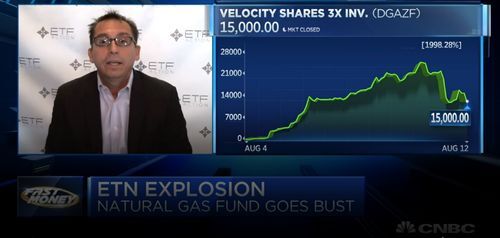
Many factors converged and they all carry a lesson for investors
Commodity Markets - Crude Oil and Natural Gas
Commodity trading is one of the more complex markets, drawing in the expertise of battle-hardened specialists, which makes it very unlikely a 'green' investor will by any means outplay trading desks from around the world
Like when playing poker with a star, you will leave your cash on the table - and then some...
One may be lucky one time and then a second time ... and then the market specialists will pounce
Even in the most unusual markets, as has been the case since last March '20, commodity markets will quickly reassert their forward looking logic ... and the traders will prove better at that than most...
...which is why an investment in United States Oil Fund LP
- the entire USO portfolio is made up of oil futures, which are rolled-up every month (by selling the current month's expiring contracts and investing entirely in the upcoming month's contracts)
- and yes, this is 'financial engineering' ... but is it wise to invest in assets of which you, as investor, are not familiar ?
This is true of all the Exchange Trade Funds (ETFs) on our Tracking Energy Markets list which, such as USO, own the underlying assets
- these funds all rely on futures contracts- using various methods to refresh their selection - with the exception of First Trust Natural Gas
), which invests in companies drawing all - or most - of their revenue from natural gas - on the positive side, ETFs are regulated by the Investment Company Act of 1940 which provides a level of investor protection which Exchange Traded Notes (ETNs) do not
The strange life of the DGAZ ETN
What is in a name ?
The Notes are in no way comparable to ETFs, except for the fact that they are indeed exchange traded ...
- the Notes are issued by a bank - which means that the investment will only be as safe as the bank itself...
- the value of the Notes is linked to an index - but their is no underlying asset (as is the case for ETFs owning future contracts) - only pricing linked to the index
- in this sense, ETNs can be viewed as synthetic trackers of an index
- the more demand for the Note, the more Notes the bank will be issuing - always maintaining the price in line with the index
- usually Notes are issued with a date of maturity - way out in the future - but, and this creates uncertainty for the investor, the bank may decide to 'accelerate' maturity and end support of a Note
- as for investor protection, the Notes are unsecured and unsubordinated obligations, guaranteed by the issuer and regulated by the Securities Act of 1933
Going into more detail, the key differences between ETNs, ETFs and mutual funds are listed on a factsheet, edited by Royal Bank of Scotland
Red faces all around
Issued by Credit Suisse, DGAZ, a VelocityShares 3x Inverse Natural Gas ETN, would go up in price as the price of natural gas went down (3 times as fast, in fact) - and the reverse would of course be true, with the price of the note dropping three times as fast in a gas market upswing
The bank decided to delist the ETN from NYSEARCA on July 12 '20, when the note was priced at approx. $400 - no further notes would be created, in effect taking away the supply-demand arbitrage mechanism
With the remaining notes ending up on the Over-the-Counter (OTC) market, liquidity dropped from some 100 000 notes a day to ... a few hundreds
This put short sellers - the traders who assumed, reasonably, that the price of the note would FALL because natural gas was trending UP - in a bind
Short sales were - apparently - very large, at around $15 million at the end of July - and when the price of DGAZ started trending UP, not down as expected, the short sellers has nowhere to go to cover their positions
...which may be why the note exploded sky-high, no commentator is really sure...
Whatever the explanation, and even if, this once, the 'green' investor who bought some DGAZ on an off-chance came out smelling like roses... ETNs are not investment vehicles for the private investor and neither should commodity ETFs
- complexity is reason enough to stay away
- and there are just too many players, all with their own priorities - banks, fund buyers, fund short sellers - and, of course, global (macro) trends affecting commodities (think international trade, politics and ... pandemics)
Duly, the notes always carry explicit warnings discouraging everyone but ... professional investors
What now ?
Actually, the list of Energy Commodities (ETFs and ETNs) included in the theme does provide value information on general trends in the energy market
By toggling between different time frames - starting at 6 months and narrowing down performance (and risk exposure measured by volatility) to the most recent one- and two-weeks periods
- market movements come alive...
- the comparison between the performance of the sub-categories highlights trends
- individual funds, ranked by performance or by volatilty on the screen, provide indispensable information on the energy market today
The paths followed by natural gas, crude oil and global energy funds provide background information on your investment decisions in energy companies - which is, after all, what the private investor should be looking for