

To follow-up on our coverage of e-commerce in China and India, the Grand Tour writ large would be incomplete without the projections propelling South East Asia forcefully into the 21st century
The striving region is well worth the attention to make up for its absence from the still-born Trans-Pacific Partnership (TPP) , namely the forgotten threesome... Indonesia, the Philippines and Thailand (70% of the population of South East Asia)...
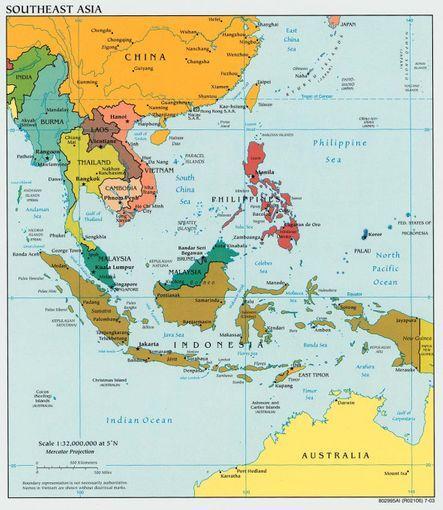
Our review of South East Asia Internet commerce penetration relies essentially on a May 2016 report commissioned by Temasek, the Singapore sovereign fund and by Google, predicting a $200 billion Internet based economy for the region by 2025
To our knowledge, this is the most reliable overview of market potential in Indonesia, Malaysia, the Philippines, Singapore, Thailand, and Vietnam
According to a December 2017 report update, the tremendous growth projected for the main segments appears on track as the regional Internet-based revenue is expected to accelerate, hitting $50 billion at the end of 2017, driven by growth above projections, especially in e-commerce, on-line media and in ride hailing
Projections for 2025 10-year CAGR 2015-2025
- E-commerce (online spending on electronics, apparel, household goods, food & grocery), targeting $88 billion (10-year CAGR 32%) – actual growth rate 16-17 : 41% per year
- Online travel (hotels and airlines) market targeting $76.6 billion (10-year CAGR 15%) - actual growth rate 16-17 : 18% per year
- Ride hailing, targeting $13 billion (10-year CAGR 18%) – actual growth rate 16-17 – 43% per year and 2025 and target revised upwards at $20 billion by 2025
- Online media — games and advertising — targeting $20 billion (10-year CAGR 18 %) – actual growth 16-17 rate 36% per year
At first blush difficult to apprehend, the torrid growth pattern across the board is powered by a unique combination of drivers
Demographics of South East Asia (SEA)
| 2018 est. in '000's | % of SEA total | 2050 est. in 000's | growth trend in 2018 | |
|---|---|---|---|---|
| Indonesia | 267 264 | 40,8% | 321 000 | 1,04% |
| Philippines | 106 778 | 16,3% | 151 467 | 1,52% |
| Vietnam | 96 651 | 14,7% | 114 629 | 0,99% |
| Thailand | 69 208 | 10,6% | 65 372 | 0,34% |
| Malaysia | 32 114 | 4,9% | 41 729 | 1,60% |
| Singapore | 5 805 | 0,9% | 6 574 | 2,50% |
| SEA total | 655 636 | 88,1% | 797 648 |
- 70% of the population is under 40 (vs 57% in China)
- Urbanization, estimated at 48% (vs 73% in Europe and 82% in North America), is accelerating everywhere except in the Philippines (partly because of the country's job opportunities in call centers outside the capital and easy commute to city centers). With less concentration in mega-cities, 41% of the population in South East Asia lives in mid-tier cities of fewer than 300 000 inhabitants
Fast growing GDP
- Nominal GDP $2.5 trillion is expected to grow at 10-year CAGR of 5.3%
- Strong growth has led to the rise of the middle class, creating the need for huge infrastructure developments as these consumers migrate to more developed urban areas
The world’s fastest growing internet market 2015 - 2020
- From 230 million people in 2015, reaching approx. 480 million by 2020 (5-year CAGR 14%)
Indonesia being the fastest growing Internet market with user base topping 215 million in 2020 (5-year CAGR 19%)
Intensifying cross-border trade
- In a close relationship with its largest trading partner, the region will tend to abide by the Chinese rules and norms and by its trading practices
- Rising Chinese investments in infrastructure and manufacturing facilities are displacing traditional investors from the US, Japan and Europe
- And, as noted by a May '18 Council on Foreign Relations workshop, China is effectively utilizing economic tools to maximize its strategic influence in Southeast Asia, such as by doling out aid deals piecemeal to ensure that countries only receive the full amount of promised assistance after they accept Chinese regional foreign policy aims
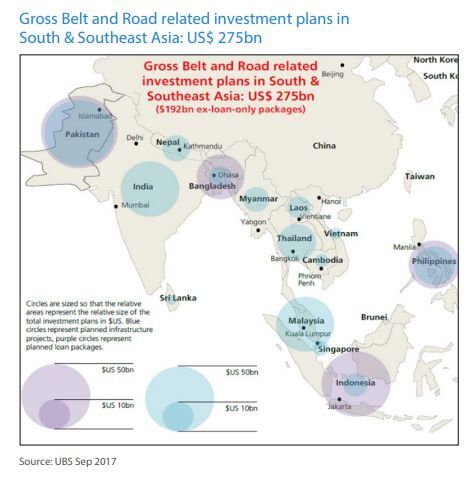
Considering the growth potential of the Internet economy, the absence of American companies, in the wake of the ‘benign neglect’ of American diplomacy, may have come as a surprise to many South Asian countries, and probably to China itself
And, all the while, Internet-based commerce carries weight because facilitated cross-border transactions are more intimately embedded in closely knit value chains between Chinese and South Asian businesses
We will review the spectacular commitment made by the Chinese e-commerce titans, and especially by Alibaba, in our follow-up note on South East Asia, ‘the Jewel in the Crown’ of another Empire ?
However great the expectations for each sector, commerce remains solely – as it has been through the ages – the advance scouting party of vast infrastructure projects staged and controlled by China's Belt and Road Initiative