
Pin-insights
Trade with China has dominated public discourse in the US because its large volumes command whole markets in industries and industry-segments
The weight of China is compounded by its strong performance in all product categories, from the most labor-intensive to high tech capital intensive specialties, which is quite unusual
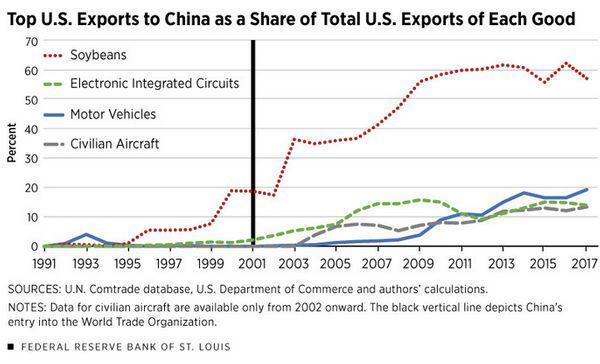
Trade negotiations cannot turn back the clock – we expect a ‘deal’ focused on specific segments, with special attention to cars & car parts and agricultural products (soybeans)
The agreement with China will impact trade with Europe' car industry and agriculture in a major way
******
As discussed in Trade is War, national interest and government interference is a natural in international exchange
The conflicted negotiations between China and the US today are a case in point
The US trade deficit - China is coming of age...
Balance of trade, and the vast deficit experienced by the US, should concentrate the attention, as America is intent on halting the erosion of its industrial base
With global trade on a fast track since the mid-50’s, exchange between US imports and exports in fact remained balanced for almost 30 years, until the early 80’s
The successful entry of imported goods on the American consumer market, mainly since 1990, have marked a sharp break with brutal consequences for US manufacturers
Trade represented approx. 20% of GDP for the US around 1990 and stabilized close to 30% since 2010, a spectacular burst of growth measured against an increasing GDP
Throughout the 90’s, the deficit generated by Japanese trade was dominant, staying fairly stable at a high level representing between 0.7% of US GDP in 1990 and 0.8% in 2000. By 2010, the trade had fallen by half, to 0.4%
US deficit with China grew unceasingly from a relatively small base in 1990 (0.17%), catching up to Japan in 2000 (0.8%) and stabilizing at 1.8% of equiv. GDP since 2010
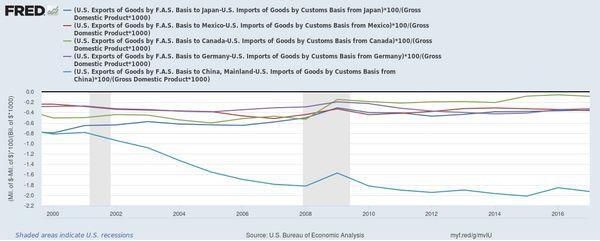
As noted in the FRED blog, China's share has dominated since 2001, when the country entered the World Trade Organization (WTO) and a noticeable trade deficit with Mexico followed that country's access to NAFTA in 1994
The position of China as dominant provider is unusual because the large volumes, commanded in industries and industry-segments, control whole markets to a large extent
By 2015, China already accounted for 28% of global auto production, 41% of global ship production, more than 50% of global refrigerator production, and, among many other products, global production of color TV sets, footwear and furniture, office machines, phones and telecom equipment, motorcycles, baby carriages and toys, air conditioners and computers for 60 to 80% of global production
It will be noted that, especially in high tech, China’s manufacturers have not always taken over from existing firms, either in America or in other import markets, but created wholly new product categories Chinese manufacturers dominate entirely, as has been the case with drones
The weight of China is compounded by its strong performance in all product categories, from the most labor-intensive to high tech capital intensive specialties (WSJ-graphics paywall)
As a result, China-made products are available to the American consumer across the board , often without alternative
- either because domestic because US manufacturers sold – or transferred – their production facilities to Chinese companies
- or because alternative foreign manufacturers are not in a position to compete on expertise, on volume or on the breadth of Chinese supply chains
The US Trade Representative - Going back to the Future ?

This is the context in which Robert Lightizer, the US Trade Representative, hopes to address two legitimate but very distinct concerns
- rebalance trade to the benefit of the American workforce
- curb access to intellectual property
In terms of trade, the judgement is out...
The goals are straightforward, achievements be hard to frame
- in the effort to rebalance US trade imports / exports, the Administration is focusing on a few targeted industries, auto manufacturing & defence manufacturing and base materials such as steel and aluminum, in part on basis of political considerations but, more critically, because domestic production of many consumer products has been abandoned and the supply chains dismantled
- further, a strong economy, as has been the case through 2018, commands a trade deficit – year-to-date (10 months) the trade deficit with China has reached $344 470 million, an increase of 11% over Oct. 2017
- the reverse is also true, if and when recession hits - with a 15 % drop in the deficit with China between 2008 and 2009
With little hope to turn back the clock to a time when Walmart was selling 'made in the USA' from a diversified manufacturing base, we expect
- pressure on car- and car-parts imports, which will impact European and Japanese assembly plants in the US - BMW, Daimler, Vokswagen, FCA, Honda, Nissan , Toyota , Hyuandai-Kia and Chinese-owned Volvo
- renewed insistence on soyabean exports mainly to Europe, to substitute for potential market share loss in China
As for China, the latest announcements of tarif cuts on more than 700 articles - as of December '18 -
- bring back duties to their original levels for cars, lithium batteries, soyabeans
- reduce tariffs on high tech imports - on types of aircraft engines, on robots used on car assembly lines...
- slash to zero duties on 'alternative meals,' such as rapeseed meal, in a move to diversify China's animal feed supply
- futher reduce to zero materials used in the fabrication of some pharmaceutical goods
In summary
- the European Union will be bracing for difficult negotiations because Germany is eager to protect its car industry and France the trade barriers targeting agricultural products. The risks exposing German car manufacturers - BMW
, Daimler Invalid tag asset and Vokswagen - stands out and will be discussed in a forthcoming note - Japanese car manufacturers - Honda
, Nissan , Toyota - are negatively impacted by market downturns in China and in Europe, but appear less at risk of new tariff confrontations - China needs to deal with political and economical pushback - imports to the US will be affected and facilitating entry of goods entering Chinese suppy chains in agriculture (soya and other animal meals), in industry (robotics) or in healthcare (base materials for pharmaceuticals) will not suffice
Terms of access to intellectual property will raise many more questions
Technology, the all-time focus of nations, overlaps balance of trade concerns and garbles governmental priorities, because of the military edge it might offer, and the industrial and trading advantages it secures
Protection of technological advance will be discussed in our follow-up report, CFIUS - mission impossible ?