

My recent note on AI – All bright and shiny – described the links of the AI ‘assembly line’
This note on AI - Great Expectations? - is focused on the immensely ambitious investments of tech giants such as Amazon, Microsoft and Google, called 'hyperscalers'
Willing to commit to a technology with over-the-top promises, those 'hyperscalers' might know of opportunities yet to be revealed...
For now, investors are learning to appreciate the potential of each link in the supply chain, one at a time
Financed by the world’s deep-pocketed operators, the AI supply chain benefits the most astute ‘toll collectors’ in the 'hardware business'
This is all about the data centers, cable networks and chips which might turn a worldview of artificial intelligence into reality
Gold dust ...
From an investor's perspective, it is vain to evaluate the profitability of artificial intelligence as an 'integrated' system. Dependencies between the links are strong but profitability will not be evenly distributed when the early excitement dies down
'Gold dust' will not be sprinkled generously and indiscriminately on all things stamped 'AI' forever
The slate has been overwritten so many times with dreams and warnings to make the texts illegible
In identifying the chokepoints, an overview of the supply chain will focus on the critical drivers which keep the promised AI growth on track
Growth is foundational to AI valuation across the entire system
Growth expectations define forward looking valuations and missteps at choke-points, just faltering for a quarter, would reveal the doubts of deeply invested entities
Trend reversal would be as dramatic as the explosive valuations of recent years
Toll-keepers are different from the "Compute" hyperscale drivers of AI growth
Toll-keepers, such as manufacturers of advanced memory semiconductor chips, contribute decisively to make the growth of Compute a reality
What these suppliers of the technological widgets running the AI ecosystem need to summon, in spades, is trust, trust in AI's potential and trust in the growth path set out by the hyperscalers
Because the toll-keepers have a choice....
Either the toll-keepers will respond with supply growth of whatever device they control or....they will levy higher tolls on constrained supply
Or a mixture of closely monitored supply growth and toll increases...
Trend signaling
While margin-enhancement is an attractive option, an investor's perspective should be laser-focused on the willingness of toll-keepers to commit to expansion ... or not
Their increased capital expenditures (capex) would be a vote of confidence in future growth of AI demand, two years ahead of time, accounting for the delay in installing new manufacturing capacity
If the toll-keepers are holding off the high capex linked to data center medium-term growth projections, they might be signaling hard-nosed misgivings
By cooling their own capex projections, the toll-keepers would signal a prudent retreat from AI's growth anticipations
By keeping track of choke-points and toll-keepers, investors will cut through the mist of great expectations
This matters because valuation of the AI model builders is entirely premised on exponential revenue growth - with profitability to follow
By identifying the moats and mutual dependencies within the supply chains, investors will gain additional (but never conclusive) understanding in AI's fast-moving segment
The approach discussed in my note complements the vast body of available information on AI's revolution
According to Epoch AI, "Amazon, Google, Meta, Microsoft, and Oracle collectively hold an estimated 71% of the world’s cumulative AI compute as of Q4 2025, measured in H100-equivalents of computing power. This is up from 63% in Q1 2024"
At this scale, the hyperscalers are the choke-points and the toll-collectors of their own destinies, folded into one
If, for whatever reason, they renege on their more ambitious expansion in data center construction, growth anticipations and valuations of the entire supply chain will be shaken
And when, not if..., the hyperscalers attempt to make full use of their pricing power in 'Compute', valuation of the entire supply chain will be shaken to its core, again
Hyperscale
AI leaders are outspending every major research endeavor in history
Orchestrated in 1940 by the U.S. government, with a clear focus on nuclear weapons, the Manhattan project, coordinated by the National Defense Research Committee, used to be the ultimate strategic investment
Not any more...
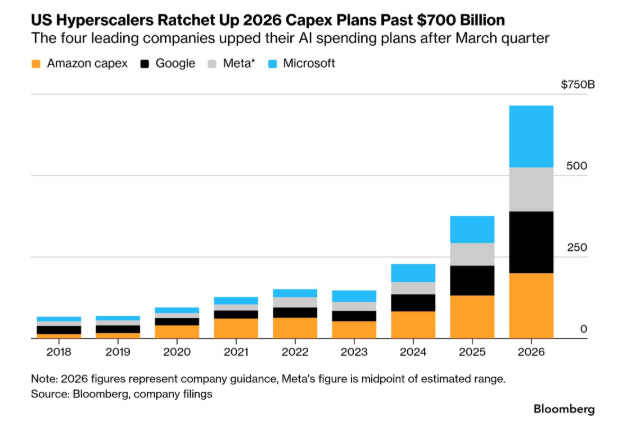
Amazon, Microsoft and Google and a few important ‘second-tier’ giants such as Meta, Oracle and X.ai have underwritten the hard tech assets on a colossal scale
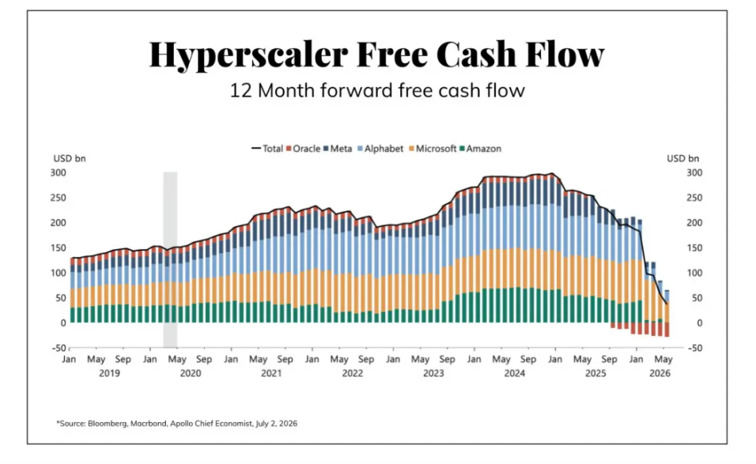
The impact on the hyperscalers' Free Cash Flow has been shattering, dropping from $300 billion to approx. zero in 18 months
Bond issuances have followed apace
According to Reuters, Morgan Stanley forecasts AI-related global debt issuance to more than double to nearly $570 billion in 2026, which covers approx. 85% of anticipated capex outlays this year
Keeping the faith, Morgan Stanley expects bond issuance to ramp in second half of 2026, as hyperscaler capex is expected to surpass $1 trillion in 2027
Only if exponential growth projections are buttressed by credible market conditions will debt finance allow the AI ecosystem thrive, if I listen closely to muttering bond vigilantes ...
The toll collectors
The toll collectors are perhaps the most fascinating of the main players in the AI show
Their flagbearer is Nvidia with Graphics Processing Units (GPUs) providing the massive parallel processing power required to train and run complex AI models
The semiconductor industry has exploded upward with Samsung’s and TSMC’s custom manufacturing of the logic chips and Micron’s expertise in advanced High-Bandwidth Memory (HBM)
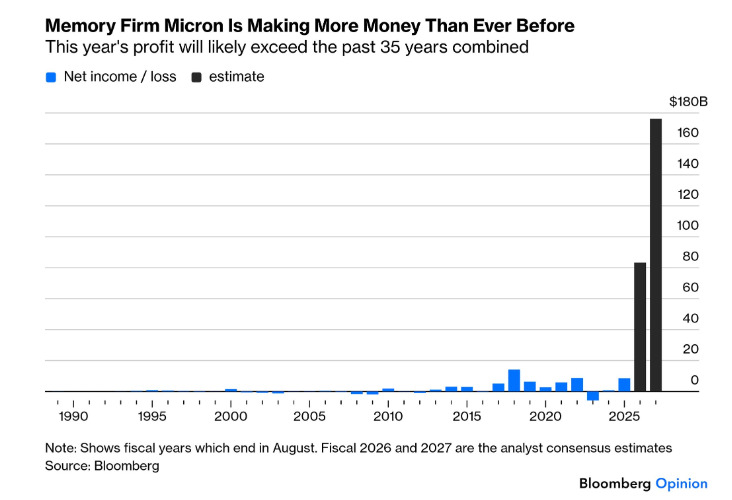
Unchallenged on the global stage these leading toll collectors must still be wondering….
Are medium-term demand projections of 'Compute' a reliable foundation of their own business strategies?
How to respond to the prospect of semiconductor demand growing exponentially when new manufacturing facilities take 3-4 years to build?
Is to follow through with manufacturing capacity as grand a scale as signaled by data center projections just a drunken gamble?
Why not keep supply tight, raise prices and collect toll for the foreseeable future?
Hard hyperscale questions
Growth projections of the entire AI ecosystem come down to issues of capex allocations for data centers in 2027 and beyond
Assuredly, between China and the U.S., a race is taking shape, "a race not one of the challengers can afford to lose" in popular thinking
Power access, the age-old physical constraint
Ambitions are spelled out in gigawatts, indicative of the astounding growth projections
U.S. data center power capacity currently stands at approx. 31 to 41 gigawatts (GW) and is projected at 80 GW by 2030 (McKinsey estimate), even up to 110 GW (Goldman Sachs - GS estimate)
China’s data centers' total power capacity is projected to surpass 60 GW by 2030, according to Rystad Technology (from 28 GW in 2025 -GS estimate)
- Power capacity is the upper limit of electricity (measured in GW) that a data center's transformers, generators, and power distribution systems can safely supply.
- Operational data center capacity refers to the exact portion of a facility’s infrastructure resources actively allocated to run computing and networking systems
- Capacity dictates the maximum amount of Compute and cooling hardware a site can operate
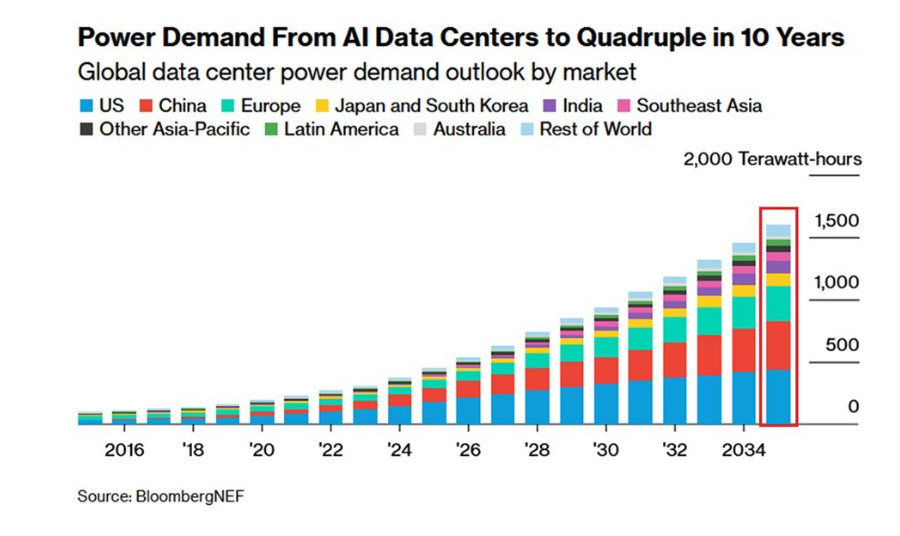
- Capacity measures the rate at which power is used (in GW)
- Energy consumption measures the total electricity used over time (e.g., total Terawatt-hours over a year)
One must wonder…
The scale of projections for electricity capacity and consumption signals a social and economic revolution as radical as the first introduction of electrical power by Edison
The many shades of 'accelerating' growth
Growth - of the exponential sort - is the breviary of the true AI believers, the underlying force of extraordinary valuations
In truth, the magnitude of the capex already committed by the hyperscalers is a measure of confidence in explosive AI
However, by their immense size, hyperscale investments have upended the context in which the data centers operate
The rush in Compute growth has created a new reality of its own, in physical locations, in Compute pricing and in project debt finance
- Local resistance to the construction of new data centers is growing, and growing fast
- Shortage of 'Compute' may not be as acute a justification of huge Capex allocations, as demand appears to fluctuate wildly
- With a premium on flexible short-term access to Compute, the leasing of such highly valued capacity is gaining ground at Meta and X.ai
- Will the bond markets remain as reliable source of finance? In 2026, the issuance of $570 billion in debt doubled from the previous year but is leniency is defining feature of the bond market going forward?
Will the hyperscalers grow their commitment to data center infrastructure to $700 billion as announced in 2026? and race to $ 1 trillion in 2027 if Morgan Stanley is correct?
New AI realities are in flux...and the 'known unknowns' of the race with China add to uncertainty
International competition will be putting pressure on demand in global AI compute capacity
The two candidates to 'global compute dominance' might stay on a leash for now
- Lack of abundant and affordable energy, distributed over an efficient grid, might throttle data center expansion plans in the U.S.
- The massive build-out of data centers in China, projected at 20% per year through 2030 by Goldman Sachs, is short on the most advanced chips
Confronted with uncertain answers to the many questions, the AI ecosystem will need an inordinate level of trust to look beyond the short term....and rise to the challenge
Growth anticipations determine future profitability, supports audacious investments in manufacturing capacity and anchors investor expectations
Slowdown in the growth trends would have a multiplier impact on falling AI valuations
What should I do with AI power?
Michael Crichon, in his novel ‘Jurassic Park’, brought serious thought about science to the general public in a thriller of genetic engineering running amok
“Because you can stand on the shoulders of giants, you can accomplish something quickly. You don't even-know exactly what you have done, but already you have reported it; patented it, and sold it.”
Since science is power, Crichton follows through
“Because things are going very fast now... it will be in everyone's hands… Experiments for schoolchildren. Cheap labs for terrorists and dictators. And that will force everyone to ask the same question -
“What should I do with my power? - which is the very question science says it cannot answer."
The application layer, the last leg of my AI overview, considers some answers
In our next note, I will discuss how AI in China is on a track setting the AI systems apart from the Western focus on 'artificial general intelligence'
Cutting through the admirable complexity of the AI technology, this is where the science meets real life user