
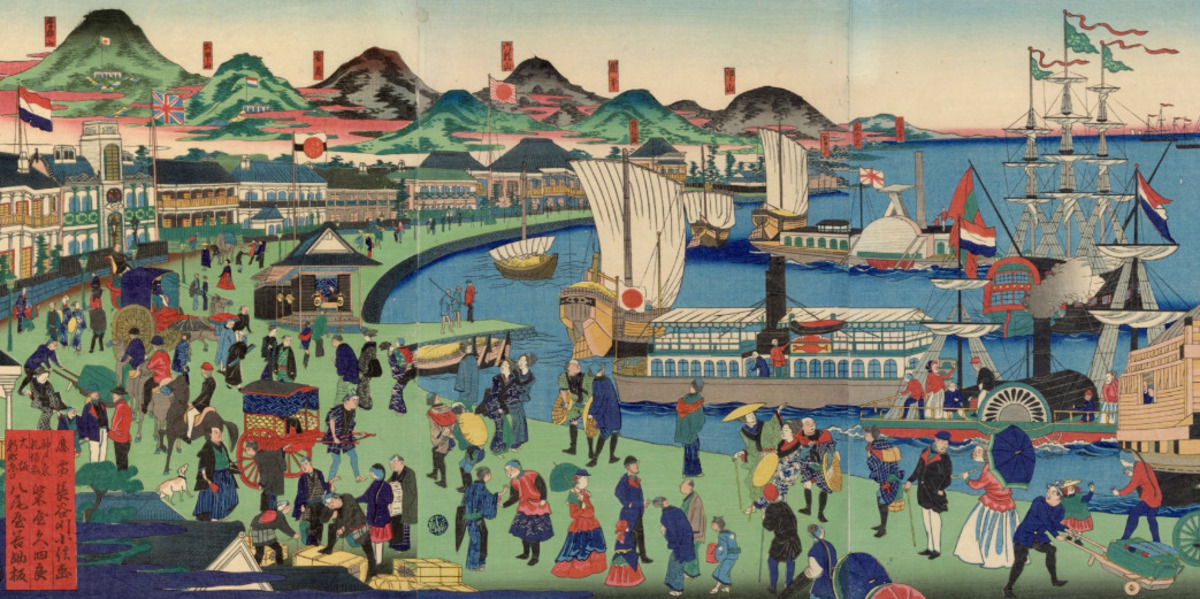
In my note on the global importance of Japanese supply chains, I quote, very much out of context (!), a famous line of Edmund Burke (1729-1797) from his First Letter on a Regicide Peace (1796), arguing in favor of total war with the French Revolutionaries
In Burke's sense of social community, the moral and intellectual dimensions of 'culture' are "the spring of energy to the State", to be protected at all cost
"Manners are what vex or soothe, corrupt or purify, exalt or debase, barbarize or refine us, by a constant, steady, uniform, insensible operation, like that of the air we breathe in. They give their whole form and color to our lives"
Manners, good manners according to Burke, matter a great deal because they define customs and mores, as indeed they do - not just in Japan or just in 18th century Britain
In context, the Meiji restoration in Japan, launched by 1857, holds lessons for ambitious plans of Western manufacturing resurgence
Success was not foretold - the cost of Restoration to social cohesion tried Japanese resilience to the limit and the emergence of industrial conglomerates (the zaibatsus) would durably reshape economic power in the country
Because Western industrial policies cannot 'turn back the clock', and because fragmentation of the economic net between the industrial 'have-s' and the 'have not-s' is a real possibility, manufacturing reinvention is very much in flux - amidst social unrest and economic power grabs
A 150-year old Meiji Restoration offers some guidance
The Meiji 'bootstrapped' Restoration
It is no coincidence that the great, punctilious attention paid to product quality has become a trademark of Japanese industrial production
Tentatively during the country’s renewed economic build-up, following WW II, the drive to improve iteratively, and on its own strengths, has been a constant, built on traditions stretching back to Kaikado's 150-year old modest shop
Borne by the 1867 Meiji Restoration which brought the Tokugawa feudal system to an end, a few features of great significance appear to be stamped with finality on contemporary Japanese policy with 'Burkian' manners....
Required with urgency to create a sound fiscal base, but adamant in protecting the nation's autonomy, the Meiji government pushed back on loans by foreign investors
- Egypt, brought down to colonial status through foreign loans, had been a warning, not a model to be followed in the 'Meiji' early days
- Resisting conceited and smug attitudes of Western overlords, the Meiji authorities were determined to ward off foreign investors and to lead economic development on their own terms
Under pressure from Western powers, unequal treaties, which enforced extraterritoriality and controlled tariffs, had been imposed on Japan in the last Tokugawa years (Kanagawa Convention in 1854 and Harris Treaty in 1858)
- The Meiji government had a clear understanding that developing countries needed to protect their industries behind tariff walls, which the treaties did not allow
- Foundational to self-contained economic growth, Western extraterritoriality was finally abolished in 1894 and full tariff autonomy recovered only in 1911
Inflationary increases in quantities of yen, put in circulation to finance massive budgetary deficits in the decade following Restoration, engineered a massive, and probably unintentional, transfer of wealth
- The samurai, original supporters of the Restoration, which had been paid off with bonds, and the urban workers, suffered a substantial decline in real income
- Farmers, which benefitted from land reform (1873) with secure ownership of the land, were further enriched by the increased value of their crops
Aimed at self-sufficiency, in the early Meiji period, a policy of public austerity - the 'Matsukata deflation' (1881-1885) - cut government expenditures and sold-off government industries
- The focus on modern economic growth, and on establishing a stable, convertible currency, inspired from Western precedents, was going to stamp the features of Japan's economy decisively
- With the acquisition of government industries, firms like Mitsui, Mitsubishi, Sumitomo, and Yasuda were bent on oligopolistic control of the domestic market, keeping foreign influence at arms-length
Each one of the features, inherited from the first years of the 'Restoration', had a 'long tail', setting Japan on an economic course with defining characteristics to this day
Domestic debt financing - often highlighted as a singularity and not without merit, given Japan's heavy load - is the distant reflection from distrust of foreign loans
Inflation is not a recent, widely criticized, experience - monetary debasement reawakens dark memories of urban impoverishments, and the recent electoral success of the Prime Minister points to sensitivity of the issue
Foundational in modern industrial Japan, conglomerates in pyramidal structures layering control of the domestic market - the zaibatsu - left a family corporation at the apex while relying on outside capital for opportunistic acquisitions and for expansion
Opportunities for Western industrial renaissance?
Measured against the history of Japanese industrialization, and the tightly knit integration of industry, finance and trade, 'relocation' of manufacturing capacity, in the U.S. and in Europe, remains a tall order
Renaissance in the U.S. and for its Western allies has probably not meant to unlock an 'industrial revolution' mirroring the wave of economic growth of the post-WW II period
In a roundabout way, the American Administration may have opened venues of partnership between U.S. firms and supply chains of Japan's industrial giants with its insistence for Japanese investments in the U.S. (for an estimated $550 billion)
With the leverage of shared interests, industrial associations might be well positioned to address supply chain and manufacturing bottlenecks in Western markets by combining Japanese expertise with U.S. market penetration
What might appear unfathomable would not be different from the investment strategy of the Japanese trading houses, sharing technological expertise across the world with minority holdings, only on a larger scale
- Infrastructure investments, such a port for crude oil exports and a gas power generation plant, currently under discussion, could become frameworks for entire networks of industrial collaboration on American soil
- Shipbuilding, a notorious issue of national security and of constrained U.S. expertise, limited to just one major yard (Norfolk, located inPortsmouth, Virginia), could upend decades of delay, inattention and (perhaps) sloth
Because economic partnerships are ultimately always - and exclusively - about leveraging an interest shared by both parties, the technical bend of the Japanese industrial supply chains and the strong motivation of American firms to nurture targeted industrial networks should be promising
This opportunity is not as improbable as it might seem because technicians all speak the same language
Just as 'manners' define customs and mores in the Japanese tradition of arts and crafts, cultural differences are bridged in technological applications and research : they give their whole form and color to our lives - as Edmund Burke observed