

Interpreting the Fed’s pronouncements is never straightforward
Traders tend to cloud their wishful thinking (rates really will go down … soon) with lasting suspicions that the Fed’s guidance (rates could well go up again…soon) will not be acted upon anytime, if ever...
...implying that the Fed's true intent actually is for rates to remain stable for a short time before falling back
Hope springs eternal
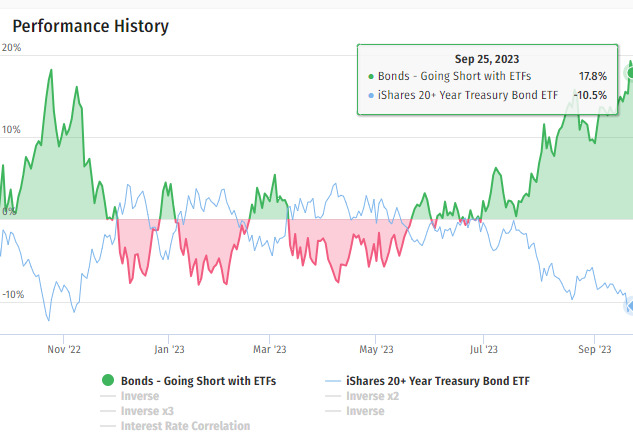
The market has been wrongfooted over the past year – as shown by the red trendline of our selection
Expectations of lower interest rates have kept ETFs shorting bonds (in the hope for a sell-off) mostly under water since November 2022 – because a rise in bond prices was anticipated by the market, in sync with falling yields
That just did not happen
The market's U-turn, throwing in the towel in July, implies that high yields might be here to stay
Inverse ETFs such as "Going Short with Bonds" are not long-term strategies but short-term tactics
Banking on rising yields today, the funds may find themselves - again - at the losing end if (and when) the perception of monetary conditions reverts
Solid arguments project rising yields for longer duration bonds (20 and 30 years)
Inflation may stabilize but will not subside - penciling higher yields in every bond investor's expectations
Affordable Chinese imports restraining price increases are dented by trade wars, domestic workforces hold out for better pay and will get it, energy prices (both fossil-fueled and green renewables) will not fall and a ballooning US federal deficit ($1.5 trillion in the first 11 months of the fiscal year) propels consumer spending
The market will be awash with government bonds for the foreseeable future ... where are the buyers and on what terms will they buy ? (short answer : at higher yields)
- Approx. 30% of $30 trillion Treasuries outstanding will mature within 16 months, according to Bill Gross, a famed bond investor. These Treasuries will need to be replaced
- Additional Treasury issues will be flooding the market to support infrastructure spending and green investments
- The Fed's quantitative tightening – to reduce the amount of money in circulation – implies either sale of bonds held by the Fed (projected at $1 trillion by Bill Gross)– or by not buying replacements of bonds as they mature – again increasing the supply of bonds in the market either way
All of the above – and anticipations of bond buyers in the market – will push yields up (and bond prices down)
Foreign buyers for US Treasuries may be hard to convince as some countries, such as China, reduce their historically high stake in the geopolitical context
Fractured US politics do not help either
Rosy anticipations remain sticky
Bill Ackman of Pershing Square (a hedge fund) explains rate ‘stickiness’ by psychological ‘drag’ as traders perceive the 4% yield range as quite attractive in their experience of a low inflationary world and yields at 4.5% - 4.7% might actually look quite cheap
If only Ackman's observation were of limited relevance - and it is not....
Stickiness of rosy anticipations by psychological drag could characterize the real estate market (which has scaled heights) and the entire stock market (which clings to reassuring economic prospects and technological wonders)
Only the world has changed, with higher yields to come…a fact which the camp expecting falling yields hotly disputes
The argument for falling yields rests on three underlying factors
As a function of term premium, inflation, and economic growth expectations, yield sensitivity can be understood as an interaction of anticipations
Term premia is the amount investors expect to be compensated for committing to one long-term interest rate (20- or 30-years bond) versus a series of shorter-term interest rates
As modeled by the Fed, the term premium for the last 30+ years has declined steadily, in sync with a trend of falling rates, both short- and longer-term
Inflation expectations are built into yield as a hedge against monetary depreciation over the life of the bond
The difference between market-based prices of the inflation-protected TIPS and the nominal bonds defines the hedge in terms of market-anticipated inflation
Once inflation expectations and term premia are stripped away, yield has to be supported by economic growth anticipations to make sense
Economic growth prospects, the third component of yield, may turn out to be high and possibly over-estimated at a time of rising yields if both term premia and inflation expectations, stripped from yield, remain historically low
Looking back, these two components have indeed been trending down over the past decades, reflecting low inflation anticipations
If these trends continue to hold true, high yields would overstate growth expectations, a reality test bringing yields down - on the back of a recession....
Geopolitics have an awkward habit of getting in the way of financial anticipations
Growing international tensions between the U.S. and China, assertiveness of the developing 'South' and the shift boosting defense expenditures around the world will test the resilience of financial markets
Even though their acuity cannot be appreciated, the risk - and the cost of redirecting supply chains - will weigh on the market leaders which thrived on globalization
In summary
Investors cannot hold on to straightforward conclusions regarding yield
With market's habit of overshooting, yield will continue to rise as the law of bond supply (abundant) and demand (shallow) plays out, driving investor anticipation for now
The risks of yield momentum cannot be overstated because - looming straight ahead - is the fundamental repricing of the entire stock market and of real estate
...if higher yields are here to stay but no one knows