

Our recent report «Carlos Ghosn – the End of the Affair” focused on the legal case Japan’s prosecutors intended to build, with Nissan’s support, against Carlos Ghosn, the firm’s CEO and Greg Kelly, executive director and 30-year employee
Following Carlos Ghosn’s flight from Japan to Lebanon, the trial of Greg Kelly, accused of complicity in the main charges levelled against Mr. Ghosn, has gained special relevance
The verdict, expected in March ’22, 3 years and 3 months after Mr. Kelly’s arraignment has to lay bare what – if anything – holds in these charges
The smoke will finally be lifting on an affair which had been engineered minutely, was supposedly fool-proof but went astray
In fact, at every turn, the planning of what looks very much like a boardroom coup at Nissan was upended by unforeseen events, by adversarial interests and greed of the plotters themselves and by cultural clashes between the French and the Japanese
Awkward maneuvering, mostly by Renault in an attempt to save the Alliance with their Japanese counterpart, would come later ...
The case for the Japanese prosecution was badly weakened by the stubborn refusal of Messrs. Ghosn and Kelly to ‘confess’ to the alleged financial crimes
M. Kelly’s refusal to incriminate his boss may not have been anticipated, considering the extreme psychological pressure to which he was subjected by the Japanese prosection
On the legal front, Nissan’s efforts to downplay the importance of the post-retirement proposals prepared by the firm itself for the signature of Mr. Ghosn and of the testimonial of Mr. Hari Nada, a key accuser for the prosecution, effectively putting Mr. Ghosn in the clear, added to the confusion
With events spinning out of control, Nissan
Japanese prosecution hunkered down behind their vast powers, delaying Mr. Kelly’s trial and keeping the dossier from the defense at every turn, maybe in the forlorn hope to avoid a reckoning
The tactics might have succeeded in putting a damper on public interest, easy to distract and ready to ‘move on’, were it not for another turning point in the affair
By escaping from Japan, in December 2019, Mr. Ghosn became a free agent, unpredictable and in hot pursuit of all the loose ends left dangling by the Nissan boardroom plotters
In the background, Japan’s industrial planners at the METI (Ministry of Economy Trade and Industry) had every reason to be concerned of political interference by the French government, which was all too eager to dust-off the country’s reputation with a global automotive champion
As a foretaste, in April 2015, the attempt by the French government to keep control over Renault’s board decisions with the so-called Florange law, doubling the voting rights of the public stake, had been a clumsy and heavy-hand tactic, with the fingerprints of Mr. Macron (at the time Economy minister) all over the ill-fated attempt
The half-baked plan left no doubt in the minds of the Japanese authorities about France’s true intentions
To bury the hatchet, a December ’15 one-page Alliance Stability Covenant capped Renault’s voting rights to 17.5% (raised to 20% in specified circumstances) and committed Renault
A win for Nissan …
…except that the public Covenant mentions ‘exceptional circumstances' such as changes to or the termination of RAMA (Restated Alliance Master Agreement)….’ and the passing of the 15% threshold of Nissan’s stake in Renault as cases under which the ‘cap’ limiting the voting rights of the French authorities would not apply
Nissan had made sure early on to interpret everyday collaboration in the Alliance with their French partners on the factory floor in mostly restrictive terms (especially regarding R&D) but governance remained unaffected, in stasis under Mr. Ghosn’s shadow…
At a time Nissan was doing significantly better than Renault, a unique reversal of fortunes, attested by inverted market cap valuations, the Japan firm could neither attempt a merger on its own terms (by taking control over Renault) nor 'renege on the Alliance
When rumors of a planned reorganization which would have folded both car companies into a single holding, started whirling confidentially by 2017, the METI must have recognized with alarm that the governance agreements between the two firms still left Nissan grounded, with a weak hand to counter Renault’s – and the French government’s – strategic options
No one will dispute that Mr. Ghosn, by the sheer power of his personality and his undisputed reputation, could bring about whatever corporate organization would qualify as his legacy
…which is why Nissan – and the Japanese officials – fell back on a key provision of the 2015 covenant, the right to dismiss board members
By publicizing artfully vague financial misdemeanors, readily qualified by Hiroto Saikawa as ‘crimes’ at the press conference on the night of Mr. Ghosn’s arraignment, in December ’18, the trap was set and Mr. Ghosn was out, not to be heard of again…or so Nissan thought
Making shock waves around the world, managing to enlist the American SEC in search of Mr. Ghosn’s crimes, showing off conceited satisfaction in France as Mr. Ghosn’s high life and wealth came to light, the fall of Nissan’s CEO was complete
Exhilarated at pulling off what they must have qualified as a real boon for Japan, Nissan’s leadership involved in the plot only had to bring the hammer down on Mr. Ghosn supposed regime of fear and abuse by vowing transparency and internal inspections
And Nissan’s management team, with Mr. Saikawa (soon to be named at the helm of Nissan), had already the right person to clear out the above-mentioned crimes, Ms Christina Murray, Nissan’s Chief Compliance Officer
…the right person because Ms Murray was not Japanese, and turned out to be fully committed to put the firm back on the right track – an opportunity of a lifetime…

On September 17, 2018, Hari Nada, vice-president for legal services, informed Ms. Murray and Global General Counsel Ravinder Passi, who both reported to him, of the suspicions hanging over Carlos Ghosn and of the involvement of the Tokyo prosecutors’ office
Ms Murray was instructed by Mr. Saikawa by early October, one month before Mr. Ghosn’s arrest, to secretly form a task force for an internal investigation into his compensation and expenses
Ravinder Passi and Manabu Sakane, a vice-president for corporate governance, joined her team.
Initially fairly small, the task force got started by laying out innocuous tasks, such as drafts of nondisclosure and service agreements, to be issued after Mr. Ghosn’s expected arrest, and planned press releases
But, before long, Ms. Murray, in the belief to fight the ‘good’ fight, and led along by Mr. Nada, engaged in dubious decisions
Presumably in hot pursuit of proof of Mr. Ghosn’s misdemeanor, Ms. Murray went along with Mr. Nada in coordinating a hit on Mr. Ghosn’s papers at company offices and in his personal residences in Brazil, in Lebanon, in the Netherlands (Mr. Ghosn’s tax domicile) and in France, timing the visit of dedicated teams at the precise moment of Mr. Ghosn’s arrest
Proceeding without warrants, flaunting the rules of discovery, the haul was partially successful in Brazil where Brian Delauter vice-president at Nissan North America, refused to remove Mr. Ghosn’s personal safe from his apartment, a bit too successful, and undoubtedly illegal, in Lebanon, where the team took away the hard drive of Mr. Ghosn’s late personal lawyer, and failing in Paris where, by coincidence, the locks to his apartment had been changed recently
Not even the morally questionable phone call made by Mr. Nada to lure Greg Kelly to Tokyo on the day planned for the arraignment registered in Ms. Murray’s team for what it was…
…so much so that Ms. Murray put her stamp of approval on a scathing report to Nissan’s board, only three days after Carlos Ghosn’s and Greg Kelly’s arrests and before any charge had been levelled, establishing that the accusations against the two executives were damning…
The report, according to Roger Schreffler’s source, was prepared by Nissan lawyers Latham & Watkins (namely Michael Yoshii) and Nissan officials Hidetoshi Imazu, Nissan’s statutory auditor, Hari Nada and Hitoshi Kawaguchi, head of the corporate communications and government affairs division
This turned out to be an early high point of what could hardly be qualified as an ‘inquiry’ yet, because the inspection of Ms. Murray’s team, following two disparate leads, started to sputter in 2019, probably to Nissan’s dismay…
Just as Ms. Murray had been tasked to do, information regarding Mr. Ghosn’s personal affairs, possibly discovered on the hard drive of his late Lebanese lawyer commandeered from his Beirut office (?), was shared with the Japanese prosecution, leading to the two later charges (January and April ’19)
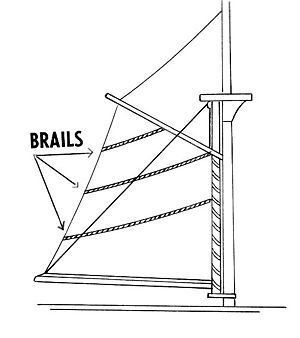
However, hit by one discovery after another, Ms. Murray started to reef the sails, pulling hard on the brailing lines by mid-2019
When Ms. Murray discovered the June 2015 proposal, signed by Hiroto Saikawa (by that time CEO of Nissan) and by Greg Kelly, linking retirement compensation for Carlos Ghosn with consultancy work and a non-competition clause, as discussed in ‘the End of the Affair’, the case against the former CEO started to look distinctly wobbly
…even moot, because the proposal had not been signed by Carlos Ghosn and had consequently never been submitted to the board for approval
And there was worse to come…
On June 9, 20109, Bungei Shunju, a respected Japanese monthly magazine, published a three-hour interview with Greg Kelly, who revealed that Hiroto Saikawa and other executives had made illegal gains by moving back the execution date of their stock appreciation rights, originally set as May 14, 2013, by one week, during which Nissan shares rose 10%.
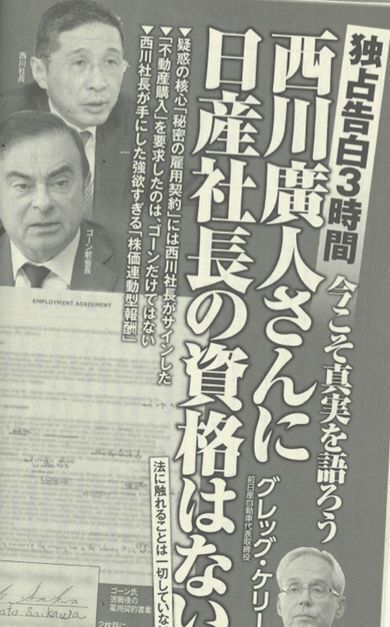
Brought in by Ms. Murray, one of Japan’s big four – Anderson, Mori & Tomotsune LLP – reported in August ’19 with an extensive list of beneficiaries of these inappropriate gains, Mr. Saikawa (for almost $430 000), Mr. Nada (more than $270 000) and 6 other Nissan executives (including Hidetoshi Imazu, Nissan’s statutory auditor who had made the first contacts with the prosecutors regarding suspicious payments to Mr. Ghosn…)
The backdating had been carried out by Mr. Ohnuma in the Secretariat office
It is unclear if Mr. Kelly benefitted, which is possible, but unlikely given the way he advertised the issue
As for Mr. Ghosn, again according to Mr. Schreffler, there is no evidence that he ever profited from shareholder appreciation rights – no evidence that, as in the case of Mr. Saikawa, they were backdated for the purpose of enriching himself.
No charges related to the matter have been levelled against him
Working next to Ms. Murray in the investigation, Ravinder Passi, Nissan’s Global General Counsel, focused for his part on conflicts of interest which might compromise Nissan’s case
As Mr. Passi would explain “We expect that the litigants [Messrs. Ghosn and Kelly] in future proceedings in Japan, the US and elsewhere likely will also seek to take advantage of the potential conflict and independence issues created by this situation.”
The law firms retained by Mr. Passi - Cleary, Gottlieb, Steen & Hamilton LLP and Mori Hamada & Matsumoto LLP, another of Japan’s big four - trained their sights on Mr. Nada who had secured a plea deal with the Tokyo prosecutors on October 31, 2018
Leaving the investigation team in the dark, Mr. Nada had remained – and still was – fully engaged in the inquiry about Mr. Ghosn, before and after his plea deal, while operating effectively on behalf of the prosecution
The report by the law firms was completed by mid-July '19, concluding with lawyerly reserve that
“They [Mr. Nada and Mr. Ohnuma, who also entered a guilty plea] had personal interests and obligations to cooperate with the Tokyo Public Prosecutors’ Office in a way that may not always align perfectly with those of the company. The risk becomes particularly more acute where such individuals are senior-level executives who would ordinarily have decision-making authority on behalf of the company.”
Mr. Passi forwarded the report to Motoo Nagai, Chair of Nissan’s audit committee on July 24th
And…nothing happened
By mid-Summer 2019, the legal case was distinctly running out of steam, though none of this was known outside Nissan headquarters
- Hari Nada’s interview on July 3, at company law offices of Latham & Watkins discredited the charges against Mess. Ghosn and Kelly
- Ms. Murray’s report (175 pages long) had been put under review in July-August
- and Mr. Passi’s conflict-of-interest conclusions had been communicated to top management
Course-correction was urgently required to regain control, with a focus on Ms. Murray’s report, likely to be widely publicized
According to Roger Schrefller, during the week of August 26, Ms. Murray gave a copy of the report to Ravinder Passi for review and met with Nissan’s board, informing them that she planned to deliver the report at the September 4 audit committee meeting and again on September 9, 2019 at the board meeting.
When a fire threatens to take down the house, it is best to dose the flames
- Ms. Murray was ordered to stop the investigations on Aug. 28 (by Motoo Nagai, Chair of Nissan’s audit committee, arguing an unspecified conflict of interest) and she submitted her resignation on Aug. 30 – her last day at Nissan was August 31
- The copies of the report (incl. Mr. Passi’s) vanished, not to be heard of again
Embers, however, have poor form to ignite…
Mr. Passi’s moral indignation at the treatment of Ms. Murray were the embers, igniting in the – for Nissan unexpected – shape of a hand-delivered memo to the independent members of the Board on September 9
The memo (with attached legal opinion) raised the conflict-of-interest of Mr. Nada,, the singular resignation of Ms. Murray and unspecified complaints sent to independent board members (but not received by them^)
Thierry Bolloré, the sole Renault representative on the Board (hardly qualifying as ‘independent’), was not physically present for the meeting and was not in receipt
To cut the story short, at the September ’19 Board Meeting, Mr. Saikawa, Nissan’s CEO, was compelled to resign on the grounds of his backdated stock benefits and the audit committee announced it was not “planning to treat individuals benefiting from improper handling of compensation from share appreciation rights as responsible for misconduct”
Mr. Passi was removed from the investigation on Sept. 12 and was requested to turn over his entire file related to his investigation of executive compensation
In his own telling, Mr. Passi would not be allowed to attend board meetings any longer and would have to move to the UK (after 8 years in Japan, with no personal desire to move or to move his family)
Shadowed by individuals from March ’20, his home was raided in mid-2020 by court officials to retrieve a company computer and mobile phone…
Still being followed after the raid, Mr. Passi and his family left Japan for good and settled in the UK
Mr. Passi and Mr. Delauter, now former vice-president at Nissan North America (who refused to remove Mr. Ghosn's personal safe in Rio) are embroiled in lawsuits with Nissan
Mr. Ghosn's personal assistant in Rio, who was requested to come to Japan to be interrogated by prosecutors (she refused), got fired
Ms. Murray is now vice-president and compliance officer for Capital One Bank in Dallas, Texas
All of which leaves open the question Renault has been loath to answer - is the Alliance truly in shambles ?
The French firm's top management cannot plead ignorance any longer and powerful players, the French Minister in charge of the Economy Bruno Lemaire and Japan's METI, have to take center stage
This note - as well as "Carlos Ghosn - the End of the Affair" - relied on documents and analysis of a series of articles publshed by Asia Times journalist Roger Schreffler