
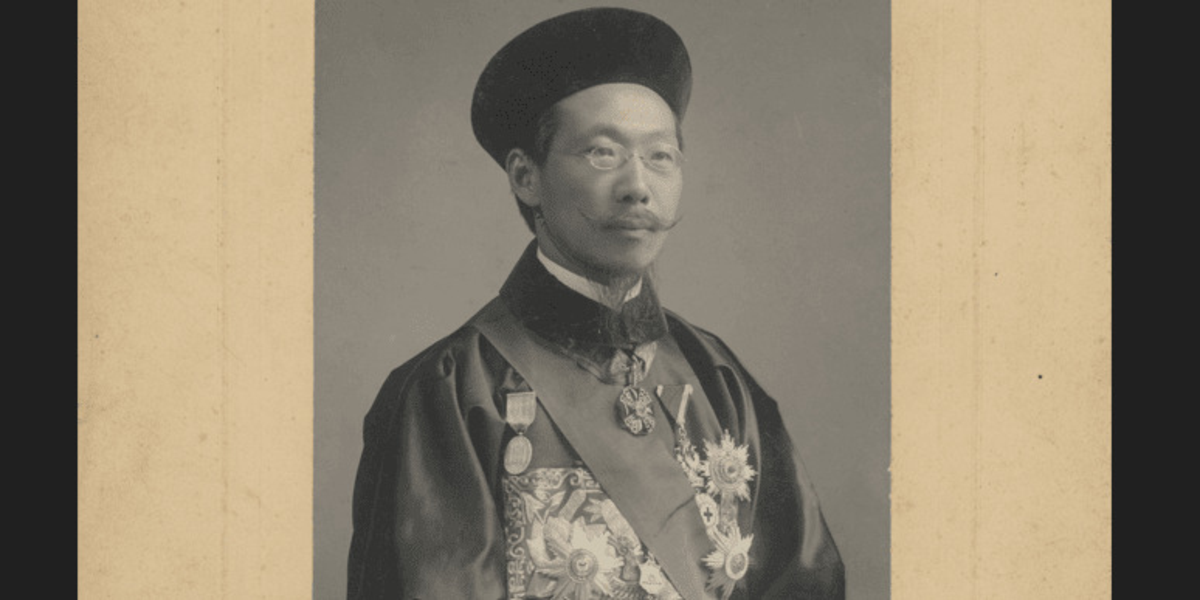
My name is Lu Zhengxiang, 陆 征祥
I was born on 12 June 1871 in Shanghai, province of Jiangsu, and was raised a Protestant in religion and a Confucianist in philosophy
I had a privileged education, first at home and, by the time I turned 13, at the School of Foreign Language in Shanghai, specializing in French, a school on which the self-righteous educated 'elite' looked down as a hotbed of traitors in cahoots with foreign powers
My unusual education was completed at the Tong Wen Guan, the school of interpreters, attached to our Foreign Ministry, and by 1893, at the age of 22, I was posted to Saint-Petersburg as interpreter (fourth-class)
With civil service State Examinations dedicated exclusively to the Chinese Classics to access the highest functions in the Imperial Qing Administration, China's officials could not be more poorly prepared for the new Century
Sidestepping the regular career path, I acquired a much sought-after knowledge of French, the language of diplomacy in my time, as well as of Russian
My life choices may seem to have been deliberate but no, they were not, even though they would seem that way in retrospect
Those years did make me familiar with novel ways of thinking, of social advance and of responsible government
Ideas lit a fire in the mind of this young diplomat in Russia who by chance never was formatted in the rigid ways of rote learning as were all his highly regarded colleagues
And the Court of Tsar Nicolas II, for all its prestige and stately protocol, enthralled me in those early years of my career with a sense of modernity
The 'stroll' we will be taking through the XXth century, dear reader, is cut short by my death - in 1949, precisely the year the Communist regime availed itself of power
My experience as diplomat and as statesman in the highest functions for my country paints a complex history of the century as I have known it
Policies of our Western counterparts were in many way 'humiliating', but the underlying crass ignorance of our culture by their educated leaders, supposedly well-versed in international affairs, remains to me the most perplexing part
As for the Qing dynasty, I promise to do my best to keep my contempt under wraps, as the master who profoundly influenced my career, Xu Jingcheng, former ambassador to Russia, instructed me to
My decades of humiliation
The Qing would finally collapse in 1911 but my earliest memories are tainted by the tragedy my country had to endure for decades throughout the dynasty's death throes
Some twenty years before my birth, the Taiping rebellion (1849-1864) illustrated most disastrously how forlorn hope in a moral order banning slavery, concubinage, arranged marriage, opium smoking, foot binding, judicial torture, and the worship of idols divided the Chinese empire
In the wars, vast areas of farmland were destroyed and between 20 and 30 million of lives were lost by famine and, with other revolts against the Qing by the Muslims and Miao minorities, trouble stretched into the 1870's
Unsurprisingly, the Western Great Powers, the British, the French and the Russians were eager to benefit, extracting the highest price for their support to the Qing
The Treaty of Tientsin (1858) was a power grasp with deeply insulting demands requiring all official Chinese documents to be written in English and a proviso granting British warships unlimited access to all navigable Chinese rivers
As this still was not enough in the impoverished state of my country, the British and the French resumed hostilities two years later, marched on Beijing, looted our capital and burned the Old Summer Palace, forcing the Qing to sign the Convention of Peking (1860) of unequal treaties with the three Great Powers
I had to start this 'walk' with these 19th century events for many reasons
The tragedy would mark deeply my diplomatic and political careers, but more importantly and with much certainty, my outrage will be carried forward well into the future by every Chinese alive
The Old Summer Palace, left in ruins to this day, as stark reminder of the Western Powers' duplicity and barbarism, is bound to loom over our foreign relations - we cannot forgive and forget...
Reading Confucius
In the Memoirs I published in 1945, Souvenirs et Pensées, I explained the influence of Confucianism in defining my character
Filial piety and relentless effort to approach personal perfection will, as I wrote, nurture the natural virtues residing in the hearts of all men
As guidance of a moral life, fostering an attitude of respect and of restraint, Confucianism taught me not to read the Classics without, at the same time, to exercise my own judgement
The enduring strengths of Confucianism will, in my opinion, frame the dialogue between East and West, throughout the XXth century and beyond, making its appreciation so important
In retrospect, and although every word still rings true, I hardly did justice in my autobiography to the interpretations of Confucius' Analects (500 BCE) and Mencius' interpretations (300 BCE)
Westerners might gain a richer understanding of Confucianism with those philosophical debates between the proponents of Li, "investigating things" through study and rational analysis to uncover universal truths (as set forth by Zhu Xi) and the "Qi" School of Mind, stressing the unity of knowledge and action—achieving true understanding only through practice (as defined by Wang Yangming)
My suggestions would be of little merit in this learned debate, but I cannot imagine that "Li" and "Qi" will not contribute together to the intellectual and cultural foundations of civilization, and ultimately to define what it takes to be a human being
Chinese Rites Controversy
The Controversy was a dispute among Catholic missionaries over the religiosity of Confucianism and Chinese rituals during the 17th and 18th centuries
Settled only very recently by the decree issued on 8 December 1939 by our Holy Father Pius XII, Chinese Catholics are authorized to observe the ancestral rites
Since I was received into the Catholic Church in 1911, the debate remains of course very close to my heart
Although I rejoice at this resolution, and fully understand the careful words chosen by our Holy Father, the wounds left by the Controversy will not heal at the stroke of a pen
It would have been presumptuous to discuss such a complex matter in my Memoirs, just five years after the Papal decree
However, it will soon be self-evident that the translations of foundational Confucian texts into Portuguese, Spanish or French could create deep misunderstandings
By transposing in Western doctrine the fundamental Chinese principle of the universe, Li, and the Qi 'unity of knowledge and action', the stage was set for incompatibility between Christian faith and Confucianism
The Controversy represented a significant clash in the interaction between Eastern and Western cultures
Four centuries of fraught relations
The Jesuits, following the "Directives of Matteo Ricci", the Jesuit who did more than anyone to share the Christian Faith in China back in the 16th Century, argued that Confucian rites were secular rituals and thus compatible with Christianity
After Ricci's death in 1610, his efforts to present the Christian Gospel in the terms of Confucian philosophy were disputed by the Dominicans and Franciscans
Chinese terms for the 'divine' were suspected to sow confusion with the Christian God and Confucian veneration of the ancestors branded as superstitious religious ritual
In Rome, understandably, this principled debate went back and forth
Pope Alexander VII had remained supportive of missionary efforts in China (1656) but Clement XI reversed the Jesuits' policy of accommodation by banning ancestor veneration as 'idolatrous' (1704 decree Cum Deus optimus)
By "retrofitting" our millennia-old Confucian philosophy arbitrarily to Western concepts, those grounding elements of Chinese society and civilization were bound to be misunderstood and very possibly distorted
I am not sure what my contribution could have been if I had lived and gone back to China as I intended
What can without fail be entrusted to those coming after me in the XXth century and beyond is to nurture a confident dialogue between the Catholic Church and China's intellectuals
On a personal note
At the death of my wife, I retired from active life, and in 1927 became a postulant, under the name Dom Pierre-Célestin, in the Benedictine monastery of Sint-Andries in Bruges (ordained a priest in 1935)
My discomfort, to this day, stems from my conviction that open dialogue between China and the West remains in constant danger
I hope to invite you, dear reader, to another walk down 'memory lane' and share the good and the awkward in my own efforts at dialogue, early in the 20th century...
Trust between our cultures is fickle and has to be earned again and again