

In a series of articles about China's economic prospects, in the short to medium term, published since early October, the reversal of the country's 'growth model' and the conundrum of Chinese leadership, were spelled out in no uncertain terms
In a nutshell, the argument goes like this
- GDP growth rests on three pillars and three pillars only :
- demand of the domestic consumer market,
- investments (private and institutional) made in the country
- and exports, netted from imports (net foreign trade supporting the local economy)
- When growth of anyone of these three drivers falters, the resulting slack in demand has to be picked up by the remaining two or else...demand in the country will drop, creating deflationary pressures - this is true in any country but China's challenge might be the largest of all
- The size of the Chinese economy underscores the complexity in keeping its growth pattern on track - impressive as the country's relentless progress has been over the last three decades, doubts are creeping in
- Underlying structural weaknesses of the Chinese growth model are the true cause of concern...and of immense consequence for the Chinese people and for the world economy
Structural shifts usually emerge in the wake of political arbitrage
Government policies are bound to have structural consequences
But the reverse is also true...
Structural singularities weigh on the national politics and constrain public options
It is true that structural challenges come in many guises
Roadblocks, even temporary bumps on the way, are often said to be 'structural' to postpone uncomfortable policy decisions
The issues confronting China's leadership, for their part, may be uncomfortable, but they are also straightforward and fully recognized
The 'demand' pillars of GDP are unusually skewed
Gross National Product (GDP), in the expenditure approach, is by definition equal to the sum of all final goods and services purchased over a year by the consumers, by government entities, by real estate and business investment and by foreign markets (as net beneficiaries of exports)
The sum of goods and services bought over a single year equates that year's GDP
This puts the sky-high Chinese savings - not consumed and not invested - at the heart of the financial domestic imbalance
At 46% of GDP, gross domestic savings (households and corporate) in China are more than double the global world average (20%)
Corporate savings broadly in line with the global average (at approx. 20%)
Household savings are the drivers of the savings rate differential, at approx. 23-25% of GDP which are more than three times higher than the global average (7-8%)
In Western developed economies, such glaring imbalance will self-correct by enticing domestic consumers to...consume
Not so much in China where a host of 'structural' factors incite households to prioritize savings
Demographics of an aging society, the one-child policy (1980-2016) and resulting old age insecurity, income inequality and housing affordability all have played, and continue to play, their part
Compounding this sense of insecurity, zero-COVID policies laid bare the frailty of China's healthcare system
Because the urge to save for rainy days is deeply imbedded in the national psyche, the contribution of domestic consumption to economic growth is - and should be expected to remain - marginal
Exports, which, from a Western perspective, represent an awesome stream of goods supporting China's economy (and swamping Western markets), hardly put their mark at all...at just 3% of GDP once gross exports (20.5% of GDP) are netted from imports (17.5%)
Growth in investments, both institutional (mostly by local governments) and private (by way of real estate), has been the driver behind China's economic triumph, most recently with massive commitments during the 2007-2008 meltdown
Finetuned over time, growth powered by investments has served the country well
- Low (repressed) interest rates, offered by the banking system, channeled household savings to real estate, which promised security and seemingly guaranteed capital gains
- The real estate sector entered a spiral of ever larger projects, financed by debt, by bank credits, special investment vehicles and bonds, and...savings of trusting households
- The liabilities of Chinese real estate majors have sent shockwaves through the financial system - $300 billion at Evergrande, $180 billion at Country Garden as of June 2023
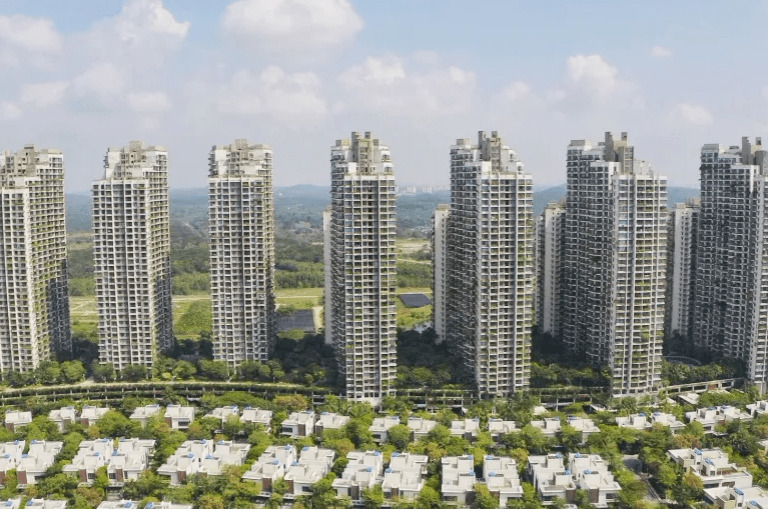
- On the institutional side, local governments (provincial and city) are responsible of infrastructure finance and their budgets are linked to real estate projects by way of land sales
- Infrastructure investments have been on a roll not least to steady GDP during the Financial Crisis (2007-2008) but also because successful developments go hand in hand with promising carriers of local government officials
- Debt finance, by way of special entities - the Local Government Finance Vehicles (LGFV) - supported these local ambitions by hook or by crook
- Built-up of local government debt has been breathtaking - at ($11 trillion) - more than 60% of China's annual GDP - of which 54 trillion yuan ($7.5 trillion) are interest-bearing , mostly (61.7%) owed to Chinese bank, according to Reuters
Victim of its success, growth powered by investments is hitting a brick wall
Bills are coming due
Debt carried by households and by government has been the most important growth driver of the economy over the past 15 years, inevitably with diminishing returns
- since 2000, indebtedness increased sharply, as shown by official statistics (residential debt grew 9 times and local government debt 6 times)
- over the past 15 years, since the Great Financial Crisis of 2007, China's total debt-to-GDP doubled to 280%
While the magnitude of debt is staggering, the liabilities are carried almost entirely by domestic entities (discounting international bonds issued by real estate developers), allowing for latitude, postponing repayment and managing interest payments coming due...
A tightly controlled monetary system, supported by State banks, all but guarantees a safe landing, giving it time...
However, if debt loads can be transferred between public entities during a transition period, and they most probably will, financial management alone will not secure China's economic recovery
Looking back, China's leadership can be expected to view debt crisis in terms of exacerbated inequality - far from the social harmony promised to Chinese citizens
- Inequality between local governments
- between the Eastern seaboard regions, benefitting from economic growth and sound finances, and the continental regions, exposed to economic downturn and potentially at risk of bankruptcy
- Inequality between households
- real estate and home ownership (59% of household assets, according to a People's Bank of China survey) have been a safe haven ...not any longer with housing prices in a slump
-
large numbers of pre-sold projects are not being completed by cash-strapped developers ...leaving on hold two-thirds of the households caught up in the crisis, with wide regional discrepancies : in southern China, 56% were completed, 40% in the east, but just 15% in the southwest and 16% in central China..
Looking forward, it is a matter of setting priorities in good order to address the challenges confronting China' economic recovery
- The social dimension of economic policy surely comes first and may dominate governmental priorities for years to come
- Policies targeting inequality will presumably be implemented case by case, progressively and without grand announcements, a cautious act rebalancing the favored Southern and Eastern regions to benefit the impoverished Central China regions
Political considerations undoubtedly weigh on social priorities ahead of economic relaunch, but it is unclear to what extent Western commentators recognize the scope of China's pivot away from economic growth at all cost
- The IMF, in a recent 'end-of-mission' press release (Nov. 2023), projects confidence in China's ability to contain the risks from the ongoing property sector adjustment and manage local government (LG) debt and to launch broad-based and pro-market structural reforms
- With undimmed optimism in China's ability to rebound, Western financial commentators hope for vast public investments, in line with the 2007-2008 debt-laden infrastructure programs
This note, as well as our previous China reviews, does not discount China's considerable economic strengths, which will act as stabilizers
However, if the fight for a more equal society is as much a priority as President Xi has repeatedly stated, Western economies should be prepared, both for the onslaught of Chinese exports in key industries (such as electrical vehicles) and for tightly managed imports, prioritizing domestic industrial growth whenever possible
"China first"