

The long shadow of China's economic achievements across South-East Asia has been a wake-up call
Indispensable regional trading partner, making its presence felt right up to India's borders, China confronts India with a simple choice
- to assert its ambitions in Asia (and in the wider world) or to fall back on inward looking traditions
Dragging the Indian subcontinent out of its geographical isolation, geopolitics have a way of throwing down the gauntlet
- economic comparisons with China's achievements are uncomfortably stark - with nominal GDP per capita 5.4 times higher & 2.5 times higher on PPP basis than for India
- the reach of China's Belt and Road Initiatives is uncomfortably invasive, from the Gulf of Bengal to the Indian Ocean
Not just uncomfortable, military challenges in the Himalayas are sounding the alarm
With a solid Bharatiya Janata Party (BJP) majority, the Indian government headed by Prime Minister Narendra Modi has had no option, except to plow ahead and explore every venue of reform to safeguard India's influential position as demographic powerhouse in Asia
Since 2016, the battle has been waged on multiple fronts
- to reform the command economy, very much anchored in agriculture,
- to up-end the administrative maze, a black hole for country productivity
- and to spread adoption rates for Internet connectivity in India's population, a potent driver on the threshold of modernity
Led from the top, digital innovation has roiled ingrained business habits and individual lives, with a mix of popular support and predictable backlash
Still, if the gusto with which India's population has taken to mobile and Internet services is any guide, the country is on the verge of a profound social and economic transformation
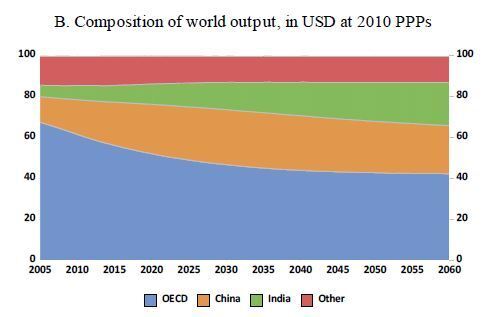
Based on deep structural reforms, the OECD's spectacular projections for India, taking up 20% of world output in 2060 from approx. 5% in 2020, should impact geopolitical calculations sooner rather than later
India's stock market seems to agree, with a total capitalization for primary company listings of $3.46 trillion after jumping 37% this year, within a whisker of overtaking the UK market $3.59 trillion - according to Bloomberg
But it will not be smooth sailing
India, with its wealth of talented leaders and global companies on Indian soil, has been mired in tradition for so long that its slow-moving economy seemed to be taken for granted
So many opportunities lost over decades, so many layers of administration secure in the way 'things are done', so many aborted reform promises buried in political backstabing were factually true
Looking ahead, digitalisation is a potent bridge exposing the economy to market forces
Farmers are incentivized to bring their produce to market on freely negotiated terms, and not at regulated prices
Small manufacturers are encouraged to broaden their trading area beyond the familiar precinct and attracting global clients
And even the small 'kirana' retail shops must be able to order their supplies of groceries and 'daily need' products directly over the Internet
It remains true that supply and demand, playing out in domestic and global environments, will require painful adjustments
Privileged - often politically connected - constituencies will be confronted with market reality (as well as its abuses and girations) as competition spreads across agriculture, manufacturing and retail
- governmental planning will have to allow for time to overcome popular apprehension, to boost adoption rates of digital processes, to facilitate onboarding of business initiatives in the new supply chains
- in rural communities, the path will not be smooth and the strong protests voiced for months will require deft handling in rolling out reforms over time , as we hope to discuss in a forthcoming note, Farmers on fire)
- systemic risks are rife because mature digital technologies, promoted by global firms with their own business priorities and their customized marketing tactics, are running ahead of the strategies laid-out for India
- the excesses of Amazon's aggressive strategies and worldly competitiveness are endangering the crediblity of the governemental agenda, although more diffuse retail sectors are less vocal in their plight than farmers...
True to form, India's reforms may run into the shifting sands of conservative social habit as so often in the past
However, the massive 'bottom-up' vote of digital data consumers, 443 million subcribers to Reliance's Jio phone data services alone as of July '21, underwrites the legitimacy of government digital policies
The call is out