

While criticism of governmental decisions, and their consequences, usually boils over in the political arena, the intuitive truth that statecraft is about managing probabilities with uncertain outcomes holds
What Henry Kissinger called 'the problem of conjecture' is about the limitations in the understanding of a cycle of events resulting from acting or - symmetrically - from not acting
The road not taken at the fork will remain in the dark
However, with the fair assumption of a rational decision process by all parties involved, one would hope for the best...
History abounds of miscalculations throwing spanners int the works of complex negotiations
Painstaking adjustments usually follow
But irrational postures, misunderstood and unpredictable, are rightly most feared in any geopolitical setting
And nothing is more irrational than obsessions, baring the cupboard of compromise and mutual understanding
As the war in Ukraine enters its ninth month, possible outcomes - and their probability - are more uncertain than ever
Obsession
Vertigo, a 1958 thriller by Alfred Hitchcock, is about obsession
Martin Scorsese described how the film is circling back to the same moment, again and again, observing how the musical score by Bernard Hermann is also built around spirals and circles, fulfilment and despair
French film director Eric Rohmer noted how the formal film technique - pure and rigorous - does not distract from ideas, which, at the core, Hitchcock’s films are about
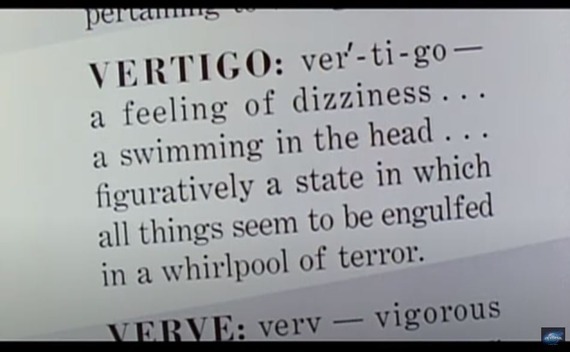
In many ways, the film's title - Vertigo - according to the Dictionary, figuratively a state in which all things seem to be engulfed in a whirlpool of terror – reads like a warning of how an obsessive idea turns into a vortex spewing uncontrolled turbulence
Conjecture
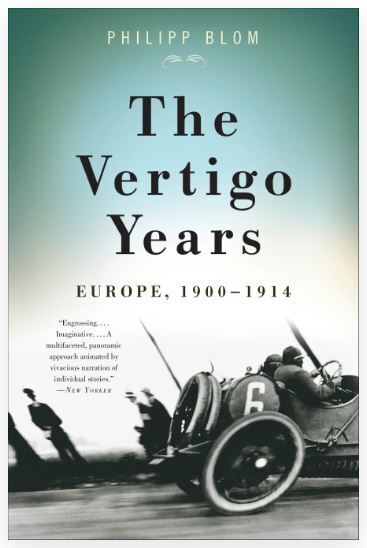
Author Philpp Blom, in his 2008 book of the same title, retraces the dark forebodings shared across Europe in the years 1900-1914
In lieu of a celebrated Belle Epoque, painting the pre-war period in graceful nostalgy, Blom documents unsparingly the forces at work in society, which were to shatter hope for international peace and social consensus
Tension building up from Moscow and St Petersburg to London by way of Paris could hardly be ignored
In France, the Dreyfus affair (1894-1906) split the country down the middle, in a deadly mix of antisemitism staked against the prestige of the French army (involved in a grossly doctored trial of Jewish captain Dreyfus)
In London, women’s rights came to the forefront with the more and more violent suffragettes, bringing 500 000 mostly women to the street in June 1908, the largest gathering ever seen in the capital
In Russia, the crumbling authority of a weak Tsar, Nicolas II, and chaotic attempts to ward off disaster fed into evermore violence
A war with Japan over Russian influence in the Far East (1904-1906), confidently expected to be won against a much smaller country, ended in defeat (and complete destruction of the Russian fleet)
Efforts to control the restless Russian society through ‘patriotic’ worker’s associations, tolerated by the police, gave voices to popular demand of a measure of representation in the autocratic regime, which had no intention to yield an inch.
On January 9, 1905 a peaceful manifestation was led by socially engaged Father Gapon to make the Tsar aware of workers’ suffering: the march ended in a massacre in front of the Winter Palace in St Petersburg
The tensions revealed by all these events – and many others – are, with the benefit of hindsight, brutal forerunners of the conflict which would shake the European continent’s deeply felt beliefs of cultural enlightenment and political legitimacy
Before World War I unleashed an unimaginable train of violence, rifts in social nets across Europe, deadening in Russia and no less acute in British or French democracies, were engulfing all beliefs confidently held in peace and prosperity, an unpredictable Continental showdown
The cracks were widening
But, waiting for clarity, crises were assumed to remain ‘manageable’ as they unfolded, on a national level
What Henry Kissinger called “the problem of conjecture”— the impossibility of having certainty about the consequences of either action or inaction—was insufficiently appreciated
Is there more certainty today….?
If anything, ‘the problem of conjecture’ seems to be compounded by ‘obsession’ guiding some of the players in the international arena
Uncertainties
The difficulty to solve the problem of conjecture in 1914 was already muddled by obsessions on all sides
The French were obsessed with the recovery of the 'lost provinces' of Alsace and Lorraine (following the defeat of 1871 at the hands of the Prussian army)
The German army was obsessed by the inevitability of a major Continental war, unleashing an arms race across Europe and justifying Germany's tactics of first strike (across neutral Belgium)
The British held faith in their Continental diplomacy resisting dominance of any Continental power, but their truest obsession was about the protection of the sea routes serving their vast colonial empire
The Russian Tsar betrayed his wariness of Germany's growing power early, in 1892, by allying with the French in terms to be reinforced for military readiness 20 years later (1911-1912)
The die was cast - conjectures overlapping obsessions with a sense of inevitability - leading ultimately to the collapse of Europe's preeminence in world affairs
It is not hard to bring history forward to 2022 - same obsessions, different actors and brinkmanship on every front
In the light of this continuity, it may be a mistake to ascribe obsessions to the sole preferences of a head of state, as the media have tended to do
If obsessions become guiding principles of government, as Russia's war in Ukraine demonstrates, it is on the strength of an intimate connection between the nation and its powerful president
Obsession, backed by national pride or convictions, is only so much more dangerous
To view counterparts in a distorted prism is hardly a good way to solve the problem of conjecture as emotions will be running high and unexpected consequences spool ever faster
In Europe’s Conundrum – a Puzzle in 3 Easy Pieces, the triangular interaction between Russia, China and the US was leaving Europe on the sidelines
Europe, however, is necessarily part of the solution as the conflict spreads misery on European soil, compelling every waring party to come to terms with its deepest obsessions
An analysis to be broached in "Germany, an anxious superpower"