

In a large conference room, facing a quite small posse of journalists for the presentation of the report "The future of European competitiveness", drafted at the invitation of the European Commission, and published early September, Mario Draghi could feel vindicated
Out of the public eye, with politicians focused on the 'here and now', Mr. Draghi could wander far and wide in Europe's "vale of tears", unencumbered and hard-charging

Popular acclaim in the spur of the moment may endure occasionally, but radical insights usually sink in over time, often over a long time, and this may be the Draghi report's serendipity
Leaving none of the very ponderous stones anchoring the European economy unturned, Mr. Draghi's report is a very understated geopolitical warning, resting on a powerfully detailed structural review challenging the European status quo
- Part A - A competitive strategy for Europe (pdf 69 pages)
- Part B - In-depth analysis and recommendations (pdf 328 pages)
Central to the dynamics of 'competitiveness', productivity growth is the driver of GDP differentials with the U.S. in Mr Draghi's telling
Quoting the report : "The EU-US gap in the level of GDP (gross domestic product) at 2015 prices has gradually widened from slightly more than 15% in 2002 to 30% in 2023, while on a purchasing power parity PPP basis a gap of 12% has emerged" - (PPP adjustment allows a comparison from the consumer perspective)
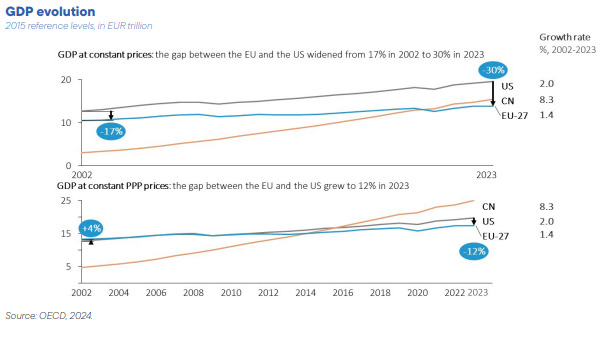
With adjustments for inflation and purchasing power, it is true that GDP comparisons remain approximations and 'per capita' calculations will be even more nuanced (reflecting US and China's more favorable demographics impacting their GDP growth positively)
However, facts are facts
The EU keeps losing ground year after year while the costs of ambitious social, environmental and security programs will balloon and the falling active population in Europe mirror unfavorable demographics
Something has to give and, as Mr. Draghi pointed out, either structural reform is addressed or it will be slow agony
This note is not intended to summarize a 400-page report - or even the 69-page 'competitive strategy' presented by Mr. Draghi
Our focus is more contained - there is no one-size-fits-all response to the challenge
- In complex adaptive systems, which surely defines the European economy, lagging productivity derives from a dynamic network of multiple interactions
- With flailing productivity, "something is rotten in the state of Denmark" and elsewhere in European governance...
- Structural highlights, in highly innovative technologies, point to the perennial weakness of European financial markets
In the Draghi report's telling, productivity is the starting point in drafting Europe's economic diagnosis
Slower productivity growth implies slower income growth and weaker domestic demand
Ergo ...by unlocking productivity, economic expansion follows and the costs of social, environmental and security policies will be assured
Painted with a broad brush, the argument is seductive and causality appears to be hard to dispute
However, suspicion lingers and many factors are in play across European economies
Productivity is a fickle measure of performance
The 'inputs' of total productivity are 'labor' - a hard to pin down unit because of wide educational ranges and age distributions - and 'capital'
Labor productivity is meaningless without reference to capital accumulation, since relatively less labor with more capital may turn out to be more 'productive' (or not...)
And, in the end, neither labor accumulation nor investment in capital relative to hours worked (capital deepening) suffice in defining total productivity (or MFP, multifactor productivity)
Ex-post productivity (monitored statistically afterwards) may try to link a trend to labor and capital inputs
Ex-ante productivity (targeted by forward-looking economic policies) may have an impact over the long term (by improving qualifications of the workforce, for instance) and will always be unevenly distributed (with focus of public and private capital allocations to privileged sectors)
Ex-ante, official productivity goals have always been long on hope...
For example, the UK economy has struggled since the Great Financial Crisis (GFC - 2018) with anemic productivity, never getting back on track from pre-GFC years and loosing ground against European partners ever since...
Reams of reports have been written on the subject (including on Pininvest in 2018) with tentative explanations...
It stands to reason that causality between GDP growth and factors of productivity is just as hard to establish for Europe as a whole
The conclusion that "around 70% of the gap in per capita GDP with US at PPP (purchasing power parity) is explained by lower productivity in the EU" may simply be a case of correlation, not causation
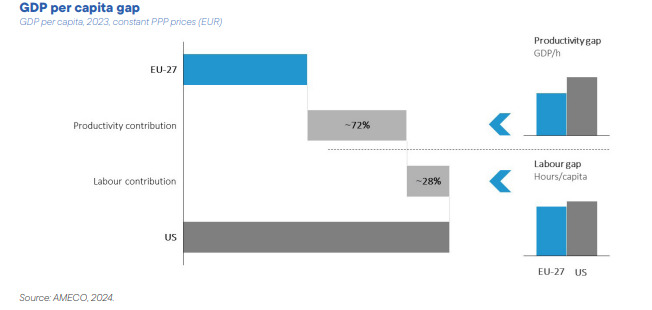
Assuming the ratio for 2023 holds over time, its explanatory power remains limited
- an average across very different national economies is hard to reconcile with structural differences by country
- productivity distribution by sector and by country will highlight further differentials, positive and negative, against US sector performance
However, in terms of international competition, productivity issues come to a head in the second chapter 'Closing the innovation gap' of the report
- labor productivity, by sector and across European countries, channels back to educational upgrades and targeted R&D
- capital deepening will impact total productivity positively by sector and by country
Taking stock of the alarming productivity lags, Mr. Draghi calls the European Commission - and the Member States - to action, under the premise that, however uncertain the impact of structural reform may be, doing nothing is unforgivable
The growth potential by sector highlights an array of explanatory factors holding back productivity, leading to riche, nuanced and differentiated, strategies reflecting national idiosyncrasies
Productivity challenges

Productivity is nothing less than a sledgehammer wielded expertly by Mr. Draghi and his expert team to pry open the national vaults of 'side-deals', dubious self-serving compromises and guilty arrangements across Europe
On the back of flailing European labor productivity, comparing EU to US average growth trends over 10 years (2009-2019), the report sets out a two-tiered radical agenda
- leveling the playing field with global competitors (as independent national champions rarely measure up)
- addressing the internal weaknesses of the EU (pressured by national interests)
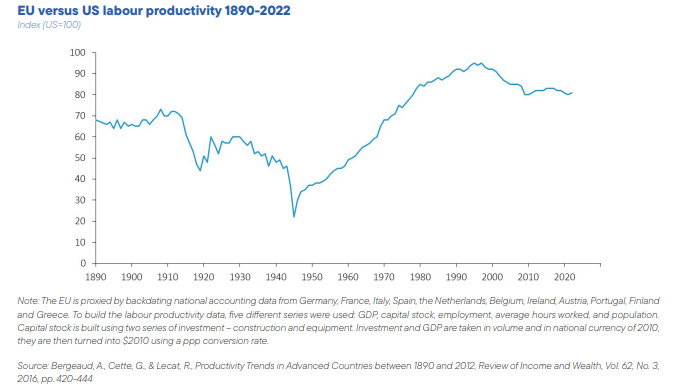
The fundamental critique lay out by the Draghi report is focused on the existential danger of inward-looking policies, singled out as key to sub-optimal performance since 1995
On the regulatory plane, the EU has been able for a long time to extend its reach globally by sheer economic- and demographic dominance, giving cover to policies devised for the European Single Market
However, national interests lead a spirited defense every step of the way, in budgetary allocation, in protection of domestic flag-bearing businesses (which are everywhere), in local regulations and, of course, in access to preferential finance
Caught up in a web of self-serving national interventions, the European Commission has gotten entangled in the complexities of necessary compromise between the interests of member states
Faced with the impossible task of setting a global agenda for economic growth, on behalf of tightfisted member states, suspicious of the smallest infringement on their sovereignty, Mr. Draghi and his team of experts took the high ground
Rather than define a framework for negotiations with the member states, conceivably with a calendar for the implementation of the more critical policies, Mr. Draghi set out his store of beneficial measures, sector by sector, simply pointing to their overall urgency
No doubt deliberate, the lack of prioritization in the name of a quest for "productivity", a goal as enviable as it is vague, presents the Member States - and the European Commission - with hard choices
- either do nothing
- or accept to reconsider some of the more egregious cases of national self-interest
- or implement to the full the recommendations for those economic sectors deemed of high priority and raising the least opposition at national level
None of the options mirrors the sense of urgency the report attempts to inject in the planning of the Commission to be installed in October 2024 - and probably the planning of the next Commission (from 2029...) as well
Restoration of European firms in the top ranks of global business is bound to be a 'work-in-progress' but not a piecemeal policy
The prize in competitive international markets may be within reach but nothing can be taken for granted
At first glance, the Draghi report has been branded as 'technocratic', given the breadth and detail of its economic coverage by sector
More relevant is the astute positioning of the recommendations, allowing the Commission a free hand while challenging the Member States to consider the consequences of their self-serving ways
This is how the economics of productivity come to be overshadowed by geopolitics and the loss of European credibility - to the predictable discomfort of every European government
ἀγωνιστής - a geopolitical tripwire
An agonist (ἀγωνιστής) advocates the political theory of agonism, which accepts a permanent place for conflict in the political sphere, but seeks to show how individuals might accept and channel this conflict positively (Wikipedia)
European Member States might be fired up by agonism, recognizing the inevitability of conflicts of interest but aiming to channel those conflicts positively, if the governments take up the gauntlet
Simply stated
"All Europe must reform to better compete with the US and China. That means developing advanced technologies, meeting ambitious climate targets, bolstering defense capabilities and securing critical raw materials, among other European Union measures"
Every one of these goals is commendable
Every goal defines Europe as a unique entity on the geopolitical chessboard
Will the Member States jump ? Will they channel conflicts of economic interest positively ? Will they compromise on self-serving national interests to enhance European standing ?
Mr. Draghi's review of key economic drivers across business sectors is a refresher of familiar tropes
Telecom, defense, pharmaceutical research, automotive industries, cloud services, artificial intelligence (AI) and quantum research all end up in 'Minor League', batting below their potential
- Telecom lacks concentration and investment capacity with 34 mobile network operators - the US has 3 and China 4 - total EU market capitalization is less than half the capitalization of US telecom operators
- European cloud operators have a token global presence, mostly in their national markets, with Orange in France and Deutsche Telekom in Germany - crushed by the American operators
- AI models are developed in the US by the technology giants dominating the 'hyper-datacenters' - Microsoft, Google and Amazon - and the European capital markets appear unable to support the investment needs of home-grown AI generative models (French Mistral, German Aleph Alpha)
- A similar weakness exposes the EU in quantum commercial developments - public investment has been large, R&D expertise strong and registration of international patents second only to the US - but...private investment remains constrained
And the list goes on with Pharmaceutical research - outpaced by the US (41%) - unless the EU share (19%) is added to the Swiss (14%) and the British (9%) R&D shares
The Member States have the faculty to break through the roadblocks: this is the unshakable certainty pervading the Draghi report
In the background, the momentum which just might drive European national 'champions' to collaborate and to partner in ambitious investment programs is powered by all-encompassing requirements of digitalization
'New tech' - of which AI is currently the very visible standard-bearer - is a tidal wave compelling every sector to up its game - and only by sharing the considerable investments of Information Technology will Europe's greatest companies remain global players...
This is true of the Telecom industry, Cloud or AI and Quantum commercial applications
It is perhaps more definitely still the case of some of Europe's vitally important industries - Automotive, Defense, Environmental Protection and Energy - to be discussed in a note coming soon
Protective of the interests of their national leading businesses, Member States are faced with a complex choice at the crossroad
Either play for time, with the current high level of European prosperity at stake
Or engage in an existential overhaul of the European markets
The democratic credentials of the European Union will be challenged because the choice will ultimately impact the life of every European