

A muddy mess...
Successive UK government have attempted to solve the structural problems ailing society
Promises were made
Fresh announcements ended up being quickly shoved aside by the next - even fresher - grand idea
And there is good reason why well-meaning plans rarely left the drawing board
Policies do not, and never will, gain traction when the most fundamental vulnerabilities of society are not addressed
The central issue, the stumbling block which has flummoxed analysts and politicians, is the UK's weak productivity
Since the Great Financial Crisis (2007), productivity is stuck in a rut
...leaving Great Britain behind, behind the US, behind Germany and behind France, cumulatively, and year after year
Looking back on 15 years (2007-2022)
Topping 1.6 £/ € in mid.2000, the British Pound fell off a cliff in October 2008 and after recovering by the end of 2015, went down with Brexit (2016) and stayed down
Wading through a morass of false dawns and political promises, Tory (conservative) governments in rapid succession must have been fully aware of key issues ailing British society
The poor performance of the Pound was mirroring economic, financial and social fractures
To follow through on the issues was another matter
Waving a magic wand has been tried and just will not do
“Get Brexit done” to unleash the UK’s economic potential worldwide, anyone?
Fight deep regional UK inequality, by ‘leveling up’ as promised by Prime Minister Johnson, what is up?
Growth for growth’s sake, announced by short-lived Prime Minister Truss, still on the look-out?
Repairing the ailing National Health Service (NHS) - everyone’s cheap promise, still waiting to be fulfilled?
Productivity, an unforgiving frailty
Whichever way productivity is computed, productivity drives the country’s growth rate, which determines the standard of living in the broadest sense
Without productivity, there is little hope for the competitive advantage promised by leaving the European Union
Without productivity growth, achieved across the country and across industries, there is no ‘leveling up’, and no chance to grow the economy or to upgrade the NHS
OECD data for G7 labor productivity, measured in GDP per hours worked, benchmarks the 6 members of the group against the Index UK = 100
From 2000 to 2007, the gap with the UK’s main competitors, France (109) and Germany (105) was manageable
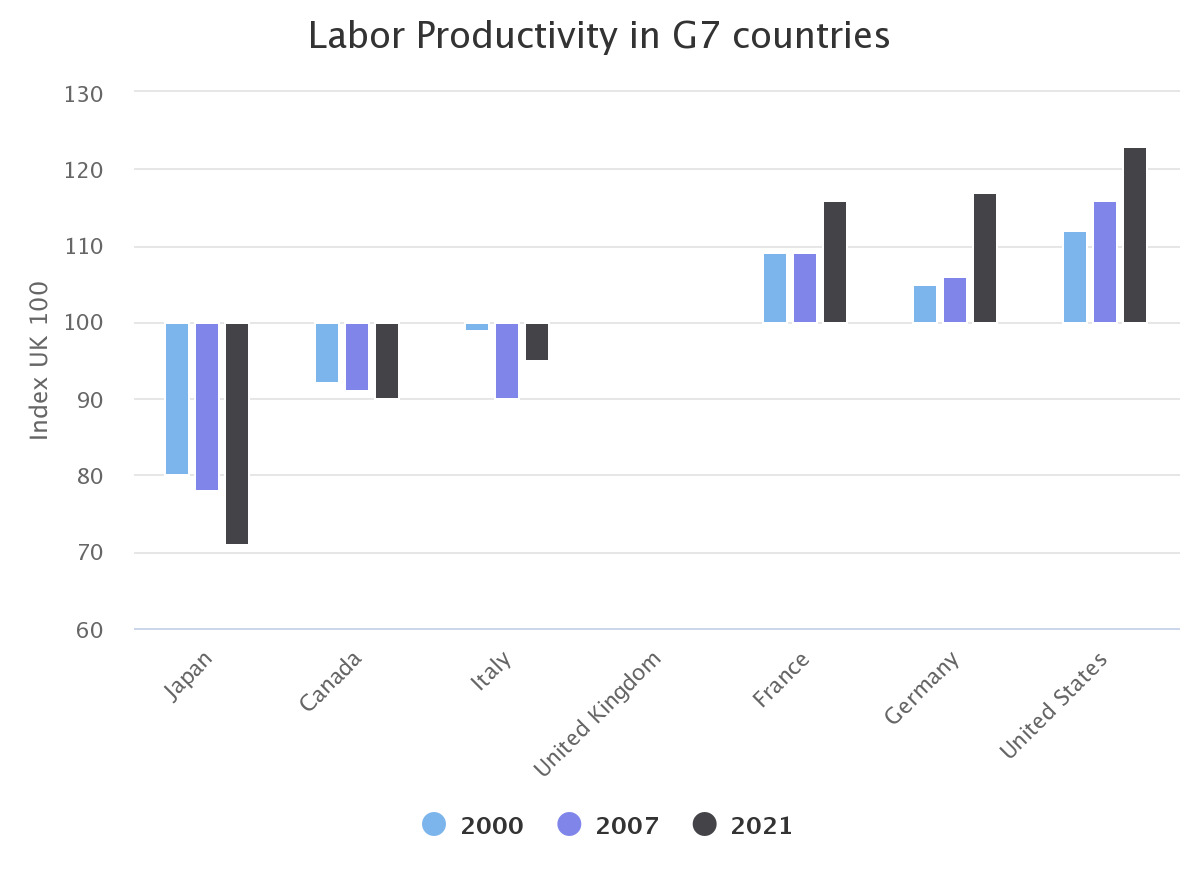
After the Great Financial Crisis hit home (2007-2008), these countries got back on track fairly quickly…
The UK did not and the spread with Germany’s productivity index, went from a decent 5% lag to a 17% abysmal challenge
There has been no end to the explanations of weak productivity since the Financial Crisis
Broadly stated, they highlight overlapping factors
- lack of investments by businesses, weak R&D, poor infrastructure and low levels of education (and of management expertise)
What national averages fail to catch are the vast difference between the top British enterprises, competing brilliantly in the American league, and the plodding legion of unproductive businesses
Stark regional economic inequalities speak volumes...
- Unquestionably, the issues have been recognized and policies implemented by successive governments
- However, structural policies are long-term strategies
- Focus on education, on regional infrastructure and on small-business access to credit is a quest promising little political pay-back
A wistful quest
Imbued by nostalgia about the UK's past greatness, British policy makers had to come to terms with the nitty-gritty of infrastructure, or of educational programs, for the benefit of less favored classes
The effort to reduce inequalities on these structural fronts may be a ‘work-in-progress’ but, on the face of actual productivity achievements, suspiciously half-hearted
Already ahead in 2000, productivity in France and in Germany got back on a growth path after 2007
French and German lower-tier companies contributed to a larger extent than in the UK, where the poorest performers even lost on productivity
It could be argued that
- the London-based financial service sector acted as a magnet for talent, finance and infrastructure support
- moving ahead at speed, the sector deepened the gap with slow-moving industries which lost ground and, possibly, steadfast support and interest from the British government
Banding together with London's world-beating financial service industries, the UK Government could hope to partake in success, a fail-safe option structural reforms were not about to deliver
Productivity disrupted
The resignation of Mrs. Truss has been commented with glee because her Premiership entered the book of records for being the shortest
True, the attempt of her government to shake the British economy out of its funk has been ill-advised but her downfall has been so brutal that neither competing Tory factions, nor the Labor opposition elaborate on a more convincing approach
There is none in sight
With every reason to avoid discussing structural reform, the UK government, whoever the standard bearer will be, seems prepared to live with low productivity for years to come
…burying any hope born of Brexit in the process
Productivity growth remains hard to explain in the best of circumstances, with somewhat circuitous computations assigning a productive impact to labor, to capital invested and, for lack of better explanation, to TFP, total productivity factor (a measure of the overall efficiency with which capital and workers are used)
But today, in the preliminary stages of a cyclical reversal, triggered by the pandemic, by a strong undercurrent of deglobailization, by the jolt of war on the European Continent, there is one foregone conclusion to be found
Productivity will be impacted in profound ways, in Europe under the yoke of the energy crisis, and probably globally
On the face of it, starting from a low base, Great Britain is not well prepared...