

"The Car Industry - a Tech Nexus", published last February 2022, laid out the challenges legacy manufacturers must prepare to confront
Electrical motorization and digitalization are overlapping and mutually reinforcing shockwaves, reverberating across the automotive industry
Under no illusion about the profound transformations, the global car makers recognized early on that the battle would be existential
- destructive of decades of investments in powertrains, manufacturing and assembly facilities - weakening the global firms and pushing tens of thousands of subcontractors over the brink
- leveling the playing field for a invasion of newish car firms (mostly Chinese)
- pointing global technology firms (mostly American) to new value-adding riches - the data their software will collect on cars and drivers...
- fragmenting the supply chains of tier-one contractors, an essential component of the European car industry
Admittedly, digitalization may require more flexibility than usually displayed by legacy carmakers in finding common ground with the American technology firms
The main stumbling block for carmakers, and the trump card held by the tech firms, is hard to ignore
One word - 'software' - covers two entirely different concepts in almost frontal opposition
- software included in car manufacturing addresses a bevy of regulations and a variety of security concerns - a complex network of engineering requirements
- software "as a service" in the novel 'digital' car mirrors consumer expectations (or presumed expectations) with little connection (if any) to traditional motorization
For lack of better options, the car industry is prepared to address the challenge of electrification with its tier-one powertrain suppliers, writing down investments made over decades to improve internal combustion engines (ICE) and managing massive losses in job opportunities, spread over as many years as feasible
As for digital applications, an uneasy peace will be sought with software giants in data revenue sharing, essential to turn a profit on low-to-mid range car sales
One challenge goes to the heart of electrification, to reach the point where a fresh line-up of electrical vehicles (EVs) might breathe new life in the car industry, : the production of batteries
The issue has apparently been blissfully ignored by politicians only too happy to gain 'green' brownie points by standing up to the proponents of traditional (albeit vastly improved) ICE motorization
However, rapid spread of EV availability - and mandated exclusion of ICE sales from European markets by 2035 - is hitting a wall
Production of batteries in Europe or in the US, promised with great fanfare, is a complex technical problem but not a critical issue by itself
What politicians seem to have discounted is (un)availability of the building blocks, the basic metals and the refinery capacity
With the Chinese EV market outstripping the entire non-Chinese global demand three-to-one - 1.5 million EVs (July - September 2022) out of total global EV sales of 2 million over the same quarter - battery availability will be the ultimate existential issue for legacy car manufacturers for the coming years
Green politicians are meeting grubby reality
Supply-demand imbalance will be hard to contain
The market for lithium has enough moving parts, on the supply and on the demand side for general confusion
Price of lithium carbonate signals the unfolding mess of good intentions
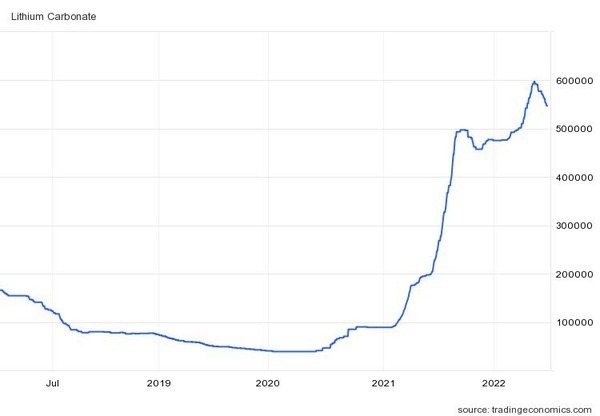
In fact, the chart tells all that needs to be known ... but none of the answers to get out a morass of projections
- lithium miners, operating on a 3-to-5 years' time frame to enter production, launched new projects early on, in the 2010's
- hiking lithium production in anticipation of rapid EV sales growth in the short term, miners flooded the market with supply between 2015 and 2018
- banking prematurely on EV demand which the carmakers were not ready to honor and the consumers were not prepared to support, prices collapsed through mid-2020
By the mid-2020, prices bounced back and supply has failed to catch up ever since with fast-gaining acceptance of EVs across the world
The 500% increase in two years, since January 2021, creates new uncertainty
Demand of the metal has been to a degree driven by automakers building up security stock
The high price - estimated to add 1 000 US dollars to the cost of an EV - could very well downsize consumer interest
China remains the premier market of EVs, with uncertainty in arbitraging priorities
- Domestic policies, from alleviation of Covid regulations (and resulting spread of the pandemic) to possible discontinuation of China’s electric vehicle subsidies on 1 January 2023, translate directly in global prices of the metal
A stranglehold on lithium refining capacity
The imbalance between volume production of lithium and anticipated demand puts China front and center
According to Bloomberg's 2020 New Energy Finance (BNEF) report, China’s large domestic battery demand, 72 gigawatt-hours (GWh), is supported by control over 80% of the world’s raw material refining, 77% of the world’s battery cell capacity and 60% of the world’s component manufacturing
China's share in the extraction of lithium is in fact modest (13%) according to IEA 2019 estimates - Australia dominates lithium mining (52%)
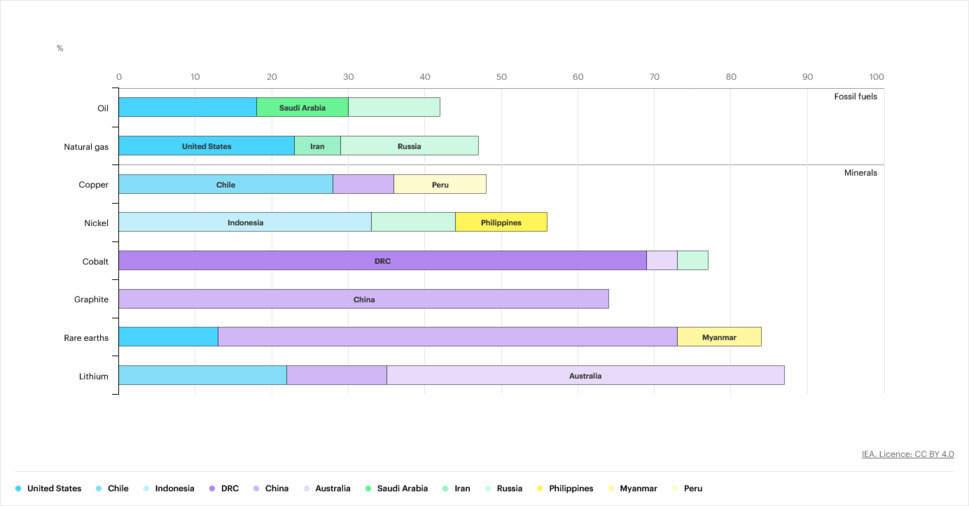
It is dominance in refining capacity, not extraction of the minerals, which puts China at a clear advantage in the manufacturing of Li-ion batteries
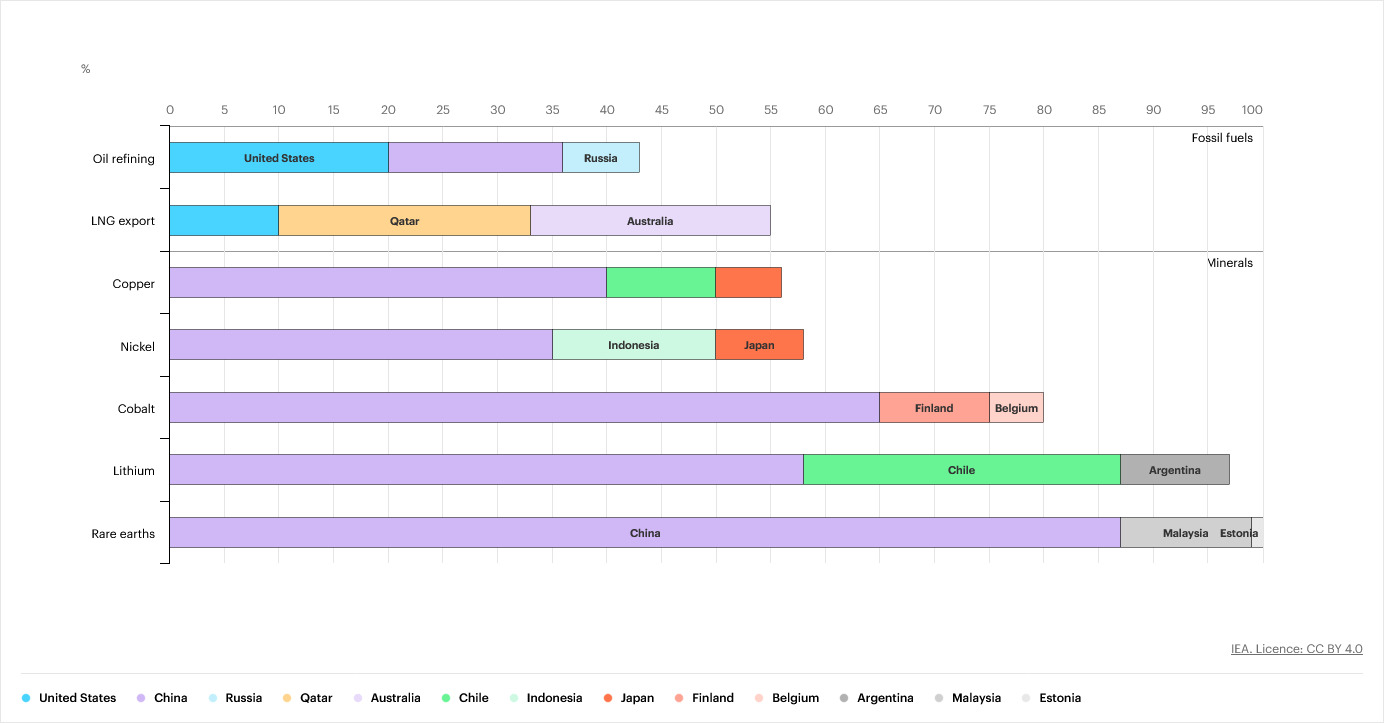
Estimates vary by data source but China's controlling stake in refining is undisputed - from 58% (IEA 2019 estimate) to 60% (BP’s recent Statistical Review of World Energy 2021)
Probably seen as less critical because of abundance of the basic metal resource, China's interests in extraction have been dropping from 13% (2019 estimate to 7.9% according to BP review), as miners, supported by the car industry, have started to expand
Minding the gap
New model registrations for electrical vehicles reflect ambitious green regulatory policies in Europe for 2035 and more conservative targets in China and in the US
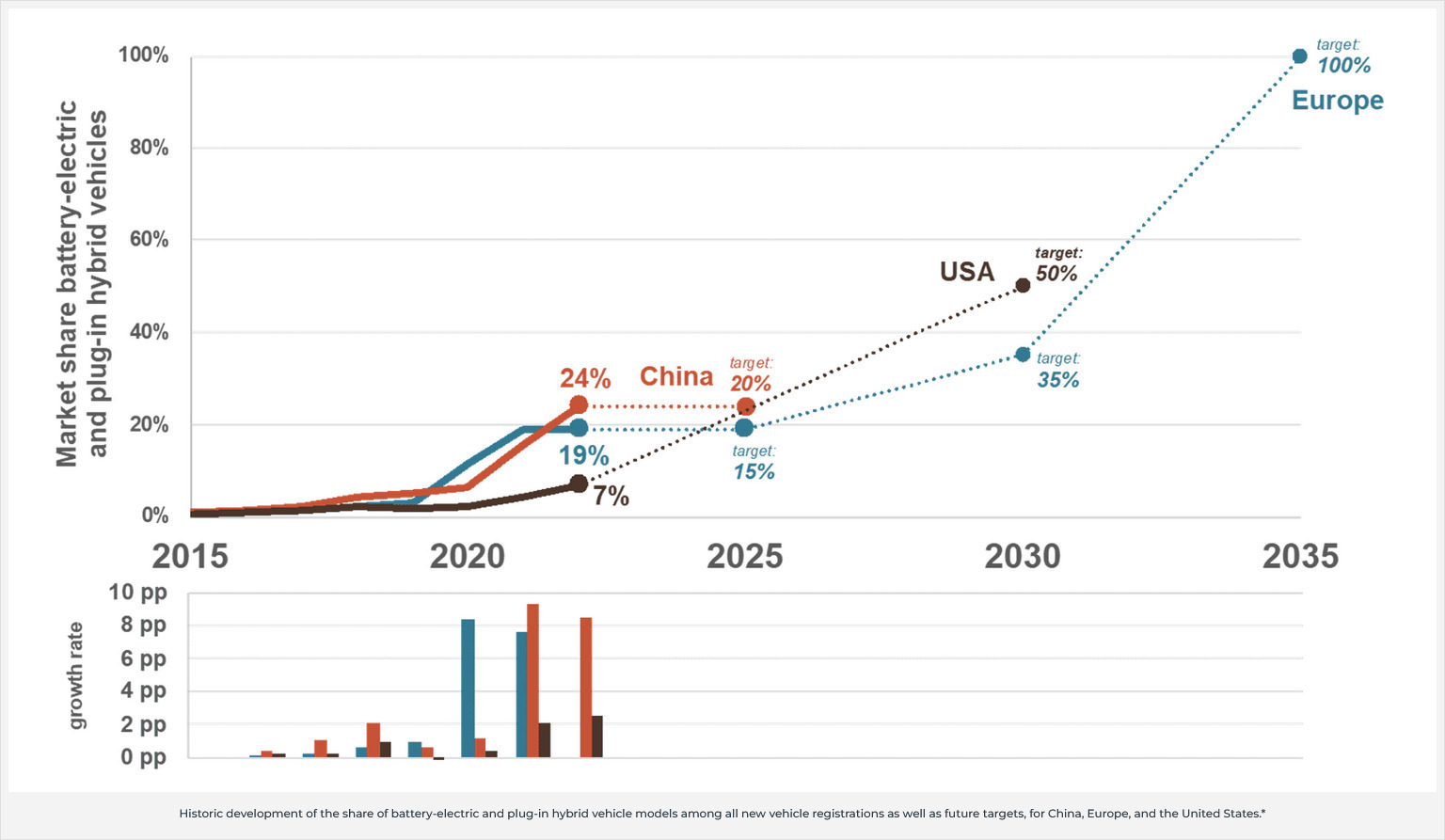
Lacking intermediate targets over the decade 2025-2035, regulations may effectively signal uncertainty about consumer uptake and cost curve of EV production
- in China, the new energy vehicle (NEV) mandate requires manufacturers to produce NEVs to meet credit requirements and allows them to use extra NEV credits to comply with their corporate average fuel consumption requirements but the roll-back of tax incentives announced for January 2023 may - or may not ? - be pushed to a later date
- similarly, in Europe, CO2 standards for new cars, which set an average target of 95 grams per kilometer (g/km) for 2020/21, compelled car manufacturers to sell a relatively large amount of EVs into the market to balance emissions of their fleets. As the main car makers achieved the emission goal by 2021, there has been less urgency to grow EV sales across the region - another case of 'wait-and-see' ?
Caution by legacy European and American carmakers highlights an array of unknowns
- gaining expertise and speed in developing domestic EV manufacturing
- access to reliable battery deliveries - at guaranteed and stable prices, critical to the cost of electrical vehicles
- fickle consumer interest if EVs remain stuck in higher price brackets
Rather than a gap, assumed to be bridged within a few years by an industry proud of its long industrial tradition, the EV market turns into a cliffhanger for the legacy carmakers
Representing 7% of European GDP, the industry contributes 10% of manufacturing jobs and 2.5 million direct jobs in 2020, according to EU automotive sector data collected by ACEA
- close to 900 00 jobs in Germany
- 220 000 jobs each in France and in Poland
- around 170 000 jobs in the Czech Republic and in Romania
- and more in Italy, Spain and Central Europe...
But tomorrow ?
A clouded future for European industry
It would be hard to criticize EU green policies, well received by the general public, if the costs - and the uncertainties - had been spelled out as well
In the end, cost targets - aligning the price of EVs on familiar ICE costs - may turn out to be properly modelled...or not
However, much has been overlooked in an industry which has always been a geopolitical stake in every manufacturing country involved, likely to turn red-hot as strategic choices need to be made
- control over the availability of the materials for battery manufacturing
- location of European manufacturing hubs, in the context of mergers of smaller car manufacturers, unable to front the costs of EV (and battery) line-ups
All the while, rapid growth in China's huge market has cemented China’s battery-driven EV standing on the global stage
According to an October 2022 PWC study, 1.5 million battery-driven EV were sold in China during the third quarter of 2022 alone - a 94% increase over Q3-2021 and 73% of worldwide EV sales (rising from 53% in 2021)
Pressed for time, and their warnings overridden by political priorities, the European carmakers have been seeking for short-term answers of their own
- protecting their market stakes in China by going all in with EV line-ups produced locally
- seeking to secure access to battery production by sharing procurement with Chinese carmakers
- relying on their Chinese EV hubs for export to Europe
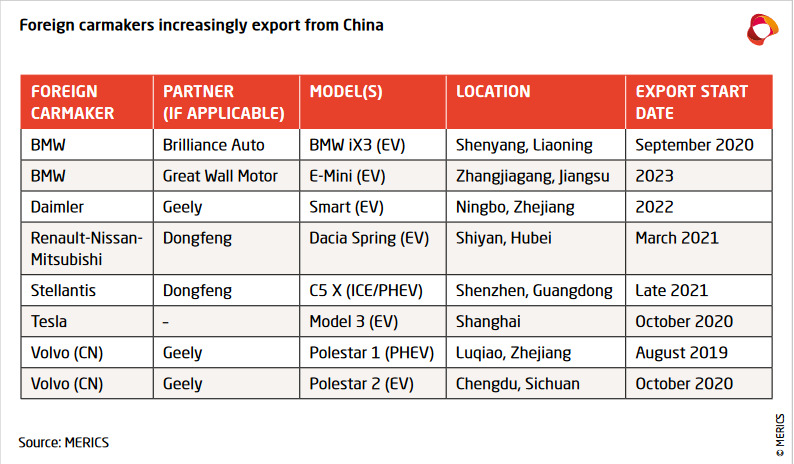
Smart Automobile, a joint venture between Germany’s Mercedes-Benz and China’s biggest private carmaker Zhejiang Geely Holding Group, targeting Europe as well as South-East Asia (Malaysia and Thailand), is another example of the sharp turn taken by legacy carmakers
Aligned with China's global interest in EV exports, a new industry segment to conquer, legacy carmakers will be seeking to ensure stable battery supply through the partnerships
This inquiry focused on greatly unbalanced supply of the key metals required for battery production
Lithium may be an extreme case but not an outlier as cobalt, nickel, copper and graphite are equally dependent on Chinese industrial capacity
However, the assumption that the disruption of automotive supply chains would somehow resolve itself proves to be flawed
Over time - the coming 10 to 15 years - it is true that new supply chains may be structured
But, as we hope to discuss shortly, the transitory period should be of major concern because the carmakers are confronted with a competitive EV challenge already, and certainly in 2023
China's car imports are coming to Europe