

The story of China's emergence as most powerful global economy, second only to the U.S., in the space of a single generation has inspired awe as well as incomprehension
By any measure, China's economic performance, raising hundreds of millions of people out of poverty, earned admiration and, for many, unshakable belief in the country's destiny in world dominance
However, mutually reenforcing trends – economic growth head-lining inevitability of the geopolitical giant’s leadership – were yesterday’s consensus
Staggering debt, the high price paid to support relentless growth, has come into stark focus
Taking hold shortly after the COVID lockdown ended, the slowdown, from the aggressive growth Western commentators had learned to expect, has entered the mainstream only recently
With a focus on 'one-off' factors, such as supply chain disruptions linked to COVID or real estate troubles expected to be addressed in short order, trend correction and reversal to 'normal' growth patterns were supposed to follow the time-tested blueprint
Such anticipations are falling short
Two overlapping causes of slowdown may actually signal a generational shift, tilting China towards greater economic balance and more social fairness
- the dynamics of a supply chain -driven growth strategy are running out of runway
- deep and growing inequality in income distribution must be confronted head on
China's ambitions on the global stage will surely not be stymied and the social-economic challenges of the country's governance might actually sharpen its edge
Going forward, we argue that progress will be measured in terms of social control and stability
Growth, for growth's sake, not so much...
Insiders
In China, from a political, social and economic perspective, success or failure reflects on Chinese society as system, not on any actor operating by free will
Key entities, such as banks, local governments or giant private enterprises, adopted modern principles of organization, and in many cases enriched themselves in capitalistic terms, creating an impression of common purpose with Western business interests
The assumption went only so far and reflected poorly on cultural and political understanding of China as a system, wholesome, self-assured and ...inward-looking
All actors operating inside the Chinese system of government are responsible to the authorities, and their success is measured in terms of contributions which may, or may not, be market-oriented
Ultimately, the Chinese Communist Party (CCP), as embodiment of central authority, will set - and adapt - the goals perceived as beneficial to the country
China's systematic perspective is 'top-down' and the rationale of the Party is to protect and to enhance the system ...
...or, as many will argue in the West, to protect and to enhance the grip of the CCP
Either way, social control and stability are the defining features of the system, of any system in fact aiming to convey trust and reliability
It is surely improbable to assume that the concept of "system insiders" has been envisioned, and carefully laid-out, from the start
The history of reform efforts within the CCP certainly proves the opposite
Going back to the 'second coming' (in 1978) of Deng Xiaoping, reform was tentative and subject of hard fights within the Party over the decades, left partially unresolved even today
It should be no surprise that reform, in a system focused on stability and control, needed all of Deng's support to get off the ground in the first place
Vested interests are the natural partners in any system aiming for stability and not fot disruption, and only mortal risk can mollify self-serving resistance, at least for a time...
Bombard the Headquarters
"Bombard the headquarters—my big-character poster", written by Mao Zedong on August 5, 1966, never was actually mounted on a wall...
However, targeting 'some leading comrades' directly and aimed at President Liu Shaoqi and senior leader Deng Xiaoping, Mao launched a movement which turned out to be impossible to control
Mao, whose erratic policy failures caused millions of deaths by famine in the country, with the forced industrialization of the "Great Leap Forward" (1958-1962), had raised deep questions within the Party
Aiming to reestablish his personal authority at a time of great peril to himself with a 'Cultural Revolution' against the Party leadership, Mao was protecting vested interests, his vested interests, which over 10 years (1966-1976) would cause millions more deaths and deep economic troubles
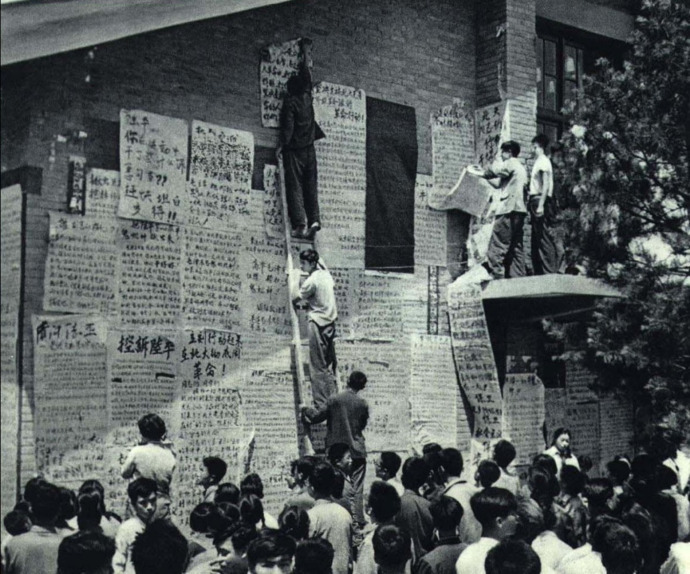
The internal conflict unleashed one faction against another in a never-ending cycle of abject abuse and violence, only to be subdued following Mao's death (1976) by engaging the military People's Liberation Army (PLA)
Following Deng Xiaoping's lead in reforming and opening of China, after 1978 and again in the 1990's, the country's transformation has been a patchwork of audacity and caution, of political interference and of free enterprise
President Xi and Party cadres of his generation, intimately and personally cognizant of the tragedies, have sought to balance the vested interests of China's insiders with a degree of flexibility allowing outsiders to flourish in private enterprise
From our Western perspective, this balancing act has brought riches to entire new classes of vested interests, rooting for more of the same, and to a middle class riding the country's economic growth
Today, the follow-up act, again in Western thinking, is preordained - to address the structural imbalance of the economy, between household consumption (way too low) and investment (way too high and probably unproductive)
Self-serving - and most probably simplistic - these expectations have been falling flat
In China, vested interests are the constituents defining the system of governance ... independent private actors (either rewarded by the market or constrained by diktat) are not
Policy choices are expected to focus on stability and control, closely aligned with vested interests...at least until now
Risk in all Shapes and Sizes
China's successful growth over a generation (since the 1990's) is conducive to lazy thinking and complacency
Only clear perception of risk, endangering social stability in China, will move the needle ...
Great inequality, of which the size and average income of the rural population is just an approximation, has been often mentioned by President Xi, making the priority the single most important driver of policy for years to come
Involving more than 450 million people (a third of China's population), lacking social protection for the elder, bypassing the educational needs of the young, with average yearly income ($2 500) down to one tenth of favored city dwellers ($25 000), policies will need to be all encompassing
The immensity of the enterprise might imply that China will turn inward, not push for global or even regional dominance - as we hope to discuss shortly
Bank debt is the other risk factor, likely to become more immediately dangerous for social stability
Vested interests, especially local governments by way of their finance vehicles (LGFVs) and State-Owned Enterprises (SOEs), were first in line to benefit from indirect project financing (via banks), overshadowing direct financing on capital markets (more limited in China)
And, as it stands, bank exposure is not necessarily well understood because of debt finance's proven reliability as engine of growth
Going back to the late 1970's, when China started rebuilding its economy, the banking system hardly existed at all - except of PBOC (the People's Bank of China), a department of the Ministry of Finance with a staff of ...80
From this slim base, 'finance' understood as simple financing windows, at the whim of local Party officials, led to a giant lending spray over a decade by 20 institutions and hundreds of trusts, securities companies and pawn shops
Cycling through an era of credit abundance, with ups and downs, the vested interests found support and opportunity at every turn
All through the 1980's, ensuing inflation (and corruption) raged, attempts at administrative controls led to runs on local bank branches, and with general unrest came the crackdown of 1989-1990 - only for the financial system to run out of control again with the unwitting consequences of Deng's 'Reform and Open Door' policies from 1992
Chaotic credit only came under serious control after the Asian Financial Crisis (1998) under the impulse of Premier Zhu Rongji with the restructuring of the Big 4 State Banks, essentially bankrupt at the time
Following recapitalization, aimed at reaching an 8% bank capital adequacy rate, the transfer between 2000 and 2003 of the equivalent of $400 billion of Non Performing 'bad' Loans - NPLs - (25% of China 2003 GDP) to 'bad banks' is indicative of the loan 'exuberance' of the 1980's and early 1990's
The monumental clean-up opened the way for listings - in 2005 and 2006 - of 3 of the major banks on the stock markets of Shenzhen and Hong Kong, raising in all $44.4 billion and topping the Fortune 500 list by 2008 (the Agricultural Bank of China -ABC - was to come later, in 2010)
Going round and round on a slippery slope
Another unbridled round of bank loans was unleashed by the 2007-2008 Financial Crisis, amidst well-founded concerns of collapsing exports
This debt free-for-all benefited (again) mostly the local governments (and their LGFVs), and was predictably followed by another round of fresh capital to be raised from 2010, targeting $42.1 billion (on top of ABC's IPO of $29 billion) - summed at $71.1 billion (11.5% of 2010 GDP)
The caution of China's leadership in approaching the economic weakness in 2023-2024 signals a newly found awareness of the frailty of the country's financial system
By refusing to go down the road well-trodden since the late 1970's and again in 2007-2008, President Xi seems to opt for financial consolidation
As reluctant heir of a dubious financial construct, President Xi will be confronting the vested interests who thrived on loans for three decades, while aiming at social stability
A tall order we expect to discuss shortly...
- What about the disappearing act of the bad bank loans
- Will the major banks be able to facilitate a shift from their traditional lending practices benefiting the large state enterprises to the consumer market
- How quickly, if at all, can such a finance 'revolution' take place, and at what cost...
Source - Financial information about China's banking system from the 1970's to 2010 was sourced from "Red Capitalism' by Carl E. Walter and Fraser J.T. Howe - published in 2011