

China debt has been the main focus of our on-going conversation about the country’s economic model
- China Debt - Now you see me, now you don't
- Previous notes highlighted the China 'growth model' - 'When the music stops' - 'Debts coming due' - 'Rearranging the deck chairs'
Discussed extensively in these notes, the imbalance of the Chinese economy is structural
- At 43%, the investment component of China's GDP is well above the OECD average of 24%
- Domestic consumption is exceptionally low at 39% of GDP, even though, in absolute numbers, Chinese consumption had been robust, albeit slowing, growing by 8% annually on average between 1996 and 2022
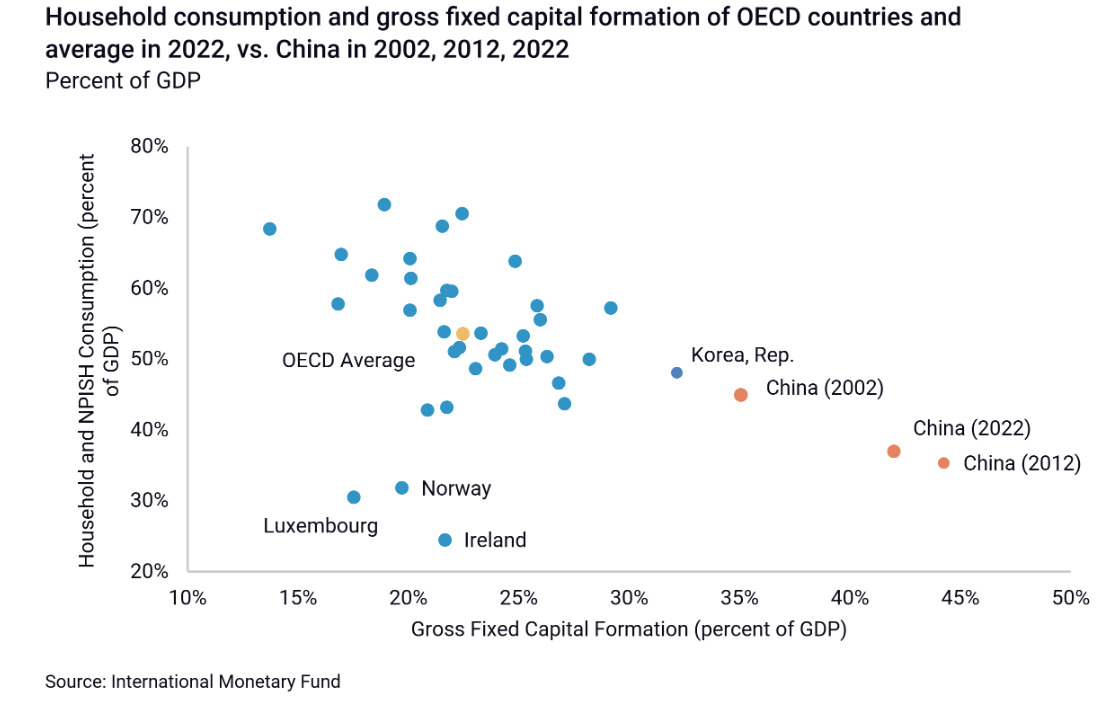
These features have backed the Chinese economy in a corner
- Chinese consumers have on average been doing great over the past decades but … just not great enough and their share of GDP is falling because GDP growth has been outpacing slowing consumption growth (on a 3-4% yearly trend over the next five to ten years, aggravated by current collapse in consumer confidence)
- Investment has remained the great and lonely engine powering the Chinese economy … as long as it lasted and profitable opportunities were up for the picking…which is not so true anymore
In a global perspective, the implications are dire
Logan Wright, head of China research at Rhodium Group, a U.S. research firm, observed that China accounts for just 13% of the world’s consumption but 28% of its investment
Investment on such a scale only makes sense if China takes market share away from other countries, rendering their own manufacturing investment unviable
Political backlash around the world has been building, bringing China to the negotiation table as fragmentation becomes the fallback option of global trade
Given time, the Chinese economy will undoubtedly rebalance, redirecting investments to new growth opportunities and favoring domestic consumption
Structural reform however has to contend with political and financial realities…which will require time, maybe a very long time, like a decade or two…
Local Governments, indispensable and unsufferable
On the institutional plane, the local government officials have over the past two, or even three decades, focused their efforts, and their careers, on capital formation (infrastructure, real estate developments and subsidies to enterprise) in their respective regions
Given discretion to encourage local initiative in funding projects for priority sectors, the governments relied on regional banks, linked to the large State banks, for loans to off-balance -sheet entities - the Local Government Finance Vehicles (LGFVs)
Lacking sufficiently broad local tax bases, debt, not organic growth, has financed capital formation year after year and at every level in intricate multi-levelled networks, with local budgets at the tip of an iceberg of those off-balance sheet liabilities linked to local banks and a multitude of investment trusts, making it hard to evaluate actual exposure and magnitude of non-recoverable loans …
According to an investigation by The Wall Street Journal, in July 2024, the total amount of off-the-book debts held by local governments across China now stands at between $7 trillion and $11 trillion, with as much as $800 billion at risk of default
- The spread of this estimate is by itself indicative of the magnitude of the exposure of the financial system - and of downright ignorance of actual default risks
- Because local governments are engaged in most infrastructure investments, with decades-long pay-out periods, intermediation (adjusting loan repayments to investment duration) must (and will) fall back on the Chinese financial system
- Actual true risk of default is consequently a matter of timing ... and appreciation
With nominal GDP of $17.76 trillion, off-the-book debts of local government are equivalent to 62% of GDP (2023)
A September 2023 Reuters report confirms the intractability of this debt load which, because of the illiquidity of the assets (such as land, projects under construction, fixed infrastructure assets) cannot be sold profitably, if at all, to contain debt
Corporate sector (ir)rationality
Industry partakes the debt overhang with local government, while households have been paying down their mortgages in the bane of falling real estate prices
Exuberant investment in officially sanctioned sector priorities has driven corporate debt forward, aligning the loan portfolio with approx. 100% of GDP ever since 2008, keeping pace with GDP growth from $4.6 trillion in 2008 to $18 trillion in 2023
Wild overinvestment by hundreds of firms has created a supply glut in sectors supporting green technologies (such as lithium mining or photovoltaic panels) or electrical vehicles manufacturing, leading to severe price wars, export dumping and inevitable bankruptcies
While the impact on loan portfolios remains hard to evaluate, losses suffered by the banking system should be material
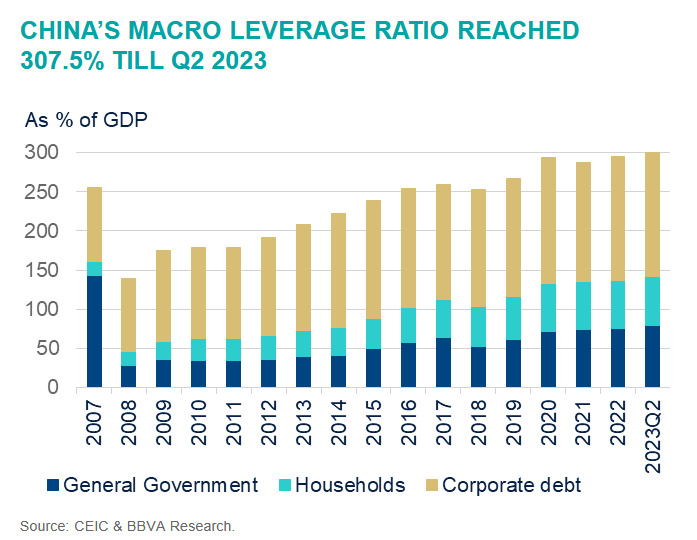
The Chinese financial sector - postponing a reckoning ?
To make China’s economy grow since the financial crisis in 2008, the Chinese banking system expanded six times, adding $45 trillion in assets in fifteen years, which represents close to half the global GDP of 2023 (which is approx. $100 trillion)
Bank assets in % of GDP grew from around 180 % to close to double at 330%
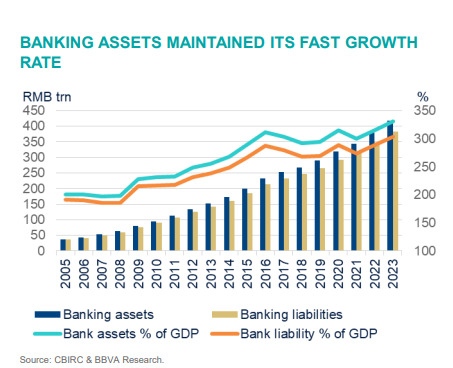
These astounding numbers can be compared to GDP which, from $4.6 trillion in 2008 grew to $18 trillion in 2023
GDP growth has not been encouraging, falling from 9.7% in 2008 to 5% in 2023, according to official data (actual growth rate has probably been as low as 3.5%, accounting for deflationary trends)
In a race to deliver growth by way of investment, underwritten by the bank loans, return in GDP terms has failed to deliver, falling off a cliff in 2020 without regaining its footing since
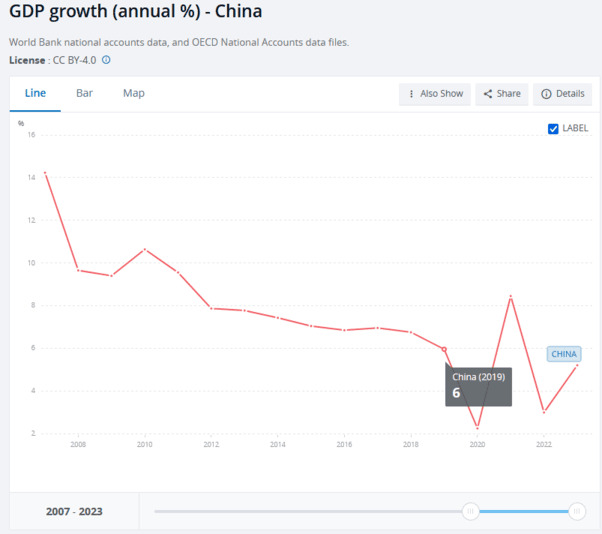
Looking back, all the way to the early 1990’s and the ‘opening’ of China to international markets, the stages of credit-driven expansion, debt crisis, inflationary bouts and financial restructuring have been a familiar modus operandi, debt vanishing ultimately in the far recesses of collective memory
This financial reality has been little commented because the economic growth pattern remained the focus of Western business and the ways in which trend correction was achieved mattered very little, given the always obscure decision processes of the Chinese State
Mostly hidden from public sight, the turf battles between the Chinese Central Bank and the Ministry of Finance, between the radical proponents of open markets and the conservative wing bent on control by State and Party, created a baroque structure
Usually ending somewhere on the middle ground, these conflicts somehow always tried to maintain the glow of international credibility while never compromising the ultimate control of the Communist Party
However, what structurally cannot be ignored has been the overriding mandate pervading Chinese finance, which has been to provide credit at any cost, especially during periods of economic weakness, as occurred repeatedly, in the late 1970’s, again in the early 1990’s and during the great financial crisis of 2008
Issued by a bank system relying directly (in the case of the State Banks) or implicitly (in the case of local government investment vehicles) on the guarantee of the Chinese State, debt reached unsustainable levels time and again
The refusal to underwrite loans unconditionally, on - and off-the-books, send shockwaves across the financial system, an unanticipated but very real policy reversal experienced by some regional banks and trust funds, while the bankruptcies of the major real estate contractors (Evergrande and Country Garden) is upending corporate industries
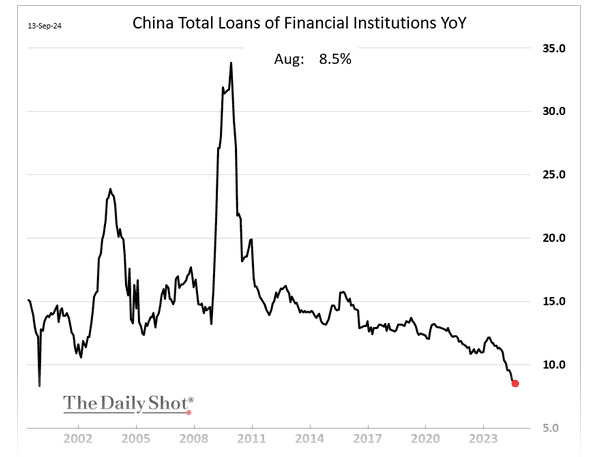
Collapse of the loan book of financial institutions since 2017 trumpets a new reality, many, many lightyears from the massive credit push of 2009-2010
What to do ?
All the options available to the government are fraught with major uncertainty
- New waves of credit to support capital formation have been engineered before … and targeted support to new projects, while desirable, is surely a poor substitute of past exuberance
- An aggressive monetary policy – printing money to vacate debt – guarantees massive inflation, given the magnitude of the liabilities, and potential social trouble
- A recession, over a long period of time, to restore the fundamentals of the economy is by any measure the opposite of the contract between the Chinese Communist Party and the Chinese people and, while an obvious necessity to cool the excesses of the financial system, probably inconceivable
Because the Chinese authorities in charge of this ‘command’ economy are anything if not rational, the outcome one could envision today, in late 2024, might be a mix of familiar recipes and new experiments
- Redirecting local investment on a limited base and in favor of new market opportunities (both domestic and export-based), putting an end to local (often self-serving) capital formation and tightening central control – all of which is already happening and will gain speed with ‘green’ investments, electrical vehicles, semiconductors aimed at domestic and Asian markets
- Easing monetary policy – recently announced as limited and progressive initiatives - maybe controlled but will be inflationary – bringing down the Yuan Renminbi from 7.2 to the US dollar to 8.5 within a year (down to 10 to the dollar over time?)
- National recession may not be an option but controlled local economic ‘roll-backs’ will not come as a surprise
China will muddle through as the magnitude of bad debt comes to light, at 40% of GDP as acknowledged by some observers, or closer to 60% (more than $10 trillion) – an insurmountable burden - as suggested by others ...
Either way, neither Chinese consumers nor Yuan-savers or owners of Chinese real estate will escape unscathed
And China's fragile social net will be fraying...again
- WSJ - Dec. 16, 2024 - China Races to Squelch Unrest as Signs of Economic Malaise Spread
- Reuters - Dec. 16, 2024 - China's Xi calls on party to 'turn knife inward' to end corruption