

Chinese population in 2020, estimated at 1.4 billion is equivalent to 18.5% of the total world population
By size alone, healthcare in China presents a unique set of challenges with a focus on non-communicable diseases (NCDs), such as cancer, diabetes, cardiovascular and chronic respiratory diseases
China accounted for 24% of newly diagnosed cancer cases, 30% of cancer-related deaths worldwide in 2020 and 25% of world’s diabetes patients
The spread of chronic diseases is correlated with changing life styles, a consequence of breakneck urbanization and with the shock of out-of-balance demographics, reverberating through the decades, both past (2010-2020) and future (2020-2030)
Accounting for 80% of China’s 10.3 million annual deaths, the diseases will become a growing burden on the population and cause severe economic loss
Prevention (providing better information to address personal ignorance or neglect), fundamental research in medecine and overhaul of medical infrastructure and logisitics are the facets of a revolution which China will be leading by necessity
A 2012 World Bank report - Toward a Healthy and Harmonious Life in China: Stemming the Rising Tide of Non-Communicable Diseases – paints tough challenges
NCDs are a set of chronic diseases, including cardiovascular disease, cancers, chronic respiratory diseases, and diabetes, characterized by a long latency period, prolonged clinical course and debilitating manifestations
The increase in the number of people with at least one non-communicable disease was projected as explosive over the two decades from 2010
- myocardial infractions were expected to double by 2020 and almost triple by 2030
- lung cancer was projected up 350% (2020) and 600% (2030)
- diabetes mellitus was assumed to go up 50% (2020) and on track to increase 80% by 2030
Updated statistics in 2021 may adjust these dark estimates, but the trend is rooted in structural and social factors, which is not a comfort
Demography paints a sobering reality – and worsening pressures on Chinese healthcare between 2020 and 2030 – reflected by the rapid aging of the population – as shown on the graph published in the World Bank report (page 6)
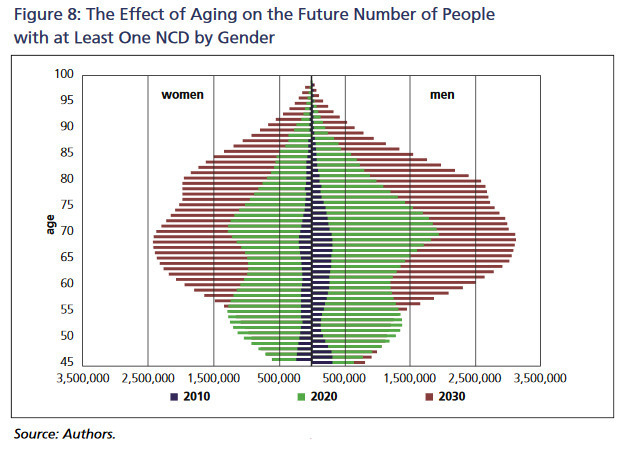
Urbanization, with 60% of China’s population living in cities by 2030 (900 million people), will be deeply transformative of Chinese lives, affecting nutrition (with prevalence of unhealthy food habits) and physical inactivity – major drivers in the obesity crisis besetting the population
A cross-check with recently published data doubles down on these dire estimates
According to a study by the Chinese Medical Journal (April 2021), China accounted for 24% of newly diagnosed cancer cases and 30% of cancer-related deaths worldwide in 2020
Adjusted for age, China ranked 13th for the mortality rate, among the 185 countries in the database
Diabetes, according to 2019 data published by the International Diabetes Federation, turns out to be more than double the 2010 estimate (116.5 million cases recorded in 2019 instead of the earlier 52 million World Bank projection for 2020), discounting the proportion of people with undiagnosed diabetes (56%, adding 65 million people to the count…)
With 25% of world’s diabetes patients, China is another unfortunate leader
There is no doubt that, a step away from chest-thumping economic and technological world records doing China proud, the attention of Chinese leadership is concentrated unfailingly on the health challenges of the decade
Implications, in terms of biotech research, of basic healthcare advice and logistics, and of care for the elder will be discussed in our follow-up reports