
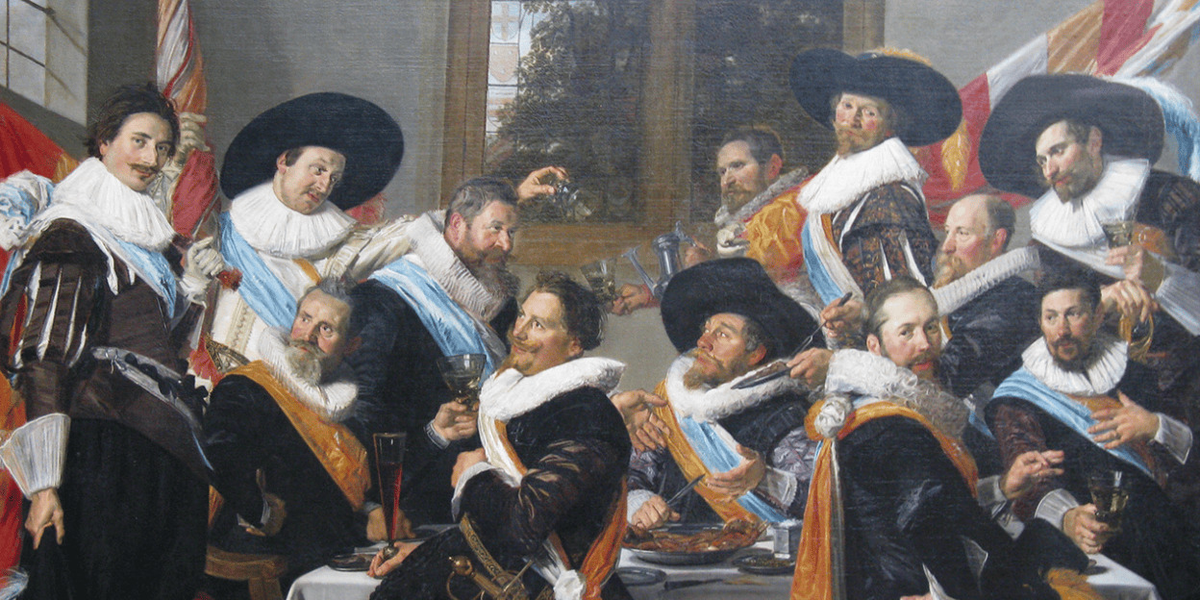
The Dutch 'Golden Century' from approximately 1575/1600 rooted a gratifying sense of self-worth in the Northern Provinces
Fading in the mist of history, the uniqueness of the period is marked to this day by the great art of Rembrandt and Vermeer, by the stately homes along the Herengracht of Amsterdam and by the leisurely country manors along the river Vecht
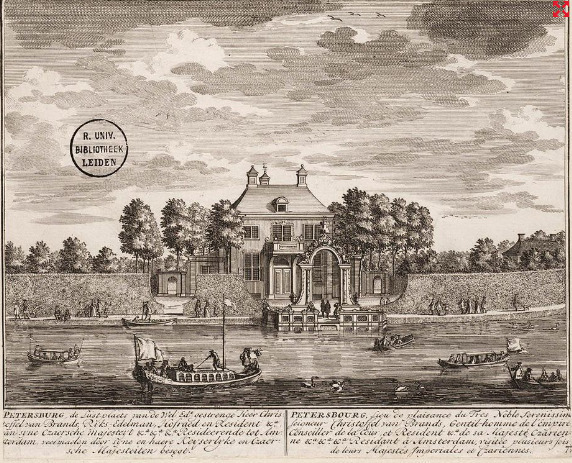
However, it would be mistaken to assume the 'Age of Plenty' landed like a comet in the Northern Netherlands by chance
It has been tempting to derive the 17th Century Dutch age of brilliance from one leading aspect or another, with a focus on geography and trading routes, on the social structure or on cultural distinctiveness
Unsurprisingly, all those factors will be convincing and even critical to overall success
Still, by reaching back into the Late Middle Ages, it is one of the most dynamic sectors of the pre-industrial age which stands out - shipping
Key to trade and human interaction, shipping evolved in small steps, over centuries, as progress in technology permitted
A breakthrough in shipping around 1550 changed everything - as a result of technological changes in the building of ships and increased efficiency of the network of shipping routes and port facilities
The productivity spurt, lasting somewhat less than a century, was the driver bringing together all the potent aspects favoring the Dutch Provinces
Without better ships and more efficient use of those capital goods, the advantages of location, and of an educated and industrious population, would have been left to wallow and to wilt
This was not about to happen, as the deep knowledge of the sea by the Dutch shipbuilders and fishermen, and the entrepreneurial spirit of the traders set out to prove
The detail of Claes Visscher's "Leo Belgicus'" map explains matter-of-factly, and without the benefit of hindsight, the source of Dutch prosperity - t'Lants Welvaert in words etched above ship riggings and structures, silhouetted on the horizon...
Urban extension (t'Vergrooten der Steden, with scaffolding around new city gates), commerce (Coophandel, with traders assisting the loading of merchandise on a ship), rich and peaceful agriculture (t'Vredich Lantbouwen) and, last but not least, security for safe passage (t'Veylich Reyden - with seemingly relaxed traders on horseback) are the engines of individual contentment
By 1611, prosperity speaks of a society of modest affluence, confident in hard earned success and still unaware of the wild riches to befall the next generation
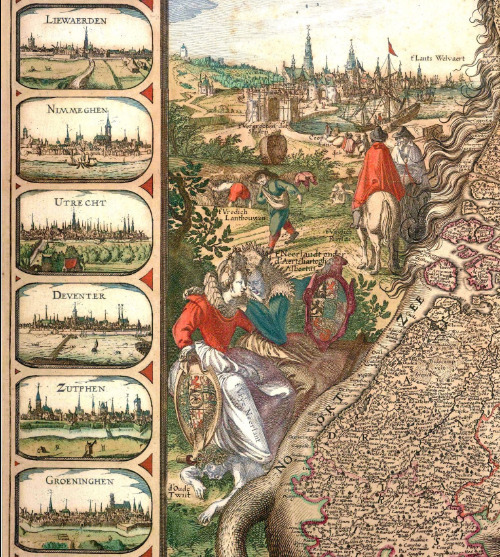
published in 1611 during the Twelve Years' Truce
Before the division of the Low Countries into a southern and a northern half in the 16th century, Belgae was a common name for the entire Low Countries and the Leo Belgicus map appropriately enough covered the Netherlands, today's Belgium, Luxemburg and part of Northern France
Sensibly - since Claes Visscher published the map during the Twelve Year's Truce (1609-1621) between Spain and the Netherlands in the Eighty Years' War (1568–1648) - two ladies preside over the Dutch good fortune in a warm embrace, representing Archduke Albert VII of Austria who ruled the Spanish Netherlands from 1598 until 1621 and red-coated Free Netherlands (t'Vrije Neerlant) who just happens to stamp her foot on a foul looking persona (t'Oude Twist - translating as old scent ?)
Following the reprieve, and ultimately after the Peace of Westphalia (1648), which formally recognized the Dutch Republic as an independent state, the 1672 Disaster Year (Rampjaar) saw the outbreak of the Franco-Dutch War, combined with the Third Anglo-Dutch War and the renewed English blockade, almost bringing down the Republic
If anything, the Dutch Golden Age was not peaceful
The outstanding economic and financial success of the Republic needs to be mitigated by the brutal swings between good fortune, severe deprivation and ruin, highlighting the frailness of society
Fire and fury and human ingenuity
In Dutch history, the "Golden Century" (Gouden Eeuw) remembered as period of great affluence – over approximately a hundred years – is variously dated from 1588, when the Dutch Republic was established, or 1609, with the start of a 12-year ceasefire during the Eighty Years' War between Spain and the Dutch Republic, and came to an end by 1672, the Disaster Year - or still later after either the death of Prince William III in 1702 or the conclusion of the all-around Peace of Utrecht in 1713
In the midst of such widespread conflicts, and from 1650 on, the coldest years midway through the Little Ice Age (1300 to 1800) marked a period of climate shifts
Portending much darkness, the climate's tentacles entwined famines and population decline across Europe... of which the Dutch escaped relatively unscathed
While Europe was at war with itself, groundbreaking scientific discoveries were not held back in the age of Galileo (1564-1642) and Kepler (1571-1630) before Newton (1643-1727) formulated the mathematics of the universal laws of gravitation
And the entire social structure was upended with the rise of capitalism, as feudalism gave way to an era of economic and financial risk-takers
In this swirling vortex, Johan Huizinga (1872-1945) encapsuled the driving forces of the Dutch Seventeenth Century ‘Golden Age’ with his cultural and aesthetic sensitivity to history
"It is the name Golden Age itself, that is wrong….If our Glorious century must have a name, let it refer to wood and steel, pitch and tar, paint and ink, audacity and piety, spirit and imagination…"
in J. Huizinga, Nederland’s beschaving in de zeventiende eeuw. Haarlem 1941, pp. 174-175
Spirit and imagination
How the Dutch managed to dominate international trade and international finance in such circumstances has been – as Huizinga suggested – a fortunate combination of “audacity and piety, spirit and imagination…”
Highly favorable – as well as much darker – factors abound but, by opportunistically ‘seizing the day’ in the late 16th century, the Dutch Republic was riding a wave of the most consequential changes since the Late Middle Ages…
Preferences of political, social or economic nature inevitably continue to taint any commentator’s emphasis, picking from a menu of determining factors ...
Each one has been relevant in time and place
But it is only in combination that they came into their own...
Geography, at the cross-road of Europe’s Western great river systems
Favorable trading routes, controlling access to the Baltics and to the Great Eastern Plains, all the way into Muscovy
Lack of feudal traditions, allowing powerful traders and a ruling class of 'Regenten' to dominate
Opening of international sea routes, following Vasco de Gama's 1498 discovery of the sea-based route to India, by rounding the Cape of Good Hope
Protestant faith and tolerance (relatively speaking, in times of great wars of religion) for the Catholic and Jewish religions
Advancement of education for both men and women
Women’s rights, again relatively speaking but notably advanced for the times
Freedom of expression and freedom of the press, making Amsterdam a beacon of intellectual life - towering above Europe with René Descartes (1596-1650) in a 20-year self-imposed exile from 1629, John Locke (1632–1704), exiled to Amsterdam in the 1680's and Baruch Spinoza (1632-1677) born in Amsterdam to a Marrano family that fled Portugal
It has been a potent mix but its constituents were hardly unique - imitation should have been the sincerest form of flattery
With unbridled economic growth, the individual enrichment in the Dutch Provinces remained out of reach in Europe’s largest countries for a reason...
The time had come for the Dutch innovative shipping designs, not for raids, like the Vikings after 900 AD and not (at least directly) for exploration, like the Portuguese in the early 15th Century but in unchallenged support of international trade
Vermeer is dead - "Niets te halen" as in 'Nothing to be collected'
As reported on the Essential Vermeer site (highly recommended), this dry entry on 16 December 1675 - "Johannes Vermeer painter on the Oude Lange dike not to be collected" (Johannes Vermeer kiinstschilder aan de Oude Lange dijck niets te halen" ) - refers to the painter's death notation in the book opened by the city of Delft's 'Kamer van Charitate'
The Chamber of Charity was a significant institution for social care and support for the needy - structured in 1614, with six masters of charity appointed by the city government working alongside six deacons to ensure sufficient income for the relief efforts of the poor
In addition to various taxes levied on behalf of the Charity, a very creative levy was that of the so-called "best outer garment", according to which the most expensive clothing item from the estate of every deceased resident must be handed over in a box to the Kamer van Charitate
In dispensing the Vermeer household of the customary 'donation', the Chamber was probably aware of the dire straights of Vermeer's wife Catharina, declared insolvent a few months after her husband's death
Extreme poverty, indebtedness and bankruptcy was far from unusual amongst even the most renowned artists
Rembrandt declared insolvency in 1656, his possessions and art collection auctioned and himself placed under legal protection of his son Titus and partner Hendrijkje Stoffels until his death in 1669
The hardship suffered by Vermeer and the artists of his age had a wider meaning
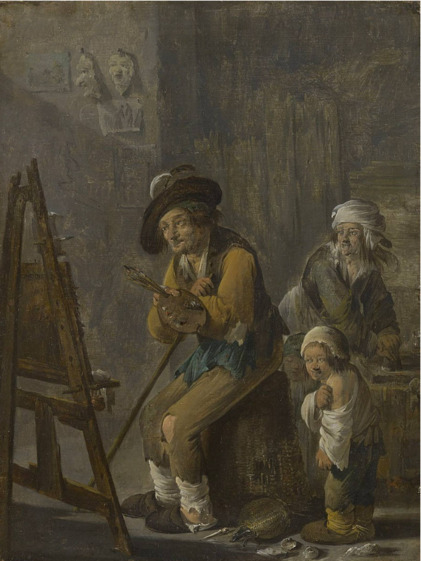
The extraordinary economic growth, and the rise of the Dutch Provinces to the pinacle of European dominance by the 1650's, was not bereft of brutal downturns triggered by intermittent wars - in 1653 following the English blockade impeding the movement of Dutch merchant ships and - still worse - in the 1672 Disaster Year
Both crises highlighted the vulnerability of the Dutch Republic's economy, entirely dependent on international trade
If the most renowned - and highly priced - Dutch artists could fall on the hardest of times, their demise - after the first economic crisis for Rembrandt and after the second for Vermeer - signals a society living on edge, ever ready for high-risk ventures like pioneering expeditions to the East Indies, and bouncing back when disaster strikes
The swinging Dutch 1600's
What the 'swinging' Dutch 1600's laid bare were uncomfortable realities of prosperity which favored a growing middle class, benefiting from the diffusion of economic opportunity - leaving the poorly educated, the less capable and a large contingent of under-qualified recent immigrants to fend for themselves
Agriculture and fisheries, shipbuilding, housing and urban infrastructure, trade and warehousing of commodities all did offer an usually large number of employment opportunities
However, to remain competitive on international markets, Dutch business was keen on continuous innovation in every sector of activity, benefiting essentially a workforce with expertise
And those same international markets would soon be exposed to English and French protectionism, to sharp economic downturns in exports and to plain warfare - reverberating across the Dutch society with material impact on the standard of living but hitting the poor hardest
Equally wild in the upturn, and ruthless on the way down, with fortunes won overnight and lost in 'bubbles', like the Tulip speculation (1634-1637), Dutch society ultimately recovered its bearings after the 1670's with a more subdued growth pattern, less 'Golden' but more durably profitable (and boring...)
Priming international trade as source of future great wealth, mastery of the seas and highly efficient cargo transportation were destined to play to the strengths of the Dutch Provinces - as I will discuss in "The Dutch Provinces and the Sea"