

The trouble with demography, a neatly structured data pool, by age group and by gender, is its irredeemable certainty
As people age, they climb a thinning population pyramid – until, at the very top, the very old are just too exceptional and too rare to be ‘materially’ relevant
The pyramid might be humbling for any government because it is ‘manifest destiny’, though it rarely is recognized as such
For the individual, who happens to belong to a specific cohort, fatalism is pervasive and as natural as the aging itself
Fatalism might be the defining attitude of all Russians, from the commanding heights of the Kremlin to the most unfavored rural poor
What is unfolding in Russia is a demographic tragedy - fatally so
This tragedy foretold is spelling disaster by 2040 with haunting finality, as I will show
How the Russian government came to dig an ever-deeper hole, and keeps on digging, might just reflect fatalism
With challenges on every front, economic, social and geopolitical, Russia could be ‘running the clock’ to leave an indelible mark on global governance, whatever the cost to Russia's people
This is why Russian demographic fatalism - and its trendline over the next 15 years - is the single most important factor of coexistence in Europe
Not so pyramidal truths
Russia’s population of approx. 144 million has become a ‘state secret’ since July 2025, when the official state statistics agency Rosstat stopped reporting monthly data on births and deaths – following the earlier hold on regional breakdown of births and deaths
With one of the latest known data on births of 90 500 – for February ’25 – demographer Rakhsa concluded ominously in the Moscow Times that “the first quarter of 2025 likely saw the fewest births since the early 1800s”
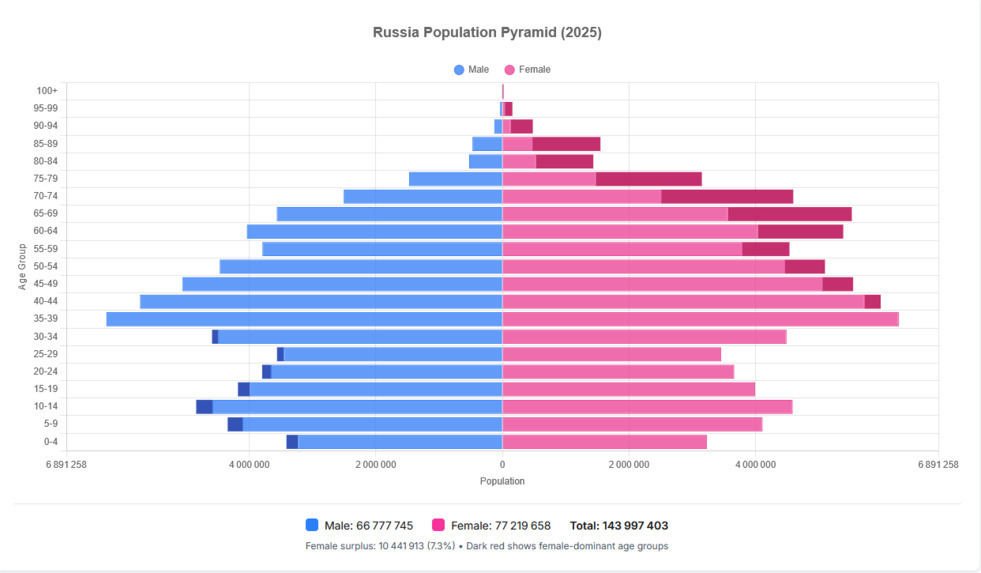
The distribution of the population by age group and by gender looks highly unfavorable because the cohorts following the 35 to 39 years’ old will not step in…
The youngest group (0-4 years old) is 50% smaller than the base on which Russian society currently relies with the 35-39 years old
Arguably, human population is retreating across the world and the U.S. Population Pyramid does not look that different from Russia’s, with a narrowing base of the younger cohorts of 0-10 years old
On a closer look, births started ‘ebbing’ 5 years earlier in Russia and – more significantly – the cohorts of young Russians have been incredibly volatile and unbalanced across age groups from age 0 to 34
Unfolding a map of intertwined crises
With the collapse of the USSR, back in 1991, births fell by 30% in age group 30-34 and 45% in age group 25-29, compared to their immediate seniors (age group 35-39)
A tentative recovery in the first half of the 2010's has possibly comforted the Kremlin in century-old convictions about the resilience of Russia’s population, fatalistic but trusting in destiny
The increase in the number of new born occurred as a relatively large generation was coming of age to have children, supported by the introduction in 2007 of the “maternity capital” program to boost the birth rate
As of 2026, this one-time payment for first and then second child amounts to respectively ₽737 200 ($9,320) and ₽1 million ($12,650) if no capital pay-out for first child - a very notable increase over 2025 for a first (equiv. $7,000) and second child (equiv. $9,300)
Of course, COVID in 2020 and war on Ukraine from 2022 were mighty rebuttals to the natural course correction hoped for
With COVID, according to Rosstat, the number of deaths attributed to the virus was approximately 670.000, while excess mortality exceeded 1.07 million
With overlapping factors and varying interpretations of excess mortality, rates of death per 100 000 are subject to dispute
The official Russian estimate suggests a terrible toll (741 per 100 000) and the model of The Economist signals an even worse outcome (1 016 per 100 000) - US rate in the same model is 434
With the war on Ukraine, death toll on Russian soldiers is estimated at 170 000 (official data) and at 220 000 as of August 2025 by independent news Meduza
Combined numbers for dead and wounded soldiers is estimated by Western sources at 1 million to 1.2 million people (also by August last year)
The retreat in the cohort of very young (0-4 years old) – down 30% from the 10-14 years old - is stark but the last known data (February 2025) of 90 500 for that month is dramatic
This is reason enough to make the true statistics a state secret if the number in any way reflects the full year
Current 6.5 million 0-4 years old counted over 4 years equate 1.625 million births annually
1.1 million births in 2025 (February *12) would imply a 30% drop over the previous age group and a 50% fall from the 10-14 years old
This rough estimate may actually understate reality as the war grinds on, but the road to oblivion is for all to see
Population cohorts and wars of aggression
Telling of this level of desperation, Russia’s gender imbalance – highlighted by the Population Pyramid – is extreme, with approx. 11 million more women than men in age groups 50 and above
Compounding war losses, the high rate of male deaths is due to everyday causes, such as murders, suicides and car crashes, and to alcohol abuse, the biggest reason for premature death among men
Demographer Rakhsa reports how excise taxes and duties are actually favoring the stronger beverages to the detriment of beer and other low-alcohol drinks, putting to rest the Gorbatchev anti-alcoholism campaign of the 1980s which led to a 3.5-year increase in male life expectancy
“Every year, at least 150,000–200,000 people die in Russia due to alcohol, and about 80 percent of them are men,” according to Raksha
It has been argued, somewhat disingenuously, that the current war on Ukraine was orchestrated by the Kremlin with an eye on the cohorts of young men of conscription age
This may have been a consideration - the age group of 35-39 year old was indeed four years ago the richest group (6.3 million men) but, at the time, one must assume these men were already established, at age 30 and above, with families and not truly of fighting age
Whatever the original intentions, a new reality has set in
The unexpectedly long war in which Russia is entangled, the clear reluctance to recruit its soldiers by conscription and the quick drop in male cohorts who follow the group of 35-39 years old all point in one direction only
The Kremlin will very probably sue for peace in the short term and claim victory on the most favorable terms possible
The outcome will leave every party to the war aggrieved
In Ukraine, the human toll, the tragedies of wanton deaths and destruction, and the criminal wrongdoing of Russian forces cannot be forgiven or forgotten
Russia may have been successful in its pivot to a war economy but, after four years, its civilian economy and its social network are in tatters
With the post-war periods of the XXth Century long conflicts in the rear mirror, this could mean revenge, in line with the disastrous weaknesses of the Versailles Treaty (after WWI) or strength and closure modelled after the post-WWII years...
Securing a durable peace
The past can sometimes be understood as an all-too-real scenario of the near future
As such, the aftermath of the 1919 Versailles Treaty might promise an uncomfortable reality in 2026
An immediate factor, setting international arrangements up for failure, was the American withdrawal from the 1919 Treaty, an unpromising start for the League of Nations which duly failed
The isolationist streak of the U.S. Senate remained a defining feature of international diplomacy in the deepening economic slump
Germany's social desperation turned violent with an estimated 350 political murders by right-wing organizations, and 22 by the left wing, between 1919 and 1923 alone
Neither American isolationism - "Going it alone" writ large - nor ransacked, thoroughly depleted, belligerents of the Russo-Ukrainian war should be taken for somehow inevitable and inconsequential
They are neither
A revengeful Russia will have, by 2035, the means to payback for the suffering the country, endured according to the Kremlin's narrative of victimization, a reflection of Germany's 1918 stab-in-the-back myth, antisemitic and anticommunist for good measure
- The single largest Russian age group - at 4.6 million men - the country will enjoy in a very long time will reach military age ( 20 to 24) in less than 10 years
- On the verge of an uneasy peace, Russia will evaluate the potential of its revamped military industry, for weapon exports and for the country's future strategic options
Which is how the decade through 2035 is set to unfold
Even though, with optimistic assumption, Ukraine would be rebuilt under democratic aegis, Russia's social and economic weaknesses will raise the challenge of peaceful coexistence by an order of magnitude
In a persistently troubled society, stressed by early deaths and harrowing poverty, hope will be given short shrift in Russia and revenge will be remain on the menu
With a defense industry recovering its strength and men of military age, in numbers and eager to make a stand, the stage is set
Or will Europe pick up the mantle - dropped by the U.S. Administration...