

The run-up in energy prices even before the start of the war in Ukraine greatly enhanced the profitability of the oil and natural gas producers
However, the abundance of cash has not unlocked as many new oil field exploration programs on a global scale as might be expected
- the giant international energy producers have been staying closer to 'home' - on a continental scale - by limiting involvement in the most complex enterprises (such as Arctic exploration) and in sensitive geopolitical contexts
- the shift to renewable energy sources has gained exceptional momentum, to say nothing of the pressure of environmental activists on fossil fuel producers - still modest investment commitments, the trend favoring renewables is undisputable
Strategic flexibility remains the order of the day for energy producers and iron-cast assumptions about the future of the sector are likely to be overturned the day after
The industry is entering a complex transition period, moving away partially from fossil energy sources, without any certainty about the timing and the magnitude of the shift
However, sifting through political commitments and climate change priorities, a few facts are hard to dispute
- The move away from polluting sources of energy is for real, and pressure will continue to build on the world’s worst emitters, China, India, South Africa and the US
- Time lines are impossible to ascertain and may be pushed back on financial grounds, but the popular demand will not ease
- Demand for fossil fuels will remain strong in every segment – with the notable exception of individual transportation, in the world's advanced markets
- In agriculture, in industry, and even in transportation in the many regions poorly connected to the electricity grid, fossil fuels retain a bright future
- The wind does not always blow and the sun does not shine 24/24, setting the stage for an energy mix combining renewable sources, nuclear power and – undoubtedly – fossil fuels
Picking their way through the minefield, the global oil giants will be hedging their bets,
- constraining the time horizon of their investments to anticipate falling demand for fossil fuels in the medium-to-long term (no one can be sure)
- rejecting the riskiest bets on technological or geopolitical grounds, putting whole swaths of pre-planned exploration fields off limits
- fine-tuning well-recognized strategic options, favoring natural gas in the fossil fuel mix
- exploring investment opportunities in renewable energy and environmental protection (carbon capture), gaining expertise and aiming for market share (albeit at a cost of low-to-negative profitability)
For the investor, uncertainty is the hallmark of investment opportunities as the energy giants will be shifting massive financial commitments
Transitions come with uncertainties
Until recently, anticipations of energy demand – originating essentially from fossil fuels and from nuclear origin – and its growth pattern over the long term – could fit neatly with investment planning by energy giants
For the energy giants, long-term cost-benefit analyses used to prioritize projected volume of demand and potential volume of supply, managing energy prices in a familiar bandwidth
The politics of renewable energy have turned that business model inside out
- not so much because the volume of renewable energy brought to the grid might become a deciding factor globally, any time soon
- but because legislation and regulatory push, driven by strong social awareness, is a game changer, fraught with uncertainty
Uncertainty plays out on both ends of the spectrum, on global demand and on supply
- With the growing consciousness of depleting fossil resources, energy demand anticipation is becoming harder to ascertain over the extended time horizon required in planning energy investments
- With public inducements to prioritize renewable energy sources, the supply mix between energy sources will be impacted in markets of stable – or even falling – demand
Making virtue out of uncertainty, most of the Energy Majors are implementing investment strategies focused on diversification
Shell’s efforts, as summarized by CNN, are a balancing act mirrored by its competitors
- Assigning around $3.5 billion and 14% of its 2022 capital expenditure of $24.8 billion into its Renewables and Energy Solutions business, which includes electricity generation, hydrogen production, carbon capture and storage, and the trading of carbon credits
- Investing about $12.4 billion into its integrated gas and oil exploration units
Investing in energy firms - How to stay safe ?
Because energy sources are the engines of economic growth, no diversified portfolio can afford to ignore the sector
Sensitive to global oil prices, investments in oil stocks will remain volatile, framed by the geopolitical tensions and OPEC + tactics
As the oil giants engage in the difficult transition to spread their risk exposure, diversification by geography and between fossil and novel energy sources
Investors find themselves in a pickle with unenviable options
- staying invested with the oil giants and sharing the uncertainties of the energy transition, compounded by a difficult geopolitical context
- or hoping to benefit from the transition with over-weight positions in novel energy sectors, taking on a gamble where the oil majors still tread with caution
Rather than attempting to outguess the oil majors, safety might be found in the energy mix providing a measure of certainty over the next three-to-five years - 2023-2028
- The medium term does not have the finality of arbitrage - in favor of Big Oil or in support of climate change - by allowing the issues to play out over time
- Because the oil producers will want to keep their options open coming 2028, they will not allow oil reserves to be depleted
- As an environmentally-sound energy mix takes shape, infrastructure investments will be diverted to address the demand
In effect, by picking a short lead time, the investor will align with investment decisions which prepare the energy transition
Securing oil reserves but...
Expenditures on oil exploration have been falling since 10 years
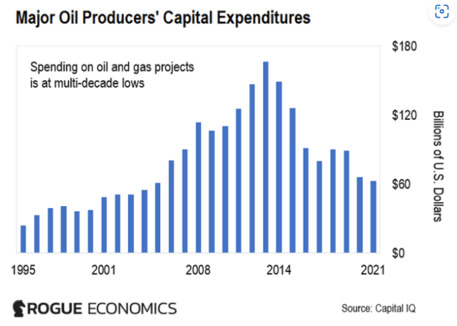
By doubling down on familiar 'backyards' - the Americas for the US majors and Africa for the former colonial powers (the UK, France and Italy) - with variants and exceptions, the Oil Majors will realign their global footprint
Along lines of longitude, American oil firms shift away from Russia under geopolitical pressure, but also from Africa, engaged in the process of offloading assets from Cameroon, Chad, Equatorial Guinea and Nigeria
For ExxonMobil
European majors enact a similar shift, out of Texas shale and Gulf of Mexico for Shell
Europe's oil firms, seeking to substitute for the lost access to Russian energy, plan to combine investments in Africa for traditional fossil fuels, especially in natural gas (ENI
Renewables are a marked departure from traditional capital allocation for European firms - ENI with Algeria's Sonatrach for green hydrogen, just as BP in Mauritania and TotalEnergies in South Africa - a trend on track to allocate about 50% of their capital expenditures on low-carbon initiatives by 2030
This tidal wave of cash, initiated by Europe's Majors, likely to be joined by US oil firms before long, will open an era of mergers in green energy
A sign of things to come - 22 renewables deals in 2022, the five biggest totaling $12 billion according to AllianceBernstein, a broker
In the meantime...
To keep reserves in shape up to the 2035-2050 horizon set by regulators, surely a time for greater clarity
- MidCap Oil firms - with favorable valuation ratios - are potential acquisition targets if Chevron agreement to buy shale-oil producer PDC Energy Invalid tag asset and Exxon's talks with shale giant Pioneer Natural Resources Invalid tag asset are anything to go by
Anticipating the roll-out of major infrastructure projects which will determine in part the future balance of energy sources around the world
- Natural Gas Turbines will be a critical link, bringing to the fore the manufacturers of heavy-duty natural gas turbines, of large capacity (150-300 Mw), used in the power generation industry
Amidst uncertainties - linked to geopolitics, to climate change and to regulatory engagement - a 2025 investment horizon for MidCap oil and renewables-linked infrastructure (benefitting the turbine manufacturers) offer reasonable arbitrage opportunities between expected performance and risk