

South-East Asia – a Multipolar Challenge, a recently published note, highlighted the structural shift in the region, where strategic rivalry between the US and China has been playing out (and will continue to do so)
Demography and economic growth in the region are the agents of a geopolitical transformation which will compel the Great Powers to realign…but not right away and uneasily
Neither the US, nor China is likely to thrash its priorities in short order
The American concentration on defense and on security will continue to dominate its regional policies but, predictably, diplomacy and development goals will start to weigh in
China will still be riding high on the economic benefits of intra-regional trade but its ability to maintain its controlling stake in the regional supply chains could become less assured over time
In a sense, both global contenders are caught in straight jackets which are becoming slightly less comfortable : military alliances for the US, supply chains and infrastructure contracts for China,
It remains to be seen if the superpowers will brace themselves for change
Foretold by a demographic wave, economic growth and - not least - expectations of democratic governance, regional upheaval creates uncertainty but also opportunity
By virtue of geographic proximity and sheer economic dominance , China is not about to be displaced from its perch...
But open societies in China's 'near-abroad' - seeking global cooperation and fluid cross-border dialogue and opportunities - will cultivate new challenges
It is up to China to summon strategic versatility to win the day, maybe by going with the flow of the Yangtze River from Shanghai to Sichuan, the most sophisticated and functional part of the Chinese economic system
Old habits die hard
America’s defense priorities and China’s trade opportunities are undoubtedly appreciated – and valued on equal footing
The benefits brought by the superpowers will remain as attractive as ever, and their Asian recipients will tread carefully
However, as the largest Asian countries assert their national interests more vocally, and their size and economic potential will support their expectations, the balance of power may start to shift
It is early days…but the US and China might have to finetune their regional strategies in the light of these local ambitions
Difficulties abound and old habits die hard
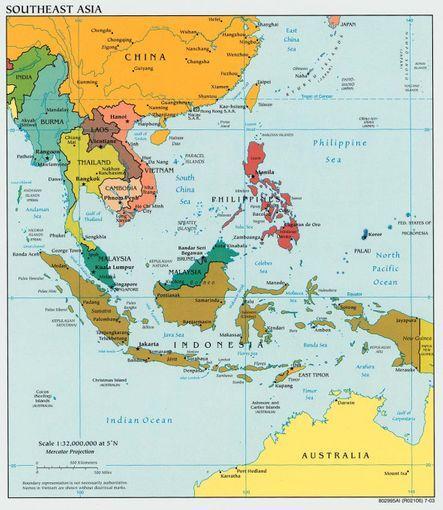
China’s aggressive posture aims at gaining control of the South China Sea where island militarization goes hand in hand with access to the fishery – and potentially mineral – resources in disputed zones and traditional fishing grounds of the Philippines or Vietnam
America’s distraction – a well-documented inability to implement strategic options over the long(er) term – may be the country’s own worst enemy
With the rise of Indonesia, the Philippines, Vietnam, Thailand and Malaysia, soon to weigh as much as half the (aging) Chinese population, and hoping to grow faster than China’s GDP, the two global powers competing for influence stand to make hard choices
The outcome for China is not forthcoming
China - from Tributary to Transactional Relations
Tianxia, the cultural concept associated with Imperial China's sovereignty over the region under universal and well-defined principles of order, was not exclusionary in nature
Tributary relations with neighboring countries rested in many ways on the symbolic Mandate of Heaven received by the Chinese monarch
How far this millennia-old vision of nominal Chinese 'sovereignty' can be bent to fit contemporary geopolitics is unclear...
Whether transactional relations with neighboring countries can be endorsed under Tianxia is surely not China's choice alone
Trade - Tempting Magnets
GDP of the ASEAN countries is expected to increase from approx. 3.08 trillion US dollars in 2020 to more than 5 trillion in 2027
The ASEAN-5 will be extending their economic advance, buoyed by demographic growth, technological progress and regional market integration
It is impossible to ignore the powerful economic undertow of China’s regional influence in this social transformation
China is now ASEAN’s biggest trading partner and the country will seek to consolidate its global market share even as it diversifies its trade away from the U.S.
Integration of the ASEAN economies in Chinese supply chains remains a work-in-progress, markedly differentiated from country to country, but weighing on the trade balances nonetheless
| GDP | as % of country GDP | Billion USD | ||
| 2020 | Exports by China | Imports by China | Trade Balance | |
| Indonesia | 1 059.9 | 3.9% | 3.5% | -4 |
| Philippines | 361.49 | 11.6% | 5.3% | -23 |
| Vietnam | 342.94 | 33.2% | 22.7% | -36 |
| Thailand | 500.29 | 10.2% | 9.6% | -3 |
| Malaysia | 337.28 | 16.6% | 22.2% | 19 |
| Singapore | 345.29 | 16.8% | 9.3% | -26 |
| source - ISEAS Singapore - July 2021 - Pininvest - 2020 data | ||||
With the notable exception of Malaysia, all Asian countries have a trade deficit with China
- Malaysia benefitted from surging Chinese demand in electrical and electronics products but also rubber products, palm oil and palm oil-based agriculture products, all of which were important raw materials and intermediate goods for the Chinese supply chain
- Vietnam's strong sales to China are equally attributed to electronics (circuit boards) for domestic supply chains
Vietnam - even more so than Malaysia (thriving on Chinese demand of its agricultural products) - turns out to be the poster child of deep supply chain integration, buoying its economy when all goes well...
The sharp sell-down of VanEck Vectors® Vietnam ETF
On second thoughts, Thailand, the Philippines and, foremost, Indonesia will be pondering the merits of trade diversification
Infrastructure investments - Reaping benefits ?
To strengthen its grip in regional economies, China is not relying on trade alone
Combining free-trade agreements, including the Regional Comprehensive Economic Partnership, with loans and investments, such as those within the Belt and Road Initiative, China has been planning to solidify its economic influence for decades to come
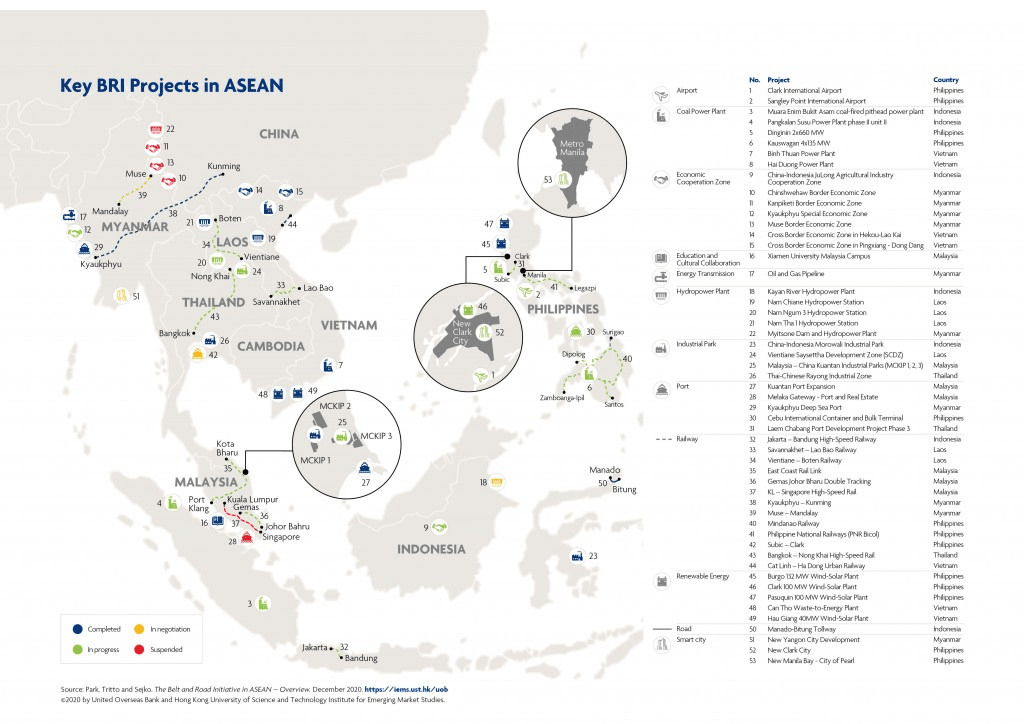
Mapped by the University of Hong Kong (link to download enlarged pdf), the BRI projects are notable for their infrastructure priorities
- 13 railroad projects - with the major Kyaukphyu – Kunming direct rail connection across Myanmar (Burma) to the Bay of Bengal - or the East Coast Rail Link in Malaysia to bypass (in part) the crucial Malacca Straights
- 5 ports - 2 of which in Malaysia and 1 in Myanmar (the Kyaukphyu Deep Sea Port serviced by the railway under construction)
Reflecting China's strategic security concerns (access to open seas), BRI benefits for hosting countries remain to be proven
Further infrastructure projects are indicative of China's controlling interest in supply chains (industrial parks, economic zones at boarders, energy supply)
- Of 6 'economic cooperation zones', 4 are in Myanmar and 2 in Vietnam - clearly indicative of supply chain integration with Chinese firms
- Energy plants raise further questions - with sensitive hydropower projects along the Mekong (3 in Laos and 1 in Myanmar)
The focus of the BRI on infrastructure investments stands out for its pointed lack of support of projects advancing recipient societies - with a single Education and Cultural Collaboration (in Malaysia)
A Rocky Road ahead
Strength of the Chinese outward going economic policy, tightening supply chains and delivering valuable infrastructure, cannot be disputed
Whether the underlying spirit, recasting the tributary system of 'All under one - Chinese - Heaven' - defined by the historical cultural concept of Tianxia - stands the test of time is not as assured
Diversity of social and economic progress across ASEAN countries, demands for democratic governance and resistance to Chinese high-handedness points to more transactional relations - a sea-change
Whether Chinese pragmatism will win the day with a reassuringly 'modern' Tinxia, giving a wide berth to ASEAN's democratic stirrings, remains to be seen
As of today, under the spell of its past economic successes, China appears unlikely to derail its push for deepening regional integration - on its own terms
In response to growing soft power expectations in South-East Asia, the US might take on the challenge....
...an uneasy balance to be found between on the one hand American military commitments and security priorities in the region - diplomacy and development goals on the other
Soft power 2.0 ?