
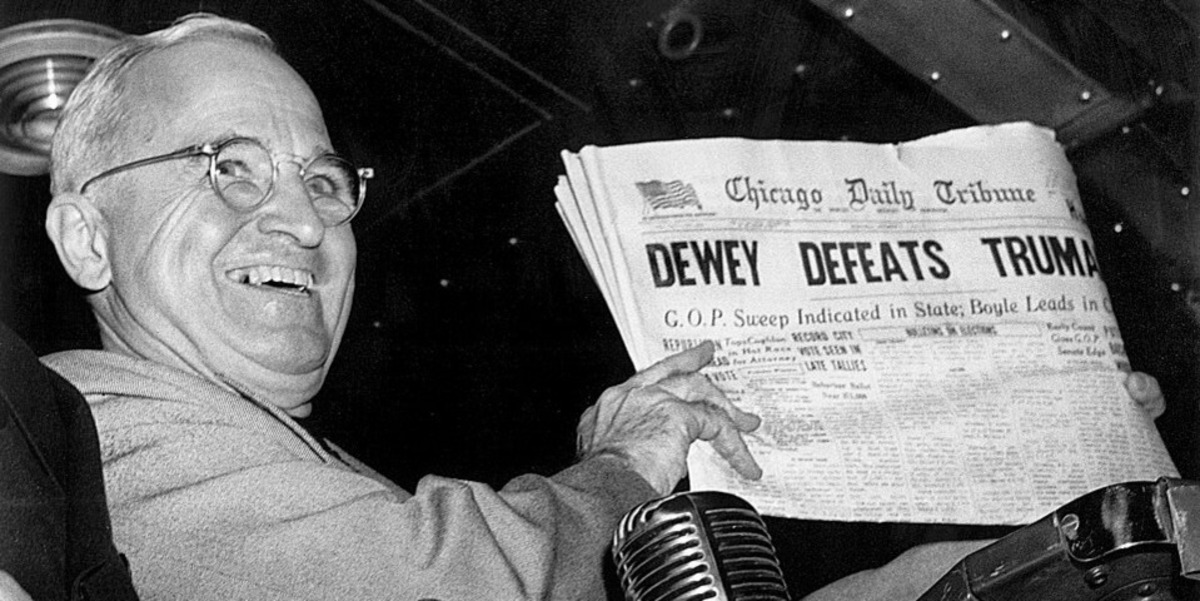
We are left to wonder what choice a "President Trump", flush from the 1945 U.S. victory in World War II , would have made:
Isolation from messy foreign involvements or a gamble on economic, and moral, reconstruction of democratic allies ?
With the dire memories of 1930's, the extremism of Japan and Italy waging war across the world, and Germany preparing for military showdown, such a president might have doubted the wisdom of pulling up the drawbridge
Russia's Stalin raised further questions about sunny American assumptions regarding the Soviet dictator's intentions, as his long shadow over Greece and Turkey called for answers early on
Confronted with hard questions, President Truman gambled ... upended resistance to free trade and military involvement, and won, as did the U.S. allies
80 years later, the stakes of economic and military competition have shifted dramatically, but the lessons drawn in 1945 still hold
U.S. isolationism in the early 20th century primed for a war no one wanted but everyone expected, and the law of unintended consequences led from one thing to another...and to Pearl Harbor on Dec. 7, 1941
With much talk about 'uncertainty' regarding the intentions of the American president, real uncertainty about the intentions and the constraints of allies and competitors should be all that matters
Commentators are feeding a never-ending news cycle covering the latest, and the latest of the latest announcements of the Trump Administration but, in the end, the flood of information seems to be oddly counterproductive – the outrage of one ‘camp’ and the congratulatory mood of the other get more muted and weariness sets in
Unfortunately, this deficit of attention does little to contain what Barbara Tuchman – in her ‘March of Folly – from Troy to Vietnam’ (1984) – qualified as persistent features of folly
Obliviousness to the growing dissatisfaction of constituents, primacy of self-aggrandizement and illusion of invulnerable status are aspects of folly, recurrent in governorship
It will be disputed if Mr. Trump ticks all three boxes and the president actually may not…yet
In a fast evolving political and social context, the president may veer either way, by containing his worst impulses and disciplining the sycophancy of some of his followers or, on the contrary, by raising his personal ‘intuition’ in all matters to an article of faith
The outcome is uncertain as the president’s executive orders meet growing public dissatisfaction, mockery of self-aggrandizement and vulnerability in the face of hard facts…
Mr. Trump’s convictions, and his intuitions, so potent with his followers, and so persuasive, incontrovertible and non-negotiable in his own mind, may be settled
However,
The complex political, economic and financial interactions of the U.S. Administration in a global setting are not settled
Reaching back to 1945, an unusual mind-exercise might frame Mr. Trump’s political sensitivities, with the choices the president might have had to confront after WWII, when the U.S. emerged as sole and undisputed world superpower
President Truman at the time made choices which proved to be decisive as well as counterintuitive
Rather than to swim with the tide and embrace constituencies weary with the war effort and hankering for nothing more as to be left alone, Truman gambled on the strength of reconstructed European allies to block the looming ambitions of Stalin’s Russia
The 1944 Morgenthau plan, by the name of Truman’s Secretary of Treasury, aimed at the elimination of German arms industry and the destruction of other key industries and remained under consideration until 1947 before making way for its pole opposite, the Marshall plan of reconstruction
It is far from clear what would have been the final decision of President Roosevelt, who died in office in April 1945: with his sensitivity to public opinion and optimistic interactions with Stalin, the president could well have been tempted to pander to his country’s isolationists and be confident in his ability to contain the Russian dictator’s impulses
Against this geopolitical background, what would have been President Trump’s decision, back in 1945?
With our knowledge of Mr. Trump’s vindicative criticism of all foreign involvement which does not bend to his will, and of his show of trust in Russia’s leadership, the answer might be forthcoming…
Seductive as it may be, such a ‘proof’ is of course facile because today’s political options cannot be relied upon to hypothesize the past
It is in fact the history of the early 20th century which could have been the guideline of Mr. Trump … so much so that even today, the president actually reaches back to the McKinley presidency in 1897 to justify his tariff policies
“Before he became president, McKinley was the driving force behind the McKinley Tariff of 1890, which raised duties on imported goods to nearly 50%. The goal was to protect American steel, tinplate, textiles, and other key industries from foreign competition. Among the sectors most affected was construction, which relied on imported steel, tin, lumber, and other building materials.”
After his election in 1896, Mr. McKinley reinforced these policies
“In 1897, the McKinley administration passed the Dingley Tariff Act, which raised import duties to an average of 57%, the highest in US history at the time. This action was part of a broader policy of protectionism aimed at bolstering domestic industries and was a key promise made by McKinley during his 1896 election campaign”
Assassinated in 1901, McKinley’s policies stayed the course with his successor Theodore Roosevelt as, in the absence of a constitutional amendment allowing for an income tax, which had to wait until ratification in 1913, tariffs were the main federal revenue system
And a radical overhaul of U.S. trade policies did not occur before 1934…
Hotly contested at the time, with major losses for its Republican proponents as early as mid-term 1890 elections – followed by the Great Panic of 1893 – U.S. protectionism could in the late 19th and early 20th century be justified by the build-up of domestic manufacturing capabilities of a still fledging American economy
However, there always are counterparties with their own national interests at stake in trade policies and the point cannot be ignored by the dominant American goods and services trade engine of today (2025)
Looking back on the run-up on WWII, a President Trump in 1945 might in fact have been unusually sensitive to the argument because one of the countries hardest hit by its loss of access to the U.S. market was Japan, which, poor in primary resources, depended greatly on its textile exports to collect the indispensable foreign currencies
Adding insult to injury, strong racist anti-immigration measures targeted Japanese immigrants to the U.S. in the early 1900’s
Riding high on the necessity to access energy and other natural resources and making the most of the lack of respect the Japanese people felt as their due, military aggression dutifully gained acceptance as solution to all that ailed the Japanese society
And both countries, Japan and the U.S. sensed that war was at hand as the law of unintended consequences came to pass...
Dive bombers, torpedo planes and fighters attacked Pearl Harbor on December 7, 1941
Far from suggesting that history may be on track to repeat itself, it is a fact that uncertainty hides in laws of unintended consequences taking on a life of their own