

The considerable noise around tariff wars is unquestionably part of the American president’s political communications
What unfortunately gets lost in the swirling tariff rate announcements, dressed up as legitimate revenge against foreign trade, is the goal pursued by the U.S. Administration
The ambition, aligned with the interests of all Americans, is grand
Economic recovery as a strong manufacturing nation aims to reverse three decades of decline in global rankings
Tariffs, barriers erected to protect the American market, are the tool, but growth, driven by industrial investment, is the end envisioned
Whether an industrial strategy, based on protectionism, can succeed is of course hotly disputed
Even so, regarding tariffs which have become reality, the ‘art of the deal’, as Mr. Trump defined his adversarial approach in a 1987 book, cannot leave fundamental questions unanswered
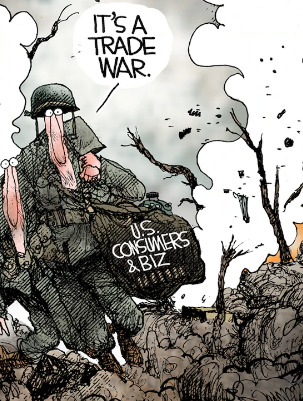
Tariffs are a tax supported in part by the exporter, in part by the importer and for the better part by the U.S. consumer
How this cost to do business in America will be shared remains uncertain
In fact, the widely discussed question of potential inflationary anticipation sidesteps the most critical questions
- Will American good manufacturers take advantage of the protectionist barriers to re-industrialize the economy (after decades of de-industrialization)
- What will it take to engage American business on such an ambitious reversal in industrial policy
- How and by whom will such an immense transformation be financed
A zero-sum game, it is not...
For lack of a more precise impact on the economy, annual tariff levies, estimated at $300 billion, will be paid for either by consumers or by businesses relying on imports for parts, machinery or finished products
- If levied exclusively on individual tax payers, $300 bn of custom duties would raise individual taxes ($2.06 trillion collected in 2025) by 15%
- Firms operating in the U.S. may choose to share the burden to safeguard market positions, such as car manufacturers estimating the second quarter 2025 hit to operating earnings at $3 billion for Toyota , $1.5 billion for VW, more than $1 billion for GM, $1 billion at Ford and the list goes on...reaching a grand total of $12 billion according to The Wall Street Journal estimates (as of August 8, 2025)
- Whatever promises the manufacturers feel "business-bound" to make, firm profitability will be impacted, limiting investment capacity and creating a drag on potential growth for the foreseeable future
Inflation might be the wrong metrics to evaluate the potential and the risks of a focus on tariffs to rebalance global trade to the benefit of the U.S.
Although the redistribution of custom levies will smooth their impact over time, a zero-sum game it is not
In the tariff wars, the deciding factor of success or failure is surely not zero-sum, it is economic growth, a rising tide lifting all boats
A consumer's economy
Personal consumption is the driver that matters most - with expenditures counting for two-thirds of the American GDP
Reason enough for the impact of tariffs on consumer choices to be of considerable interest, but the outcome remains unclear and can only be evaluated with a significant lag
The levies ultimately showing up in prices paid by the consumer will skew demand
- Domestic substitutes, when they are available, are likely to be more expensive
- When substitutes are not readily accessible, or attractive to the consumer, demand might just evaporate
Because impact on prices and on demand will be diffuse and vary by industry, inflationary pressures remain unconclusive
The magnitude of decline in consumer demand is yet to be discovered: it will define the first order of success or failure of the tariff policy
At this point, no one should argue confidently that the impact of tariffs on prices will be a modest 'one-shot' bump in inflation
Consumer demand could fall and by absorbing the tariffs, company profits could fall as well
Growth projections would need to be downgraded either way...
The potential impact of economic growth, most obviously domestically but also on foreign trade partners, is the fault line of the ‘America first’ discourse
The goal presumably is to reassert economic dominance by increasing the share of the U.S. in world GDP
The U.S. economy has been holding up well over the past decade in a range between 24% (2018) and 26% (2023) of world GDP in nominal terms...
But at purchasing power parity, it is a different story - the U.S. has lost its crown a few years ago and the country will only recover its standing by economic outperformance
When the framework of this growth strategy will become known - and it is not as of today (August 2025) - the financing of its implementation could be the stumbling block, bringing great expectations down to size
Financing great expectations
In my preliminary discussion of the U.S. dollar's centrality, the path to success already seemed to get narrower and more arduous
This observation stems from budgetary imbalance ... contributing to a debt-built-up, close to $30 trillion (and exceeding 100% of GDP), never quite immune to market turbulence and drifting, unstable like a flat-bottomed boat
- The size of the federal debt is a factor of instability from the start - no one knows precisely at what cost the debt will be refinanced this year (approx. $11 trillion of which $9.2 trillion to refinance debt arriving at maturity), and next ...and the year after that...
- U.S. financial markets depend to a large extend on foreign capital - both in the bond market ($9 trillion - 32% of total Treasuries) and in the stock market ($30 trillion - 18% of total) - introducing an additional variable of uncertainty
The large foreign holdings of US. assets - Treasuries, stocks and company debt - reflect the accumulation of dollars in the hands of foreign entities, as mirror image from the trade deficit
- If the trade deficit narrows, foreign investors, with less dollars on hand, may be less acquisitive of U.S. assets
- In this chain of events, more Federal debt and less foreign investors in U.S. assets, the crowding out effect, pushing private investment out to finance public debt, does not bode well for economic growth
Because the U.S. dollar still remains the undisputed pivot of global finance, hogging investment opportunities in size, liquidity and transparency like no other currency, the American economy may be immune to global trade hic-ups
Tactics initiated by Mr. Trump have to score with a Royal Flush...
- Inflation anticipations will not spill over in the domestic economy
- Expected growth will not disappoint
- Unresolved tariff policies will not drift into open-ended conflicts, especially with key allies such as Canada, Japan or the European Union
Just maybe...but the tariff shocks will reverberate across the economies of America's (ex) trading partners with still unpredictable consequences
To be discussed in The U.S. - Parting with the global economy...