
The war raging in Europe has concentrated the minds in the West on the brittleness of national borders
The sense of security permeating continental Europe for decades has certainly proven to be naive and overblown, but it is no excuse for a loss of perspective in geopolitics
...namely by accounting for a theater of potential conflict reaching fever pitch - in Asia
The Western Pacific, the South China Sea and Taiwan set out the geography of a confrontation between China and the US which has been couched on occasion somewhat airily in terms of domestic policy by both countries
This should not be because nationalistic appeal tends to morph, quickly running out of control
In America, to be ‘tough on China’ is a sure crowd pleaser. China, after all, had been ‘stealing American jobs’, to say nothing of its undemocratic ways and its responsibilities in the spread of the Covid pandemic
This is no less true of China which portrays the country as a victim of Western attack and likes to portray its diplomacy as fighting ‘like wolf-warriors’ to restore national dignity – another sure crowd-pleaser, this time for the Chinese public
Consequences are unfortunate for the many countries in the line of fire, caught in a tug-of-war threatening their trade flows and their security
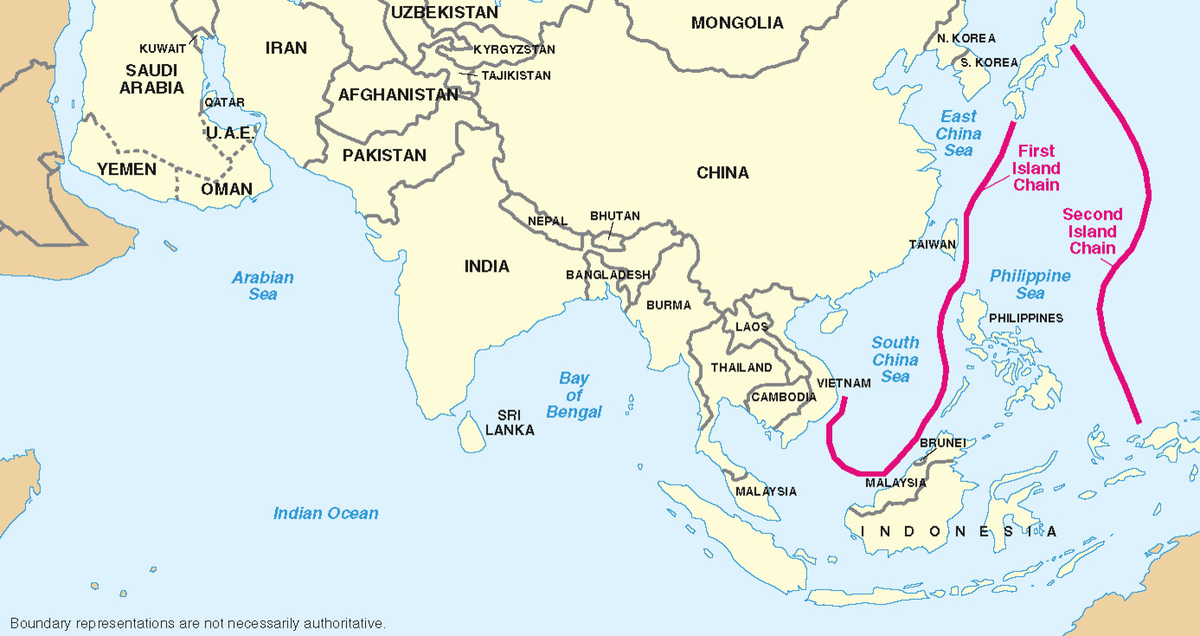
Bending to the geography of an 'island chain' no more than two hundred nautical miles from the Chinese coast, from Indonesia in the South to Japan by way of Malaysia and the Philippines, their governments may wonder on what terms the status inherited from World War II will survive
As a symbol of US military protection, the 'chain' has been yanked by American distraction and by Chinese assertiveness
Ideological feuds between the two global powers are rife
The stakes are high for the US because reliability of military commitments has to be ascertained again and again, leaning against the doubts of insecure allies
The stakes are just as high for China because its challenge of American military dominance in the Western Pacific is weighed down by its interest in peaceful coexistence to nurture its commercial interests, in the region and of course globally
The nations belonging to the 'island chain' have been bystanders of the confrontation, constrained in their options and aware of mounting risks
The nations have literally been 'hanging in chains'
For how long ?
Hawks, noisily in the Trump Administration and just as effectively, if in more restrained fashion, in the current Biden Administration, have taken advantage of America’s mood to push for one train of sanctions against China after another
By pandering to American domestic sensitivities, short-term ‘wins’ might be misconstrued as safeguards of the national interest, US politicians might get caught up in their own discourse and, critically, competing powers in the geopolitical sphere might miss the red lines, as Russia's President Putin discovered at his cost in Ukraine
Red lines best remain indefinite, the more potent for their vagueness, but with a keen eye on national priorities, the terms of dialogue and of potential confrontation need to be set
This is true of America where overlapping interests, sometimes circumstantial, sometimes predictable, belie profoundly held bipartisan resolve
China mirrors American hawkish impulses in its own terms, pitching national pride with abandon and staking the power of the State on uncontested dominance of the Communist Party
With the Chinese armed services, propaganda institutions and security agencies tempted to outcompete one another in the name of a vaguely framed national interest, dialogue is no less urgent than for the US, to make confrontation manageable
Caught up in this great power competition, the 'island' states are reminiscent of weather vanes, exposed to whirling ambitions they do not share and seeking security on terms they do not control
Chained for better or for worse ?
Hanging in Chains
‘Hanging in chains’, as gibbeting was known, was a spectacular post-mortem punishment in Britain of criminals whose corpses were suspended between earth and sky to be displayed for days, weeks, months, years and even decades, in specially contrived metal skeletons, the ‘chains’

Gibbeting was intended to inspire terror among witnesses and onlookers, exiling the criminal body to a liminal space, and leaving it there until there was little, if anything, left, depriving the criminal of burial
According to Sarah Tarlow, a total of 144 individuals were executed, then gibbeted, in Britain under the Murder Act (1752–1832)
Ghoulish to our modern sensitivities, the ‘chains’ certainly continue to focus the attention two centuries later
And the same attention should be paid today to a very different sort of chains – on the theater of the confrontation between the US with China – chains which, left unattended, could turn no less haunting
Geography might have provided America with a sense of security, ensconcing its Asian allies safely in an island chain of its military making
The credibility of arrangements reminiscent of an iron cage might have to be re-evaluated in the light of South-Asian demographic and economic growth
America...
In the views of American strategists and military, the first island chain draws a continuous line, no more than two hundred nautical miles from the Chinese coast, from the Ryukyu Islands and Okinawa (south of Japan's mainland) along the western seaboard of the Philippines and Malaysia before reversing along Vietnam – rounding the South China Sea
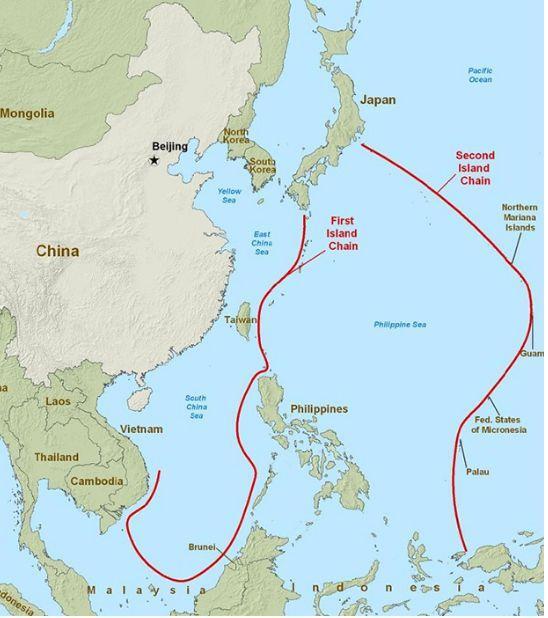
The second island chain, across the Philippine Sea, is, in a way, a figurative link between Pacific Islands, a wavy line from Central Japan (Yokota air base and Yokoska naval base) down to the Indonesia’s Western New Guinea (Manus Island base) by way of the Marianas and the scattered islands of Micronesia... were it not for Guam
This is because this "island chain" is essentially a pivot around the island of Guam, American territory gained following the Spanish-American war in 1898
For the U.S., Guam is a hugely important strategic military operating base, earning its nickname ‘the tip of the spear’ during WW2’s Pacific campaign, a military air base with a two-mile long runway, huge munitions and fuel storage facilities, and a naval base, home port to four nuclear-powered fast attack submarines
And China...
In the Chinese perspective, the description of the chain links is hardly different, except for the fact that the U.S. military base locations appear to be material proof, blocking China's outreach
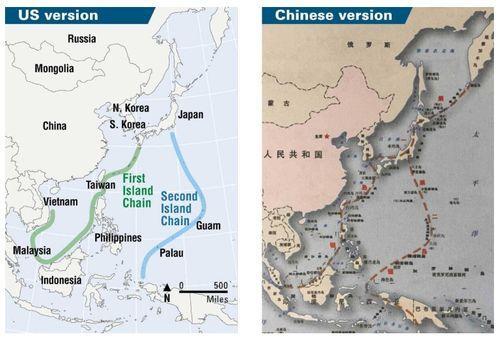
By focusing attention on the American military presence, the map drawn by the Chinese Navy (PLAN) is in many ways revelatory of China's security constrictions
The first island chain, marked as a 'hard' barrier, links the entire U.S. military base system off the coast of China, which is why South Korea and Japan are covered since the countries are hosting major American military capacity
- By extending the chain up to the Russian Kamchatka peninsula, the Chinese thinking appears to put the Sea of Okhotsk "in play". Located north of Japan, the Sea has been a sensitive area of confrontation between Russia and the U.S. during the Cold War, since the 1980's a stronghold for Russian nuclear-powered ballistic missile submarines, and engaging the Chinese Navy today in training and operation drills, all in the vicinity of Japan
- Unsurprisingly, the Chinese 'chain' skirts (more or less) the east coast of Taiwan (ocean side), marking China's sphere of influence
- Vietnam, where the U.S. do not have any military base but access the Cam Ranh Bay facilities for navy repairs, is ignored
The dotted line, faintly visible on the map, asserting China's sovereignty over the maritime domain from the east coast of the Philippines to Borneo and reverting along the Vietnamese coast, encompassing the South China Sea, paints the clearest picture of potential confrontation
Map reading of the second island chain tells a different story which, in China's strictly military interpretation, is only proper
- American military infrastructures may be large, especially at Guam, but are limited in number
- While running the risk of reading too much in a single map, one cannot dismiss entirely the perception that the second chain is an after-thought, lacking strategic credibility in the Chinese perspective
By simply linking the well-known locations of U.S. air and navy bases in Asia, 'island chains' never would, by themselves, provide any information
And yet, revealed by map similarities and differences, the tenets underlying military as well as commercial perspectives of China and of the U.S. are growing apart
Links in the island chain
With a sense of inevitability, the countries of the chain might seem destined to remain forever the wallflowers staying well away from the dancefloor of geopolitics
That perception belongs to yesterday's foreign policy when these nations could be mere ciphers, mostly aligned with American security concerns
Growing more diverse, relying on a large young population, growing digital economies and boosting trade across the entire region, they hold their own in balancing China's economic power
Anticipating not so much fading American military power as inconsistencies in its exercise, cautious steps are boosting national military power, with US encouragement
Japan has shown the way and the lesson has not been lost on the other 'majors' in the region, Indonesia, the Philippines and Malaysia, who, on the strength of their demography and their growing economic strength, are starting to assert their own national interests
It is not altogether improbable that China, still holding on with a sense of entitlement as dominant regional superpower, feels its influence slipping
As China's demography ages, and its economy matures, the country is bound to lose traction in the region and its current military show of force in the South China Sea could signal weakness on every other front (demographic, economic...)
After establishing itself as global superpower with extraordinary speed, China will not settle easily into the comforts of middle age
Rebalanced geopolitical influences across world's most populous region offer an array of diplomatic opportunities to America, as we expect to discuss in "a Multipolar Challenge"
They could just as well slip into heigthened millitary confrontation, spelling disaster worldwide
Either way, it would be the defining moment of the second quarter of the 21st Century