

The meaning of currencies is in the eye of the beholder
Renowned management consultant Peter Drucker supposedly imparted words of wisdom by observing «what gets measured, gets managed"
Whether or not Drucker actually made this pronouncement, it turned into a mantra of management...with dubious results
Measuring anything and everything is a questionable criterium, possibly distracting managers from their true priorities
In managing currencies however, measurement has taken flight in the widest possible sense, measuring the past (debasement) and measuring the future (repos, options and futures), pricing 'bridges' between currencies and offering protection (Central Bank swaps)
Foundational and incontrovertible, convertibility of any currency has been elevated as defining factor of its valuation, measured relative to the valuation of other currencies.....
Freely convertible currencies, such as the U.S. dollar, the euro, the Japanese Yen or the Swiss Franc are recognized as reserve currencies, held by Central Banks across the world
With value effectively managed by a country's Central Bank on behalf of its monetary authorities, holdings of non-convertible currencies required a leap of faith ....
Value of the Chinese Yuan is managed and this status is reflected by its desultory 2% share of global central-bank currency reserves and just 4% of international payments by value (even though the country represents 20% of global economic activity)
Acting as a magnet, international trade is boosting confidence in the global import/export leader, China, and attraction of the Yuan (also traded under the name Renminbi -RMB) ...
Today, the Chinese currency appears to be benefiting from growing acceptance of trading partners
If the momentum holds, consequences might be profound, impacting the U.S. dollar which is currently used in 50% of international payments by value
Currencies are many things….
Overlapping functionalities of currencies are the drivers of international trade, by way of lending facilities in most favored currencies, of calls on Central Bank currency reserves and with the recent launch of digital tokens
Currencies form an array of interlocked valuations, relying on trust – a fickle base exposed to geopolitical storms
Because currencies always convey power, financial weight and investment security, in sharply disparate degrees, the stakes for the U.S. dollar, the Chinese Yuan and the Euro could not be more different
In distinct ways, those dominant currencies have been keen to assert dominance, either undisputed - and military - might (in America) or through pervasive global regulatory influence (in Europe), but the attraction of convertibility and light-touch capital controls remained crucial…except for the Chinese Yuan...until now
Yuan ‘raison d’être’ – What matters most…
Tight control over capital flows in Yuan translates into tight control over the currency
Tight control makes holdings in the Chinese currency, and in Yuan priced bonds, dependent on the regulatory settings, and on the uncertainty of any evolving context
Lending from Chinese banks in Yuan will be exposed to similar uncertainties
…except for the fact that the Yuan track record tells an unusual story today
Yuan riding high
And there is more to the Chinese currency’s challenge than meets the eye
China has significantly increased its use of the Yuan for international trade, with nearly one-third of its $6.2 trillion global trade in goods and services settled in yuan as of June 2025, up from 20% in 2022 and 14% in 2019
When including all cross-border payments, such as bond purchases and foreign investment, the Yuan's share is even higher, reaching 53% in 2023
To further advance financial market liberalization without relinquishing control over the currency, Yuan-denominated financial instruments offer attractive options to international traders and investors
Loans
Chinese banks have notably reduced their dollar lending to other emerging market economies (EMEs), increasing lending in Yuan - Sustained dollar lending declines are concentrated in Asia and attributed to Chinese banks, according to a May 2025 Federal Reserve study
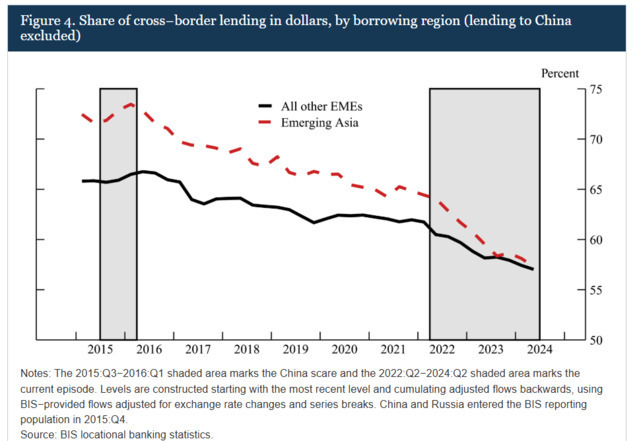
Cross-border lending in dollars to emerging Asia fell a total of 16 percent from the start of 2022 through 2024-Q2
The dollar share of cross-border bank lending to emerging Asia has fallen faster than in other EM regions in recent years
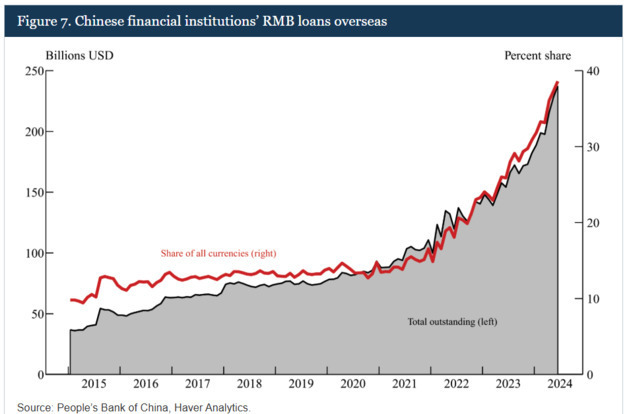
According to the Fed, "the simultaneous shift of Chinese banks' global cross-border lending away from dollars into Yuan (also named Renminbi -RMB) and the similar sustained shift from dollars to "other" currency lending in emerging Asia, where Chinese banks are important lenders, strongly suggests Chinese banks are primarily responsible for the latter"
Bonds
Dim sum bonds are yuan-denominated debt issued outside mainland China - in Hong Kong
Becoming a key avenue for yuan internationalization, Deutsche Bank estimates annual dim sum bond issuance tripled between 2022 and 2024, hitting 1.4 trillion Yuan (about $196.5 billion) in 2024. Observers expected that figure to be higher this year. In the first three quarters of 2025, the issuance volume had reached RMB 574.03 billion ($81 billion), reflecting a robust year-on-year growth of 12%
This rapid expansion can be attributed to a combination of factors, including the divergence in monetary policies between China and the United States, the widening interest rate differential, supportive policies for the internationalization of the Renminbi and strong market demand
Panda bonds are issued in mainland China by non-Chinese institutions, enabling foreign entities to easily access the currency,
Those entities are
- Chinese-owned companies incorporated in offshore financial centers but with primary operations in mainland China.
- Foreign corporations, financial institutions, and sovereign entities
Surging from 2023 onwards, gross issuance reached renminbi (RMB) 155 billion in 2023 and RMB 195 billion ($27 billion) in 2024. Momentum has remained strong in 2025, with 137.3 billion yuan raised through the first three quarters
A Deutsche Bank report concludes that both Panda bonds and Dim Sum bonds play complementary roles in promoting RMB internationalization and provide valuable options for issuers and investors seeking RMB exposure.
Swap lines to central banks
Issued to further support internationalization of its currency, 32 central banks have benefitted
With a total of 4.5 trillion RMB ($630 billion), the swaps rival the scale of IMF swap lines - even though only a fraction have been drawn on - according to the Economist
Financial plumbing - the tools of the trade
CIPS
Chinese Cross-border Interbank Payment System (CIPS) is a financial messaging system intended as an alternative to SWIFT, created in 2015
As the Economist tells it, more than 1,700 banks have signed up to CIPS across the globe, up by a third since before the war in Ukraine
Transaction volumes rose faster than ever in 2024, up by 43% to 175trn yuan ($24trn)
Clearing banks to settle Yuan payments (almost all of which are operated by Chinese institutions) have been set up in 33 markets. Some joined this year, including banks in Turkey and Mauritius. China began working with the United Arab Emirates in June in order to expand the CIPS network into north Africa and the Middle East
Retail payment providers - UnionPay and Alipay...
Rivaling Western incumbents such as Mastercard and Visa, UnionPay, a Chinese card network, is now the world’s largest by transaction volume and is accepted in 183 countries
Alipay, a digital-payment service, is accepted by 80 million merchants worldwide, compared with Visa’s 100 million
mBridge
mBridge is a digital-currency network, built by China with other central banks and one of the highest-profile cross-border central bank digital currency initiatives
As blockchain-based payments ledger, mBridge is designed to support real-time, cross-border payments and foreign exchange transactions
In October 2024, the Bank for International Settlements unexpectedly announced it is backing out of the mBridge payments scheme, days after fresh concerns were raised the payments network could be used to evade sanctions....
the GeoEconomics Center’s Lipsky concludes that China may look to integrate the project into their other existing settlement systems, such as the Chinese Cross-border Interbank Payment System (Cips)
“They have more flexibility now to move their CBDC projects into their other cross-border payment systems”
Reading the tea leaves, a Chinese perspective
With pragmatism, China's leading monetary thinkers will have noticed that their currency, like any other, is only as relevant as their actual, practical, utility
Trading volumes - and ability to weigh on monetary options of emerging markets - are turning the Yuan into a vehicle of choice for commerce and related lending, as well as for conversion of liabilities (such emerging market debts as linked to New Silk Road lending)
What is more, China may have been an eager student of the 1974 radical monetary policy of Richard Nixon, suspending indefinitely the convertibility of the U.S. dollar into gold
Confidence in the dollar’s convertibility to gold had begun to erode during the 1960s as foreign central banks accumulated increasing amounts of dollars, far exceeding the U.S. gold supply
The Bretton Woods Agreements and the petrodollar system of oil transactions in U.S. dollars (following the 1974 oil embargo) had laid the foundation for the American currency
However, the American currency perennial dominance has relied on richer and more diverse foundations
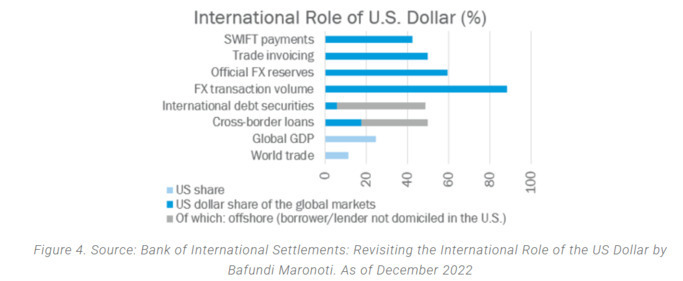
- approximately half of all debt securities and cross-border loans in global markets are denominated in USD
- the U.S. dollar dominates in its role as a vehicle currency between non-U.S. dollar currency pairs
- dollar invoicing is used in more than three-fourths of global trade (while the American economy represents just 20% of global GDP
None of these lessons are lost on China's keenest observers of global geopolitical competition, evaluating competing strengths and potential opportunities
Everyone of the U.S. dollar's foundations is exposed to purposeful competition, as the Yuan's ambitions demonstrate
With debt securities issued in Yuan, as vehicle currency between South-Asia currencies (for now..) and invoices of regional trade (and beyond...), Chinese financial infrastructure is being tested and implemented
The lack of convertibility of the Yuan into global reserve currencies may lose a measure of relevance, if (when) fragmentation of national payment systems come to fruition
If the valuation of the dollar in gold ounces is any guide, the currency's debasement has been staggering - from an official $35 an ounce in 1970 to ...$4 000 on the day of this writing
Another lesson Chinese monetary authorities might weigh...
A follow-up report set in 'monetary geopolitics' will discuss the options of the dollar, going forward