

Once upon a time, ages ago (in 2019), cannabis was the latest BIG thing, the fail-safe investment with enthusiastic consumers (presumably) and – more importantly – with financial backers going on and on about "not to be missed" opportunities
The comments we made at the time layered irony in swaths thick enough to plaster smoked-filed rooms a few times over
That was then…
A cannabis high... really ? – In July 2019, readers were reminded of the tulip mania in Holland in the 17th century and, more recently in the early 1990’s, of the wild excitement around emu farming (a bird originally from Australia)
Neither ended so well …
As the Robinhood Series – Cannabis – suggested in August 2020, ever-optimistic investors should find succor in a cannabis investment rationale by balancing their exposure to ‘pure’ cannabis and hemp growers with related businesses along the supply chain
These recommendations have stood the test of time ...
Updated to account for mergers or departures from the Cannabis industry, the selection regain relevance...
Price signals are loud and clear ...if the trend since late October holds...
For insights, test the selection over various time frames (6 months, 3 months and 1 month) on the menu at the top right
The original line-up of the theme (38 stocks) posted in July 2019 has been slimmed down to 22 firms most likely to be impacted by growing consumer demand and, no less significantly, by the slow wheels of Congressional legislation
Concentration of the industry has become an enduring factor
Firms with promising businesses have been acquired before but renewed merger activity in 2023 might signal positive ‘vibes’
In fact, the firms operating in the industry should be the best-informed insiders
- Arena Pharmaceuticals by Pfizer in 2021
- Aphria by Tilray in May 2021
- KushCo Holdings by Greenlane Holdings in September 2021
- Valens Company by SNDL Inc. In January 2023
- Hexo by Tilray in June 2023
- Zynerba Pharmaceuticals by Harmony in October 2023
Things better left unsaid
Caught up in the wave of high expectations and a bright future for cannabis, beverage and tobacco conglomerates have been trying to draw a veil over their investments in the cannabis industry ever since
Poster child of strategic wishful thinking, Constellation Brands
The strategy was supposed to put Canopy in pole position of the cannabis industry by buying market share hand over fist
Acquisitions (presumably with Constellation’s cash) proceeded as planned with the purchase of Acreage Holdings, Jetty Extracts, and Wana Brands…and Constellation would have expected to benefit directly from the growth opportunities in American markets
Despite hard lobbying, the chances to overcome federal roadblocks were disappointed times and again as losses continued to build-up – by October 2022, Constellation had enough…reducing its holding to 20.7% and taking a write-down of $1.1 billion
In a business still uncertain about its strategy to drive growth, wavering between vertical integration from farm to consumer and specialization in value-adding cannabis fabrication, Constellation has shown that opening the floodgates of cash does not do much good
The beverage conglomerate was just making advance payments at very high cost on projected growth which depended on federal regulations with little certainty…
Altria
Molson Coors
In the end, familiar fear-to-be-left-behind led major firms down markets which were still in flux and none of their familiar playbooks worked – not growth by acquisitions (Constellation and Altria) and not creation of a business (CBD sparkling for Molson Coors)
If market cap is any indication, serial acquirer Tilray comes out on top
Looking forward
It may be time for another look at the broad selection of cannabis-related stocks
Some forward-looking guidelines for investors, suggested back in 2020, remain relevant and have gained clear investor support over the past three months
- vertical integration – resting on a strong distribution network, focused on regional presence (Nevada for Planet 13
, Massachusetts-based Curaleaf or Florida for high-flying Trulieve ) before expanding nationally - focus on the medical marijuana segment - of the selection suggested in 2020, only Trulieve still concentrates on cannabis applications
; Corbus Pharmaceuticals Holdings and Arena Pharmaceuticals have been withdrawn as biotechnology firms and GW Pharmaceuticals has been acquired by Jazz Pharmaceuticals in 2021 , a biotech firm which maintains a "GW Cannabinoid Platform" - picks, shovels & finance – such as the suppliers of production equipment and consumables Scotts-Miracle Gro
, finance with Innovative Industrial Properties and marginally involved e-commerce platform Shopify Invalid tag asset
Is this time different
Hard facts are often difficult to define
Causality explaining the 30% run-up in cannabis-linked stocks over the past 3 months could be another a case of wishful seeking
A case however can still be made in anticipating a brighter future for the industry from an array of circumstantial developments
- unfailing financial support benefiting major cannabis producers such as Curaleaf (market cap $4 bn)
, Green Thumb ($3 bn) , Trulieve Cannabis ($2 bn) or Tilray ($1.7 bn) sends a message of confidence in long-term potential, as years of losses have been piling up - "picks, shovels and finance" of Cannabis-related firms has been a profitable niche for early entrants, Scotts
and Innovative Industrial - with structural changes, the industry has in all likelihood matured and M&A concentration leaves the most determined management in charge of the remaining firms
- US state legislation allows medical use in 38 states and the District of Columbia - of which 24 (and D.C.) also allow recreational use...creating growing dissonance with the FDA's federal regulatory enforcement
- uncontrollable spread of synthetic drugs just might strengthen the argument in favor of legalized and regulated cannabis use
And finally, a look at the map of state legislations published on Wikipedia draws a line between 'do's' and 'don'ts' with clear implications in an election year
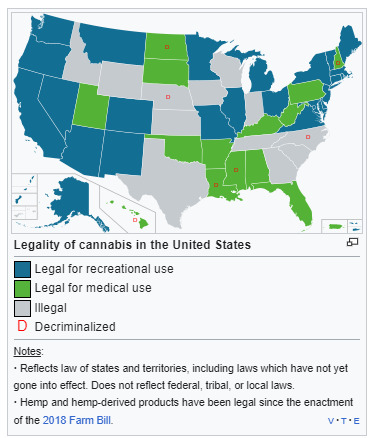
A health care policy should not be confused with political opportunism but it is...
Different times after all...early investors are betting on the next stage of liberalization