
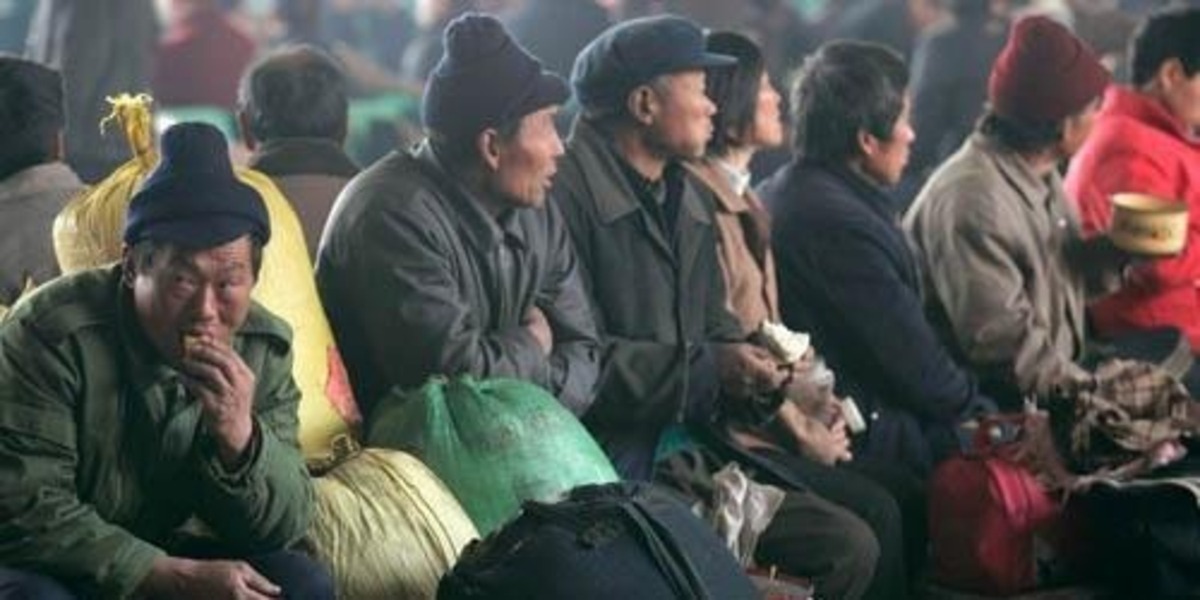
In China, hukou is the household registration system which is often presented as defining feature of the socialist command economy, implemented in January 1958 by the Chinese Communist Party to enforce strict migration control and prevent mass urbanization
Dividing urban and rural residents into two different categories, locking rural dwellers out of the cities, the system reflected the paramount concern to secure food for urban life, a policy which was undoubtedly hardened as the Great Leap Forward (1958-1962), an ill-considered policy of industrialization, caused the deadliest famine ever wrought on mankind, starving millions of Chinese people
However, it would be mistaken to link the hukou system solely to the central control of the Chinese Communist Party (CCP)
The registration system could in fact be symbolic of the continuity between the commanding heights of the CCP and regimes pre-dating its advent, stretching all the way back to the Spring and Autumn Period 770 – 481 Before the Common Era (BCE), a period which ended in partition and opened the time of "Warring States"
Dating household registration in one form or another back more than 2700 years to 685 BCE has far-reaching implications because the rural social structure in China, molded over millennia, cannot be so easily overruled as priorities change
And priorities have changed in profound ways as this note intends to highlight
Household registration according to place of birth has been recognized since the 1970's as fundamentally unfair by denying rural hukou holders access to a variety of entitlements provided to urban hukou holders by the State (specifically healthcare, education and housing)
Because the rural population had been living off the land, social services initially appeared unwarranted and the near impossibility to transfer to an urban hukou effectively locked migrants out of these benefits
Running directly counter the ideology purported by the CCP, the resulting social stratification and the lack of mobility on equal terms heightened the sense of urgency to reform, when the centrally planned economy started gradually to be dismantled
Market-oriented reforms (1978) opened the way to fast growing industrial sectors and, as corollary, expanding demand for labor
Adjustments muted by contradictory goals
A series of adjustments to the hukou system mirror the contradictory goals which constrained the central decision process
By seeking to inject flexibility encouraging rural hukou holders to seek work in the cities while remaining mindful of the financial burden of universal urban hukou social benefits, reforms were bound to be tentative
From 1978, relaxed residency requirements encouraged the exodus of hundreds of millions of rural workers without official registration
In 1984, a Notice by the State Council opened a pathway to urban hukou - in practice only in small towns, without aligning social welfare benefits and - most importantly - by requiring the farmers to forfeit their rights to farmlands, house construction lots and related villagers' rights
This cautious attempt at flexible adjustments essentially failed
Another round of reforms (1997-2001) attempted to open the door more forcefully
By setting the bar quite high for rural hukou holders "who make investments, start businesses or purchase commercial housing" and show proof of "lawful and stable residence" to allow city settlement for themselves and their families, in large and medium-sized cities, the renewed attempt ended in disappointment
As it turned out, the renewed effort at flexibility was counterproductive
- The guarantee stated by regulation "...to retain operational rights to contracted farmland and to allow farmland transfer with compensation in accordance with the law" was ignored by local authorities demanding migrants to forfeit their rights
- In lieu of lowering barriers, decentralization of the hukou administration to local governments in the 2000's created new stumbling blocks as land speculation by local governments misaligned incentives
- Ultimately, rural land holdings were the sole insurance migrants, exposed to an uncertain future in the cities, could fall back on
Not to be deterred, a third round of hukou reforms (2011) introduced still more flexibility in small- and medium-cities with city-wide 'talent programs' requiring three years of legal and stable employment, and legal housing (specifically including rentals) for urban registration
- 8.35 million new urban hukou's were registered annually but it was a success in name only
- These registrations were inflated by rural college students (who obtain urban hukou automatically), not by rural hukou's transitioning
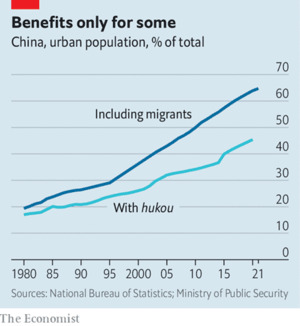
- In 2012, about 53% of the Chinese population lived in urban areas, yet only 35% were registered as urban hukou holders, that is, about 235 million migrants living in cities or townships with rural hukou
Most recently, in July 2022, what should count as the fourth round of hukou reform was announced under the banner of China’s “New-Type Urbanization Implementation Plan” in the 14th Five Year Plan
- In principle, the announcement is the most radical change of all, doing away with the hukou based on location of birth
- China will implement, first on a trial basis, a Hukou attribution system based on where the applicant commonly lives, without any threshold or restriction, and without any reference to the place where he or she was born
- With one notable exception, excluding cities with more than 5 million inhabitants (which are also the most desirable destinations for migrants), the reform upends hukou altogether, albeit on a trial basis
Tentative attempts at reforming the hukou system to dissolve the boundary between urban and rural status have been a 'work-in-progress' at best
How local governments - often astute in raising new barriers with 'point' systems and exposed to overwhelming social expenses - and how the migrants themselves will respond remains to be seen
With ingrained socio-economic headwinds and misaligned financial interests, chances to reach this ambitious goal look dim, notwithstanding the vast importance of the enterprise
On China's scale, possibly undercounted as migrants may tend to bypass city records, the magnitude of migration is immense
- Data from China’s National Bureau of Statistics estimated migrant workers at more than 290 million in 2019, accounting for more than 20% of the total population of China
Progress in hukou reform, inevitably conditional and however piecemeal, is to be applauded and its urgency remains incontrovertible
Butting heads with China's social structure, molded over millennia
Successive attempts at reform of the hukou system have failed to address shortcomings which might weigh down China's economic outperformance for decades to come
- Sensibly, farmers are intent to hold on to their rights to farmland and the 'Opinion of the State Council' guaranteeing such rights in 2014 might - or might not - stand against land speculation of enterprising local authorities
- Economic uncertainties of urban employment compound the merits of rural rights as the strongest form of insurance - and the recent COVID crisis has justified such caution many times over
Consequences for the domestic Chinese economy run in direct contradiction with global planning deepening urbanization
- With weakening demographics, a much-needed steady flow of migrant workers to support the industrial and service sectors is not guaranteed anymore
- Agricultural modernization aiming at larger farming lots will be stymied by farmer's reluctance to forfeit age-old family rights to the land
- Rebalancing GDP from foreign exports to domestic consumption, on the back of newly empowered urbanites leaving their rural frugal traditions behind, will be slower than hoped for
The dilemma facing China's leadership is profound
Efforts to address the fundamental flaws of a divide locking rural China in a second-tier society cannot be set aside
The costs of fair and equal social services for all Chinese people could, over time, exceed the financial capacity of an aging society
Transitions will be longer than expect and the Chinese middle class might turn out to be most impervious to reforms hitting their pocketbooks and valuable benefits
A challenge for the ages
In Western telling, not disavowed by Chinese authorities, rural migration is usually presented with a sense of the inevitability of economic progress
It should not be so
Behind the massive numbers reported in this note, human suffering and human resilience are scaling heights difficult to conceive in the developed economies
According to 2006 data, all sectors of the Chinese economy rely on migrants - 37% are active in manufacturing, 14% in construction, 12% in restaurants and 12% in services
- In the textile industry, 70 to 80% are migrants - in construction 80%, in chemical and mining industries 56%
- Close to 50% of migrants are women and up to 66% in global export centers such as Shenzhen
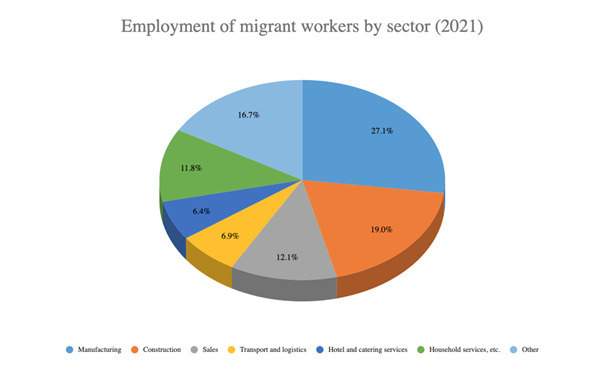
By 2022, most rural migrant workers were still employed in low-paid jobs in manufacturing, construction and an increasingly wide range of service industries
Migration has many faces, moving back and forth, between urban employment and rural seasonal work
And many activities open to migrant work remain precarious
- Low wages, when paid at all (20% paid late or partially according to China's National Statistic Bureau) - with further research signaling much worse practices
- Poor working conditions, violating Chinese Labor Law under tolerant local administrations
- Work accidents - German magazine der Spiegel (Sept. 13, 2006) reported the deaths of 100 000 people in 2005 in work-related incidents
- Lack of labor contracts - for a quarter to a third of all migrant workers - with regional observations much worse (by an order of magnitude)
- Very low level of social protection - benefiting only about a quarter of workers for a basic pension, medical insurance and work-related injury insurance
- Mediocre living conditions - close to 80% of migrants live in dormitories in very diverse conditions, from shacks to decent lodgings
Family life is paying the price
- A China Labor Bulletin ( November 2009) 'Paying the Price for Economic Development' outlined the heavy toll on the children of migrant workers
- The most recent official data available, based on the 2015 1% National Population Sample Survey conducted by the National Bureau of Statistics (NBS), put the total number of children of migrant workers that year at around 103 million or about 38% of the total number of children in China
- The psychological consequences for the parents and for their children are profound and weigh undoubtedly greatly on the current efforts of China's leadership
- In the broad setting of Educational Challenges in China, the issue will be discussed in a follow-up note
At the sharp edge of social balance in China, the gradual reform of the hukou registration system remains the nexus of conflicted interests
- National growth priorities aligning the central government and big exporting conglomerates
- Local economic expansion, an overriding priority set in the short-term by government officials eager to secure their personal advancement
- Budgetary constraints shifting the cost of social protection to local authorities, encouraging the latter's land speculation to fill the public chest
- Middle class resistance to an allocation of the economic benefits, at best unpredictable, probably unfavorable
And, for good measure, the proverbial wariness of farmers, anywhere in the world and since the beginning of times, for supposedly helpful reforms is unflappable
Well-intended planners have their work cut out...