

The world’s two largest economies, the US and China, have been trying to convince themselves that their political commitments and their geopolitical angst will somehow create novel, and separate, national realities, economically and financially unmoored
Could this be true ?
Untethering their economies from global networks, in the name of national control over supply chains, is a power play
Power plays will impact country interactions over time - dragging on with political twists and turns
Both countries, however, are confronted today by globally intertwined financial networks, unescapable, invasive and blandly assertive
In a sense, a financial system is just a framework, interconnected with other national systems, recording monetary flows in and out of one economy, mirroring the reality of GDP, imports and exports of goods and services, and corresponding financial transfer
In other words, a financial system could be defined as a ledger, objective and all-knowing, recording the strengths and the weaknesses of each economy – and their interactions
Lost in the noisy streams of over-promised policies in America, and in the equally firm commitments asserted in China, the constraints of the financial framework, both domestic and international, are blissfully discounted
Confident in the potential of their domestic markets, their respective governments may indeed feel entitled to dictate economic policies with real-world consequences for their citizens, their consumers and their respective companies
What cannot be ignored, however, is the impact on international markets, of which even these sizable economies are constituents, nor the feed-back effect on their respective domestic markets
The financial and economic timelines are for real and they are setting an agenda of their own
One who knows when he can fight, and when he cannot fight, will be victorious (the Art of War - Sun Tzu - Chapter 3 - 18)
The American and Chinese governments can disrupt but cannot ignore their mutual dependence, nor their exposure to the world
America alone ?
America’s megaphone policies aim to create a sense of inevitability, precisely because options are in fact constrained
The trade deficit – much maligned by the incoming Trump Administration – has an exact counterpart, the financial flow of foreign investments into America
The dollars spend by Americans on imported goods have to be returned to the American economy – and they are – as company investments, corporate or Treasury bonds, allocated by all those foreign dollar recipients, indifferently Chinese, Japanese, Europeans or others
It should be forthcoming that these foreign dollar allocations are important contributors – foremost in financing the American budget deficit by way of foreign ownership of U.S. bonds
Assuming the reduction of the trade deficit is achieved – which would come as a surprise – and, in an even more extreme scenario, imports and exports balance – foreign investments will fall drastically, simply because there will be no more ‘foreign’ dollars available
Budgetary shortfalls would have to rely entirely on the domestic markets, without foreign ‘fill-up’, again mechanically leaving only two options
- either reduce the budget deficit to align with available domestic finance
- or extract additional finance for public purposes (and to the detriment of private borrowers) at higher interest rates
Implications are not attractive – restoring the federal budget to health is politically improbable and would be economically impactful on growth – and rising interest rates will be equally critical in a ‘growth’ agenda, squeezing out private borrowing capacity
With a relative ‘dearth’ of dollars globally, either of these options is likely to lend strong support to the dollar
A more sensible federal budget and higher interest rates would act as a magnet - confirming the preeminence of the American economy and of the U.S. dollar
Since America’s domestic policy alternatives are decidedly unattractive, another cycle of trade deficit and budgetary deficit might just keep the show on the road
More of the same – with a few tweaks? One keen supporter of this outcome will be China because the country’ vaunted growth engines have fallen flat
China alone ?
Since Deng Xiaoping's 'Reform and Open Door' policies from 1992, China’s newish banking system has been running out of control again and again, brought back from the brink and recapitalized repeatedly...
Financed on a gigantic scale directly by the State Banks and indirectly by local banks, investment, and not domestic consumption, has been the growth driver of the economy, concentrated on solely two sectors – real estate and public infrastructure
If and when the real estate sector runs entirely out of houses to build, and infrastructure out of bridges and roads to plan, predictably, the economy would come to a halting stop
A stuttering economy, with truly dire consequences on world trade, remains improbable but what is not, in a singular convergence with Mr. Trump’s vision, is China - willfully - going it alone
Nor is the intention far-fetched for a country which has been hammering away at supply chain integration for decades, upstream, downstream and everywhere, thumbing its nose at international specialization with a tight grip on the most basic production (like Christmas decorations) as well as reputed high-end technologies
Christmas decorations are just one example, amongst many, of complete domination achieved by Chinese exporters (2017 statistics, as relevant as ever...)
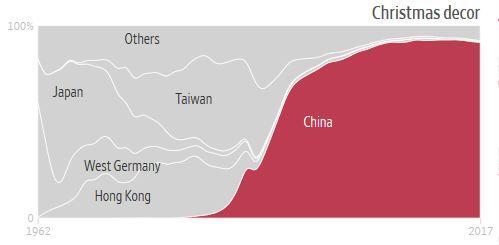
A singular aspect of China’s growth, pointed out in "Jostling for the front row", is that low tech manufacturing has not shrunk over time with the country’s technical progress
China remains a major player at every level of manufacturing, covering the full range of workers qualification and advancing with speed instead of moving upmarket
- from low-tech products (apparel, commodities) with low-wage workers
- to mid-end products (such as household goods) as the work force gained expertise and more investments were directed both domestically and internationally
- and entering ultimately high-tech manufacturing
Much has been achieved but, as the French economist Jean-Baptiste Say (1767-1832) would like to remind, for every seller of Christmas decorations and electrical cars, there has to be a buyer
And it has been shown that Chinese domestic consumption does not pull its weight
This structural misfit is the picture-perfect translation of investment-driven growth
Creating oversupply in the housing market (by debt financing of real estate promoters) and for infrastructures (by debt financing of local governments), growth targets have not been so kind to the Chinese consumers, effectively deprived of their fair share
Conceivable in economic isolation, allowing cautious rebalancing between investment and domestic consumption over time, the Chinese growth model has been torn asunder by the very globalization on which it feeds
Ripping the top-down command economy to shreds with urgency, investments have remained, as always in China, the fallback option of growth at any price
Becoming ever wilder as truly advantageous opportunities fell under the iron law of diminishing returns, pumping more cash financed by the banks in more dubious electrical vehicle manufacturing (hundreds) or silicon products (thousands), the dead end is for all to see
Gripped by deflationary pressure since the end of the Covid-era (2023), with feeble consumer recovery, China needs export markets to entice the foreign consumers its industry cannot find at home – precisely when the international demand is faltering
While presenting itself as open for trade and foreign investment, China used to maintain the firewalls isolating its financial banking system from prying eyes – risky, unwarranted lending being a familiar trope in political interference
But with collapsing real estate prices, and deeply indebted local governments, bank assets cannot afford an even more drastic reality check today....40% of bank assets are said to be linked to crisis-ridden real estate
Addiction to debt to engineer growth has been great while it lasted but the law of diminishing returns has been setting the agenda, commanding attention
Government and corporate debt in China have been growing at 2x GDP growth for years which puts even more debt growth - in the name of "economic stimulus" - off the table as totally unsustainable and ineffective
In effect, China has been stimulating its economy all the while, with less and less to show for it
A fragile financial system, anemic domestic consumption and narrow investment opportunities (focused on a few potential tech breakthroughs) appear to frame China's economic options very tightly
The challenge is weighty, reaching deep into the innards of the Chinese growth engine - upending everything, domestic consumption (weak), investment (faltering), demographics (down) and productivity itself (falling, a few rare highlights notwithstanding)
What is called for is time - and probably a lot of time on a bumpy road which may, or may not, pivot back to a most concerning distraction, a show of geopolitical muscle with unpredictable consequences
The same song sheet after all
The two economic giants share a strong preference for financial independence, under the premise of full control of their destiny
However, their options are constrained by past financial excesses - debt on both sides of the Pacific
America cannot walk away from foreign debt financing, especially if government debt growth comes to pass as announced by the new Administration - and its mirror image, trade imbalance is likely to be more resilient than politicians expect (or hope)
China, of course, is the indispensable counterpart, more urgently seeking a trade settlement than the leadership lets on, for want of better outlets where its bottomless supply chains hope to meet consumer demand
In the name of respite, to gain time in getting a grip on the debt exposure - federal budget deficits in America and pervasive debt in the Chinese banking system - and to correct the imbalance of their economies, China and America are fated to compromise...sooner rather than later
Geopolitics may still loom but, while their national interest are deeply conflicted, these most sensitive issues - Taiwan, Russia-China relations and the South-East Asia power struggle - may have to wait
Europe
It is the player left out of any ‘grand bargain’ between America and China because, on the world stage, Europe has been principled - and too rarely transactional
As will be discussed shortly, Europe pays the price of worthy geopolitical goals – human rights, climate change, fair & competitive trade, open markets –and the lack of clearly asserted priorities to buttress the interests of the European Union