

This past week’s NATO meeting in The Hague (Netherlands) - June 24-26, 2025 - turned out to be blandly predictable
The Alliance members just sang from the same old song sheet, committing to rising defense contributions (or preparing to rise soon… )
Rather than throwing ever more staggering amounts of cash unthinkingly down the money pit to sooth the ire of the American president, EU governments have to come up with a plan
Maybe it is behind closed doors that the hard questions have been asked
How collective interest will define the budgeted defense expenditures allocations – under shared standards and interconnected in a master plan
How the war on Ukraine has upended hardware priorities and military strategies
How European weapon systems can maintain (or regain?) their competitive edge globally
How standardization of weapon systems can unlock mass production based on long term financial commitments
These issues sit at the crossroads of national sovereignty, one nation at a time, of constrained budgets (supported by aging populations of tax payers), of defense ‘champions’ determined to defend their turf and of major uncertainty about the fundamentals of future clashes (in space, in cyber or on the ground)
Unknowns
The European defense industry is caught between these contradictory priorities and it would be naïve to define an action plan, while the governments remain unable to address the most sensitive ‘unknowns’
- Is a battlefield still a confrontation, framed by the geography of the Great East European Plains, flat lands so inviting for an invading army ?
- Even if this attraction remains true, as the Baltic States and Poland seem to believe, will cyber-attacks and space wars become an essential factor of military victory ?
- From the perspective of the defense industry, order books for military gear have to be framed over the long term, such as 2050, staged over intermediate commitments, to support the necessary investments - how about it ?
- Because of NATO’s deep integration of weapon systems across allies, resting on a core of advanced US technology, clarity about the long-term engagement of the US manufacturers and linkage with European defense manufacturing capacity should be foundational, is it not ?
Ultimately, military conflict might pivot to a WWI physical confrontation in muddy trenches, supported by drones, as on the front in Ukraine, or to nuclear confrontation, on the Korean DWZ or to the ‘safety’ and terror of potential mutual technological AI-driven destruction - the most decisive 'unknown' of them all....
The potency of these ‘unknowns’ is in fact known, making the news coverage of the latest NATO meeting on June 24-26, 2025 embarrassing, to say nothing about the fawning
Except for confirming the projected enhancement of defense expenditures in the near future (2035), sidestepping specified intermediate goals, and without budgets to support these commitments, ‘unknowns’ continue to be relegated to fantasy land
Presumably, the lessons of novel conflicts will be learned and the core military framework has the ability to evolve on the margins
This rational must be recognized because it is just not possible to set a peaceful nation on war footing as a ‘precautionary’ measure
Resorting to the true and tried formula, politicians, just like the military, “always prepare for yesterday’s war"
Though none of our introductory questions will be effectively answered, the complexity of the relationships between NATO allies looms large in a not-so-distant future
Weapon systems - America writ large
In budgeted defense expenditures, self-sufficiency and potential European reindustrialization is the talk of the town
Because European military operating with American gear alongside US forces will be most effective -and coordinated - the more advanced American military technologies drag European military expenditures in their slipstream
A widely commented March 2025 report of SIPRI - the Stockholm International Peace Research Institute - highlights the dependencies
- European NATO members more than trebled their arms imports between 2015-2019 and 2020-2024, with the U.S. supplying 64% of those imports in the most recent period, compared with 52% in the prior five years
- Dominance of US technology makes America the supplier of choice for advanced long-range strike capabilities like combat aircraft, with European orders for 472 combat aircraft from the U.S. by the end of 2024
- France’s Rafale, Sweden’s Gripen and the multinational Eurofighter have all lost sales to Lockheed Martin’s F-35 and Europe lacks air defense systems as proven as US-based Raytheon’s Patriot and its PAC-3 missiles
According to SIPRI's Arms Transfer Database, American strengths are in fact unevenly distributed between weapon systems if the global export orders recorded for delivery after 2014 are any guide
- Unassailable with 996 combat aircraft and 342 helicopters on order : only France offers a serious alternative in aircraft (214 on order) and no ally competes in manufacturing of helicopters (Italy has orders for just 26)
- NATO allies represent about 50% of those American exports, with orders for 472 US combat aircraft and 150 combat helicopters as of the end of 2024
- Balanced for the land-based SAM - surface to air missiles - between the US (41) and Germany (33+)
- Weak regarding major warships, with military aircraft, the most complex weapon systems, reversing the competitive advantage entirely with just 7 on order in the US vs. 29 for the UK, 26 in Germany and 22 in France
This is not all... as noted by Foreign Affairs author Celeste Wallander (July/August 2025)
"The reliability of the U.S. defense industrial base and the scale of the Pentagon’s long-term contracts offer additional incentives to use American weapons
European countries still choose U.S. military equipment over their own partly because American defense contractors, accustomed to servicing the enormous U.S. armed forces, are typically capable of providing decades’ worth of maintenance, parts, and upgrades. This reliability is one reason why European countries have inked contracts for fifth-generation F-35 aircraft despite the high prices and torturous timelines."
Whatever geopolitical considerations may prevail for a time, the American defense industry is in for the long haul and European defense will, in the short term, gain by seeking complementarity, large volume response capacity and rapid turn-around order delivery, and competitive pricing
A "down to basics" of sorts.... until the fog starts lifting on some of the hard questions regarding the future of warfare ...
European Defense - a Maze
The defense industry in Europe is not to be jested with and European exports tracked by SIPRI show enduring strengths
A focus on international export markets plays down the 'home grown' advantage of any defense manufacturer and, besides French combat aircraft, a range of weapon systems stand out
- Major warships (aircraft carriers, corvettes, destroyers, frigates and submarines) - 85 orders shared between NATO allies, dominated by Germany and France vs just 7 for the U.S.
- Tanks and fire-support vehicles - attracting slightly more orders than American firms (403 vehicles) - shared between Germany (in association with France) and Italy (512 vehicles)
- Artillery - just France and Germany manage to reach half the US exports of 678 systems
Ammunition (155mm shells), with the war in Ukraine in focus, has been revealing European defense strength and weaknesses
- Strength with Rheinmetall's real estimated annual output of 580 000 shells (vs official statements of 1.7 million) as of early 2025, with more in planning stage vs American output planned at 100 000 shells monthly by the end of 2025
- Weakness in the company's European production capacity with shortages of explosives, nitrocellulose, and modular propellant charges
- Lack of governmental engagement with limited long-term procurement agreements, and difficulties in securing manufacturing equipment
A significant player in many advanced weapon systems, European defense cannot quite discard an opportunistic and fragmented presence in international military exports
Quite sensitive to this perception, European defense has cemented cross-border strategies
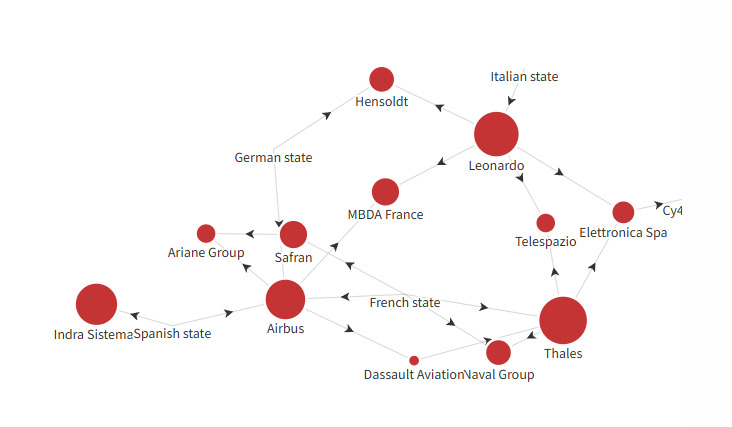
The key players in European defense are concentrated and specialized, with the German, French, Italian and Spanish states looming in the background
All the same, the maze of the joint interests and partnerships in European defense seems inward-looking, almost fortress like
Juggling with a fair number of competitors vying for defense euros, with vocal governmental interests and bound by awkward reliance on national markets as jump boards of international expansion, Europe's large defense conglomerates appear caught up in the maze
Exit routes from the maze will not be 'static', relying solely on familiar tropes, shared interests and credible product line-ups in established markets
A dynamic setting - streamlining a master plan of European defense to support the issues raised in our introductory comment - is the defining exit route of shifting possibilities in modern warfare
With the massive European defense spending, European adaptability is a matter of complementarity with the US military-industrial complex in Europe and of competitiveness on the global market
A two-pronged strategy in uncertain times
More on NATO has been published
- about "European defense industries under the gun"
- regarding Art. 5, "Pick your umbrella before it rains" and "The meaning of Art. 5"