
Governing is the art of interpreting for now, in the present, the boldly stamped expectations held for the future
In diplomacy, one country's national interest is advanced - gingerly or forcefully - amid myriads of adversarial foreign strategies, under a cloud of the unexpected
Future expectations, resetting present ambitions of global players, can only be conjectured and each country's sense of purpose is subject to drastic reality checks
This is how the Ukrainian battlefield went on to put diplomacy on notice, bringing an undreamed future into the present
War on the European theater was unthinkable... until it was not
War blending human determination and sacrifice with experimentation in advanced technologies belonged to science fiction ...until it did not
In the run-up to the war, neither the Russian aggressor nor the American advisors to the Ukrainian government were prepared conceptually to envision a quasi-standstill after four years
Ukrainian military courage, civilian resilience under extreme circumstances and Western support with intelligence, weapons and cash have been decisive in protecting the country's independence
Russia' military command has booked tactical successes by adapting on the fly to confrontations on the battlefield no one had anticipated - but strategic breakthrough it is not ...
All the parties, directly or indirectly, to the war - foremost Russia and Ukraine, but Europe, the U.S. and China as well - must prepare for a reality check
Who ultimately holds the cards to prepare for a future of contradictory expectations...
Will it be one of the national players confidently projecting power to reset the global rules ?
Or will technology itself, undercutting national ambitions, reinvent the rules of warfare ?
The features of this future have not yet emerged, carved in stone...
But all the players have to take a gamble - now
Russia's post-war period - 2026-2035
By failing to control Ukraine, Russia has not achieved its primary objective, with grave consequences for its future
A 'middling', albeit nuclear, power before the war, Russia is even more 'middling' today, with an economy in shambles, exporting basic commodities (oil and gas) with little growth prospect, a fast-aging society and a disastrous birth rate
Although unlikely, another aggression cannot be discounted to distract Russian society from domestic woes
Russia's regime has the means
- An upswing in male demography by the early- to mid-30's - 4.5 million individuals ranging from age 20 to 25 - is the outlier before gradual and then vertiginous decline, as I will discuss in the forthcoming note 'Manifest Destiny'
- A powerful weapon industry, honed by war emergencies, is the sole - and outstanding - turnaround Russian success achieved during the war, and a reversal to civilian purposes may not be forthcoming, since credit facilities and market demand have been severely curtailed for the non-military sectors of the economy
Russia's authoritarian regime may also have the motivation to break the military stalemate in the near future
When the civil society comes to recognize that the human losses, and the economic hardship, were for very little is a moment of great danger for the regime
America's distraction, America's focus
Viewed from immense distance in the American Outback, Europe is a geographical entity, prone to pathological and bloody wars for no obvious cause
Hard to appreciate in the light of Europe's 75 years of peaceful coexistence, the perception of the Continent's history as an aberration is probably shared by a substantial majority in the country
America's "isolationism", as it is understood in Europe, is the mirror image of the country's pride in its spectacular achievements, to be protected first and foremost against future messy entanglements
Old NATO sell-by date
While presented as standard bearer for democratic regimes, the NATO Alliance fitted in America's Cold War strategy as insurance policy against European discord as well as bulwark against Soviet expansionism
Insurance may or may not have been relevant but, supported by the Marshall Plan, discord faded between the flourishing and collaborative European economies
Protection against Soviet expansionism did matter in preserving democratic institutions in Europe but what - in all likelihood - mattered even more to the U.S. was a buffer zone securing the Atlantic Seaboard - and its main ports, Antwerp, Rotterdam and Bremerhaven - from Soviet assault
As the world's premier sea power, America has focused unremittingly on dominance over the oceans bordering the North American landmass, East and West, by projecting its power on the distant shores of its allies
With the risk of Russian dominance over Europe fading into irrelevance, control over the North Atlantic has shifted to a much smaller but equally weighty priority - the Greenland–Iceland–United Kingdom (GIUK) Gap
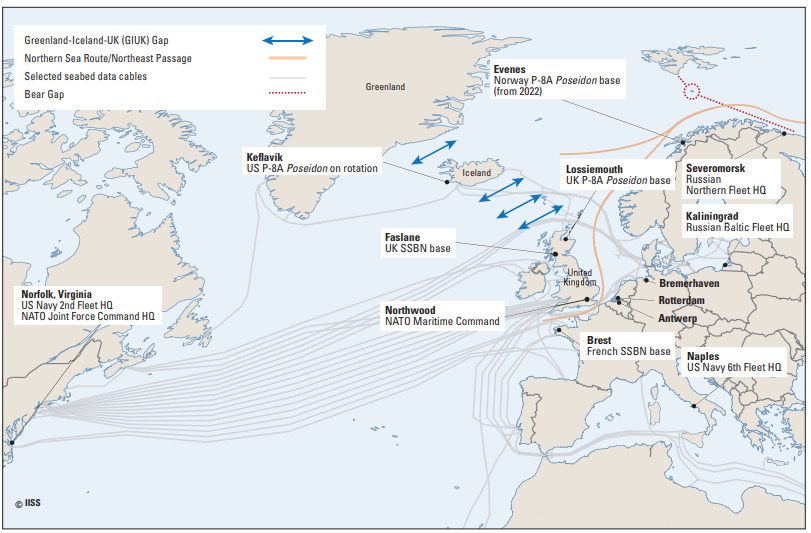
The GIUK Gap has always been the focus of military attention but with new geostrategic, geo-economic, technological and climatic developments, the Gap has become the primary focus of American defense strategies in the North Atlantic
While Greenland has been drawn into a gratuitous confrontation between allies for all the wrong reasons, security in the GIUK Gap lays the foundation of a tightly drawn Northern alliance
New NATO priorities
With the Soviet's fall and Russia's poor showing in Ukraine, NATO's original 'raison d'être' evaporated
In sorting out the future expectations for NATO, fire and brimstone American pronouncements have had their uses in separating the wheat from the chaff
Preposterous assaults on all things European are a distraction but the urgency of the underlying American expectations in anticipation of future conflicts are not
America has no interest in maintaining an outsized presence in Continental Europe where the risk of conflict is low while the risk in the Pacific Basin is high
With one exception...strong defense commitments with the U.S. between nations involved in the GIUK Gap - including Denmark and Norway - could be defined in a two-tier NATO
The non-GIUK Gap nations will be expected to negotiate a light touch American presence (intelligence, radar systems, etc.), leaving the costly projection of military strength, and the shared responsibility of operations, to the European majors, Germany and Poland on the Eastern border, France and the UK as sole nuclear powers
Because the two-tier "new NATO" aligns future expectations of the members of the Alliance and their different agendas, the restructuring I am drafting in a broad sweep would be satisfactory...and feasible
China's gamesmanship
Never let a geopolitical opportunity go to waste
China's leadership has undoubtedly concluded that its relationship with America will define world history of the XXIst Century, in peace or in war
Russia may have its use to foil coordinated European policy of which China could take a dim view
However, and more dramatically, Russia's failure to achieve its war objectives gravely degrades the country's credibility
In Russian weakness, the opportunity beckons to reopen the Unequal Treaties by which the China's Qing dynasty ceded to Russia a large swath of Outer Manchuria, setting the boundary along the Amur River and all the way down to Vladivostok
As I discussed in "Russia - Geography Lessons", the Treaty of Aigun (1858) and the Convention of Peking (1860) can only be a source of major concern in Moscow if the maps, published in China, including the areas to Chinese territory are anything to go by
In no uncertain terms, the strengths displayed by the U.S. and by China bring the near future forward into the present
Economic interdependence and opposed military interests foster major uncertainty
Between the two sovereign giants, the die is cast and the confrontation will set the world stage for the coming decades
It will also be the time for Europe to step up ....
Europe is a union of sovereign countries, significant on the global stage in unity, irrelevant in disunity, in the G-2 world of China and the U.S.
In the Russo-Ukrainian war, the potential of technological advance to redress the scales on the battlefield continues to be a dramatic reality check
Future expectations of drone warfare and robotization put military strategists on notice, to be published in an update of the August '25 note NATO - Domination of machine over men