
"...when there is a sense of reality, and no one will doubt that it has its justifications for existing, then there must also be something we can call a sense of possibility..."
Robert Musil, the Man without Qualities (1930-1943) - Part 1 'a Sort of Introduction' - Chapter 4
(translated from the German)
"Wenn es aber Wirklichkeitssinn gibt, und niemand wird bezweifeln, dass er seine Daseinsberechtigung hat, dann muss es auch etwas geben, das man Möglichkeitssinn nennen kann....
Robert Musil, der Mann ohne Eigenschaften (1930-1943) - Erstes Buch, Erster Teil, Kap.4
Geography is reality
For Russia, sprawling across the Eurasian landmass, with frontiers bordering all of the world’s sensitive regions, from Central Europe to China, by way of the Middle East, a crisis is always a heartbeat away
Upheaval, however, cuts both ways, revealing the country’s weakness in an out-of-control context, but implying opportunities
Russian security concerns could be read either way...
- as cutting-edge sensitivity to threatening developments
- as an audacious gamble to leverage risk for the country’s benefit
The Ukrainian stand-off is no different and to make sense of the Russian strategic options, the perceived threats and the potential of leverage have to be spelled out
Leverage is possibility
Threats may - or may not - gain traction and most probably, antagonism cannot dispense of a measure of control
Whatever form the confrontation may take, only clear understanding of the leverage sought by President Putin, and his true goal in the current stand-off, may signal the significance of the threat and open the way to dialogue
The bond between threat and leverage is unbreakable - the one has no meaning without the other
The threat – derived from the reality of geography – is for all to see
Threats in many shades of grey
Security on Russia’s western borders – in the precise reverse of NATO’s concern during the Cold War – center on the Great Northern Plains stretching from Germany to Poland and on the Fulda Gap – easy routes to the Russian border, across, as it happens, Byelorussia and Ukraine
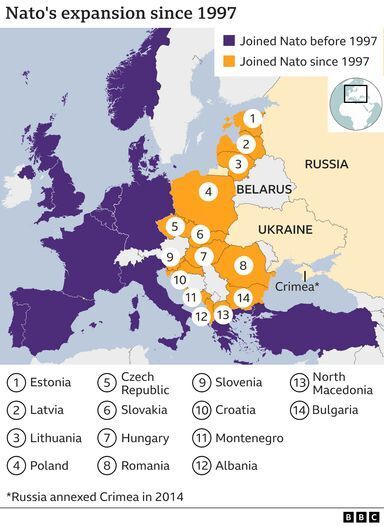
NATO’s enlargement tells the story
- Poland, Hungary, and the Czech Republic joined in 1999
- Bulgaria, Estonia, Latvia, Lithuania, Romania, Slovakia, and Slovenia joined in 2004
- Albania and Croatia in 2009
- Montenegro (2017) and North Macedonia (2020) are recent new member states
But it is hardly the entire story…
In a decade 1987-1997, a whole range of treaties addressed security issues in Europe comprehensively
- In 1987, the Intermediate-Range Nuclear Forces (INF) Treaty eliminated nuclear and conventional ground-launched ballistic and cruise missiles with ranges of 500 to 5,500 kilometers
- In 1990, the Conventional Armed Forces in Europe (CFE) Treaty reduced the size of conventional forces deployed on the European Continent
- That same year, the Vienna Document expanded transparency about weapons and military training exercises
- The 1992 Open Skies Treaty allowed reconnaissance fly-over missions to collect information on military activities
- The 1997 NATO-Russia Founding Act marked a high point in cooperation
The 1994 Budapest Memorandum on Security Assurances relating to Ukraine sent Kyiv’s nuclear weapons to Russia in exchange for promises that three nuclear powers, the Russian Federation, the United Kingdom, and the United States would respect Ukraine’s territorial integrity - France and China gave weaker individual assurances in separate documents
The relationship with Russia went downhill after 1997, under the cloud of NATO enlargement, the Irak war led by the U.S. and regime change in Georgia (2003) and Ukraine (2004)
At the Bucharest conference (2008) the aspirations to join NATO displayed by Ukraine and Georgia were ‘welcomed’ and, though the two countries were not invited, the Alliance agreed (paragraph 23 of the Declaration) that the countries will become members of NATO, involvement in the Membership Action Plan (MAP) being a 'first step'…as unambiguous as summit declarations come
Discontent inevitably led to Russian treaty violations and, just as inevitably, to American step-by-step withdrawal from its various treaty obligations, turning the Conference on Security and Cooperation in Europe (CSCE), established in Helsinki (1975) where the rapprochement was kickstarted, into a mostly empty shell
As sole remaining platform, New START (2011) limits all Russian and American deployed intercontinental-range nuclear weapons and has been extended until 2026, gaining symbolic status by keeping open lines of military dialogue...
Still... and improbably in the current stand-off, without downplaying the merits of balance in nuclear and conventional weaponry on a peaceful continent, the risks exposing the frailty of the Russian regime may not be of the military kind
Closing in on Russia’s borders, the West deploys not only – and probably not essentially – a military presence but an attractive economic and social model, obviously popular in Central Europe
…wherein lies the true threat, as perceived by Russia’s regime
Russia’s strategic purpose, to control Byelorussia and Ukraine, with a lead role in the countries' social and political future, as buffer states guaranteeing Russian institutional continuity, cannot be doubted
However, over the very long horizon required by the regime, and assuming this goal could be achieved, it remains fraught with uncertainty
Creeping Western economic and social influence has always been slippery and difficult to corner by autocracies, making the hard power of military balance all the more attractive... although a temporary fix is not a policy
Manufacturing a crisis
Leverage, to make the best of the upheaval created by the fast-evolving popular expectations in Central Europe for social and democratic reform, is effective when the counterparts – the Western democracies – end up shouldering constraints limiting their options
Energy, a vital component of Western wellbeing, fits the bill
The pivot in Russian energy policies, from strictly commercial endeavor to strategic pressure, has been unexpected because Russian energy deliveries were ironclad contractual commitments since the 1970’s
Even if immediate concerns about European energy sources are resolved in the near future, the reprieve is likely to be temporary
Russia’s president has slapped down the one – and only – card under his control, energy exports to Europe, his country’s most profitable and dominant market
With limited options to achieve his strategic purpose of control over Russia's 'near-abroad', Mr. Putin can be expected to make the best of leveraged energy deliveries – even though the policy is far from promising in the long-term
Trust of Gazprom’s commercial partners has been put in play and will not be restored
Unambiguously, energy deliveries to Europe will become unreliable and subject to the vagaries of geopolitics
Quality of energy leverage will inevitably erode over time as alternative importers to the European markets step in
With his willingness to impair Gazprom’s commercial standing, President Putin will take the economic brunt on his country’s accounts, on its balance of payments and on Gazprom’s contribution to the Federal budget
Still, Russia’s short-term outlook is likely to remain positive - substituting Russian oil and gas deliveries is hard - and with high energy prices, revenue is secure
A pivot and a calculated risk
Over the medium-term, with leverage still in place, things are bound to look very different
European importers will rebalance – at least in part - their energy supply and reduce Russia’s market share
However, more weighty anticipations may explain Mr. Putin’s about-face on European energy guarantees
- European environmental policies, moving consumption away from fossil energy, are critical to Russia’s energy exports and will impact the country’s economic and political standing in the medium-term
- Europe’s single energy market, constraining to a considerable extent Russia’s old energy policy of ‘divide & rule’ to make the most out of long-term contracts on national markets, has become a fact of life
- Europe, with its growing elderly population, shrinking industrial base and focus on service economies, will not remain the dynamic export market Russian energy providers have enjoyed since the 1970’s
In single-minded pursuit of reliable export markets, it comes as no surprise that Mr. Putin’s foresight aligns opportunistically short to medium-term leverage on European energy demand with the long-term potential of new markets, in Asia
Leaving pipeline planning to Gazprom’s powerful lobby of engineers, tolerated by the Russian president with much reservation and perhaps unwillingly, Mr. Putin has effectively reset Russian priorities in energy exports
If played out successfully, the gamble will strengthen the hand of Russia's energy sector at large, possibly at the expense of Gazprom...
The true significance of the current stand-off may be found in Europe taking a backseat to Asian markets served by way of liquid natural gas (LNG) deliveries …
…a seductive irony considering Gazprom’s stubborn faith in pipelines serving ever so profitable European markets
A sense of possibility
Never a great supporter of pipeline extensions, Mr. Putin may have anticipated that, by relying on infrastructure built at great cost, Gazprom, the provider of energy, would run out of options if – and when – buyers colluded to extract the best terms of trade
…which is of course what the European single market engineered over a decade (since the 1998 First Gas Directive and conclusively legislated in the Third Energy Package of 2007/2009)
Reasonably confident that Russia' novel strategy will bear fruit, Mr. Putin relies on Novatek, the country's largest private natural gas producer, to open the Northern Sea Route to serve Asia's vast potential, with the Russian nuclear-powered icebreakers as his beck and call....
Ambiguity is sometimes necessary and should even be called for in many settings
This is certainly the case for Russia's military deployment which may - or may not - be more than a provocation, for energy exports which may - or may not - be linked to Russia's influence in Ukraine and for the strategic pivot to Asia which may - or may not - impair European economic engagement with Russia
On balance, Mr. Putin retains first mover advantage
For how long ?
In hot and cold conflict with Russia, the U.S. and its European partners might weigh Robert Musil's exhortation
"Whoever has it [a sense of possibility], does not say, for instance: How this or that has happened, will happen, must happen, but he invents: Here this or that might, could or ought to happen. If he is told that something is the way it is, he will think: Well, it could probably just as well be otherwise"
„Wer ihn besitzt, sagt beispielsweise nicht: Hier ist dies oder das geschehen, wird geschehen, muß geschehen; sondern er erfindet: Hier könnte, sollte oder müßte geschehn; und wenn man ihm von irgend etwas erklärt, daß es so sei, wie es sei, dann denkt er: Nun, es könnte wahrscheinlich auch anders sein,,