

Driven in part by US security considerations,
...in part by domestic political calculations,
...in part by local employment priorities,
the American effort to alter the supply chains putting China at the center of global trade commingles legitimate national security concerns with down-to-earth economic interests
A recipe set-up for failure...
While international trade will very probably be reordered to some extent under American influence, the outcome may not come close to the promises held out by reluctant trade partners
The single most significant cause of failure (and there are many) is to ignore the dynamics of globalization, a muti-facetted flow of economic interactions in which entire industries - and countries - are actors as well as beneficiaries
The commanding forces of globalization
Overcoming the constraints of geography and powered by the wonders of digital communication, the drivers of international trade over the past half century set the stage for a profound transformation
Revolutionary by nature, defining the terms of trade between nations and between industries, these factors cannot be wound back easily, if at all
The early stage of globalization came about with container ship transport, an innovation which supported the emergence of competing nationally integrated supply chains
Each of the soon to be called ‘Asian tigers’ – South-Korea, Taiwan but also Hong Kong and Singapore - rode the wave of global trade on the strength of vast international salary differentials and determined national industrial strategies
Competition however did not stop at neatly defined national boundaries for very long
In globalization's 'second act', the ease of communication, brought about by the advances in Information and Communication Technology (ICT), gave new impetus to a critical factor of success, specialization and economies of scale in transnational arrangements
At every stage in the supply chains crisscrossing the world - the dual engines of ease in transportation and advanced communication established moving networks of mutual dependencies tying industries and loosening national identities
In step with the revolution in communications, technological expertise freely shared at every stage of the supply chain has brought whole industries in emerging markets up to world standards
Tightly knit just-in-time delivery protocols and quality controls have fostered a sense of responsibility and also a wave of collective expectation in new markets fully engaged in international trade
The dynamics of globalization have redrawn the import-export trade flows, alleviating physical constraints conclusively in tangled webs of supply chain intermediaries
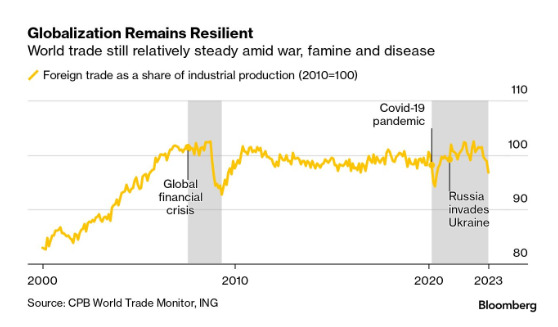
Unsurprisingly, this economic integration via cross-border commerce has shown remarkable resilience
A mixed picture
Fragmentation of global trade, under the dual push of low transportation cost and ease of communication, is a slippery reality which national policies are poorly equipped to address
Truly integrated supply chains along country borders are rare (with a notable exception - China) even though, in political discourse, they have become more useful as fictions than as hard facts on the ground
Even China's powerful exports rely to a very large extent on imports - and this is especially true of the massive volume of foreign-made semiconductors required by China's electronic industries
According to OEC, "between March 2022 and March 2023 [monthly] exports of China have increased by $40.7B (14.8%) from $275B to $316B, while imports decreased by $-3.18B (-1.38%) from $231B to $227B"
Next to crude petroleum imports ($30.4B), March 2023 imports of integrated circuits came out on top - at $30.7B - supporting the top monthly exports of China : Telephones ($16.2B), Integrated Circuits ($13.2B), Computers ($13.1B), Semiconductor Devices ($7.06B), and Electric Batteries ($6.2B)
Tentatively, with the right mix of educated work forces, attractive wages and committed capital, any enterprising business could fit in this newly fragmented trade network anywhere...
However, this is not true either - muddling the picture further....
Complex interactions between physical constraints (distance, delays and complexity in on-time interactions, cultural and educational gaps) have favored regional hubs – and are likely to continue to do so
Regional agreements linking Asian countries to China, the US to Mexico and Canada (“New NAFTA”) and the unique trade agreements of the European Single Market have become a defining feature of globalization
However, South-East Asia’s deep integration with China stands out by its size
To wit, China's March 2023 exports to the US ($43.7B) are overshadowed by exports to Hong Kong ($26.2B), Vietnam ($14.9B), South Korea ($14.8B), and Japan ($14.1B)
Conversely, China's March 2023 imports from the US ($16.1B) are lower than imports from Taiwan ($16.9B) - surpassing the US on its own - Japan ($15.2B) and South Korea ($13.9B)
No effort to rewrite the map of global trade can ignore the tight integration which sets South-East Asia (including China) on course to dominate trade with the US - and with all the developed importing countries - possibly for decades
On-shoring, a puzzle
With compelling logic, economies of scale drove disparate market places to integrate the supply chain relevant to their strengths – securely entrenched in deliverable volume (at favorable prices), flexibility and technological know-how, but dependent on the linkage up- and down-stream
At this juncture, China stands apart by virtue of its size
China's ability to scale multiple market places to global competitiveness, alternatively within its own boundaries or in closely linked regional supply chains, has become a puzzle of opportunistic bets, tactical choices and strategic options, in a trade-off between national security stakes and global trade interests
The paradox is rooted in China and the US's equally potent concerns weighing national security interests against their dependance on global trade
Global trade is an enduring bond and a win-win game neither trading partner, China or the US, is willing to forsake
National security, laid down in subjective terms by the geopolitical giants, is a zero-sum game each player remains determined to win
Central to American ambivalence and Chinese defiance is the civil-military integration of the semiconductor industry
To break the impasse, the US Administration hopes to separate the civilian segment of the industry - good for both trading partners - from the military segment which sets China on course to challenge American dominance
However, there is no certainty how boundaries can actually be set between what will be - and what will not be - available for international trade of semiconductors
Control over access to advanced semiconductor manufacturing equipment - however inconsistent with principles of global trade - is a gambit which may, or may not, reset the power balance on US terms in the short run
Whether mere tactics or true strategy, the American China policy is clearly a 'work-in-progress' putting Dutch ASML's EUV systems
How the firm, with its own supply chain of thousands of specialized firms, often critical to the manufacturing process, and the American and Asian specialists in advanced semiconductors, will manage the turmoil will be discussed in ASML, the horse and the barndoor