

The October 7, 2022 announcement by the US Administration to curtail shipments of semiconductor manufacturing equipment to China was widely anticipated by the markets since early August
Savaging the share prices of the companies directly in the line of fire, the policy acted like a wrecking ball, shaving close to 30% off share prices over 10 weeks
Recovery however was as speedy as the downfall had been spectacular, erasing stock losses entirely by the first quarter of 2023, although a softening outlook into 2024 may reverse the trend
Even if the market has no crystal ball, the logic behind downplaying the potential impact of China’s market is worth investigating
Overshadowed by their dueling statements, the strategic options of the US and China will determine in large measure the future of the global semiconductor supply chain
- China's strong commitment to gain control over semiconductor manufacturing for domestic and for exportable goods remains unbroken - but, in the light of efforts since 2014, official engagement, backed by large subsidies, has not been entirely successful
- The gamble of the U.S. Administration, and of the semiconductor industry, is to take advantage of China's relative (and unusual) failure to keep the country in a state of limited dependency, just one or two steps below American expertise
Whether the American game plan will succeed in the medium-term remains to be seen
- During the current year, and probably well into 2024 as well, Chinese manufacturing will have little choice but to abide by US export rules
- Further out, a hard push by Chinese leadership to catch-up in semiconductor manufacturing equipment to break through the bottleneck of Western and Japanese dominance appears preordained - by any means possible....
...raising even broader questions about actual possibility to duplicate some of the most complex global supply chains ever conceived on which advanced semiconductor manufacturing equipment depends
Equipment makers riding high
The recently published 2022 billing statistics of semiconductor manufacturing equipment (SEMI) highlights the dominance of the Chinese market (26% of total sales), but also the huge significance of Taiwan and the spectacular growth of investments that same year in the US (+38%) and in Europe (+94%), although from a much lower base
| Global Semiconductor Equipement Billings |
|||
| By region | Mkt Share | $ in billions 2022 | 2022/2021 |
| China | 26% | 28.27 | -5% |
| Taiwan | 25% | 26.82 | 8% |
| South Korea | 20% | 21.5 | -14% |
| North America | 10% | 10.48 | 38% |
| Japan | 8% | 8.35 | 7% |
| Europe | 6% | 6.28 | 93% |
| Others | 6% | 5.95 | 34% |
| Total | 107.64 | 5% | |
| source - SEMI - April 2023 | |||
US export controls single out the most advanced manufacturing equipment
In reality, critical machinery, notably ASML’s extreme ultraviolet (EUV) lithography system, was already out of Chinese reach since 2019, following a high level push by the US Administration
The understanding of the US export constraints has been quick to migrate from a focus on ‘losing China’ to the aim of maintaining the country in a state of dependency - reassuring Asian and Western equipment makers (and their investors) at the risk of becoming overconfident
Rather than a forceful diktat, a more subtle approach leaving the door half-open could be in the cards, complicating the Chinese response
In other terms, the manufacturing industry has concluded that China’s investments may shift to benefit domestic production over time, but that the delay may extend well into the future if imported machinery remains one step ahead of whatever domestic equipment makers can deliver
There can be no doubt China’s leadership commitment to autonomy will translate in a dual push
- Inducements for the semiconductor industry to invest in machinery made in China
- Pressure on the main manufacturers including semiconductors in their production to buy ‘made in China’ chips
On both fronts, the Asian semiconductor industry – and the Western and Japanese equipment makers – can be expected to lose some sales over time
- On the equipment manufacturing side, the impact might be blunted if the chance to import better machines – always one step ahead of domestic machinery while still below the ‘top-of-the-range’ – proves to be a powerful draw for the Chinese semiconductor industry
- Regarding semiconductors themselves, reluctance of consumer goods makers might not be any less pervasive to secure and protect export markets where wholesale adoption of Chinese chips could be less than forthcoming
The strategy might count as wishful thinking on the part of the US Administration if China’s determined push to evade the grip of foreign equipment and semiconductor makers picks up speed
Dispensing with indispensable imports
China's effort to break free from the country's giant semiconductor imports - exceeding $400 billion in 2022 and comparable in hard currency to crude oil and iron ore combined - has been ongoing since at least 2009 and the results have remained disappointing
Our 2019 notes highlighted China’s challenge and strong commitment to sidestep the barrriers
February 2019 – Integrated Circuits, a Long March - The focus on the production of the semiconductors themselves has become more intense since the 2010's - and strategic plans published from 2014 on have locked the Chinese state, the local governments and the largest private companies in close partnerships
March 2019 – China’s Silicon Hearts - The relentless effort of China's premier technological companies aims at secure semi-conductor expertise and production capacity
April 2019 - Tackling the Chinese offensive – Stirring up a hornet’s nest, from the protection of intellectual property to fair competition in China to issues of national security,
According to data from the General Administration of Customs (GACC), sourced by Chinese semiconductor site ijiwei.com, foreign semiconductor equipment dominates the Chinese industry
- China's total import and export over the past five years, valued at $164.57 billion and $15.08 billion respectively, result in a trade deficit of $149.50 billion
- In 2022 (year-on-year through November 2022), China's imports totaled $34.72 billion and exports reached $4.12 billion, setting the trade deficit at $30.6 billion
Also according data from GACC, sourced by South China Morning Post, chips (Integrated Circuits) imports & exports present a more nuanced picture
Since 2006, the rise of China's trade of integrated circuits has been proof of the sector's strategic importance
- Between 2006 and 2017, Chinese imports grew 250% and exports, starting from a very small base, reached $60 billion
- As of 2022, imports increased again, by 63% in just 5 years to reach more than $400 billion
- Exports of Chinese IC's also grew significantly from $60 billion in 2017 to $154 billion (+150%)
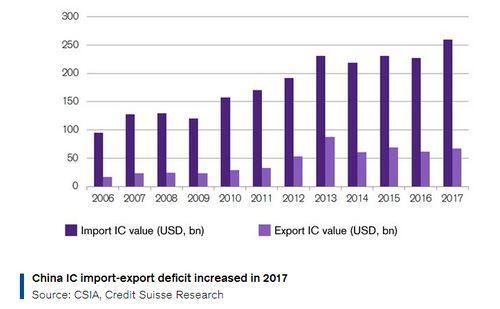
ICs remain as China's single largest import item, equivalent to its imports of crude oil and iron ore combined in 2022, according to China's customs data
- China's Integrated circuits (IC) imports, year-on-year through November 2022, amounted to US$415.6 billion
- The value of exports, slightly increased to US$153.9 billion, leaving the country with an IC trade deficit of US$ 261.7 billion
China's deficit in ICs - already high in 2017 at approx. $200 billion - actually increased more than $260 billion 5 years later
Highly dependent on foreign semiconductor imports, China's persistent vulnerability is striking in the light of multiple rounds of official subsidies since at least 2009 when the 02 Special Project aimed to "break China's dependence on imports"
Configuring supply chains, one link at a time
As far back as the 1980's, China's leadership put the development of Science and Technology (S&T) at the center of economic modernization to catch up with the West
Information technology and microelectronics were recognized as foundational to advance an ambitious agenda of digitalization deeply integrated in the real economy
Lagging in core technologies and keenly aware of their strategic vulnerability, China's top leaders opted for international openness to close the gap and build up domestic expertise
China's economic success on the world stage is an often-quoted testimony of the merits of integration in global supply chains but, on balance, the results for the semiconductor value chain are mixed
Explanations as to why Chinese ambitions in the semiconductor industry have fallen short again and again will remain debatable
However, key factors pointing to the singular nature of the supply chain raised barriers to entry over time - hurdles persisting to this day
Of unique complexity in their own right, the process steps in the value chain rely - for efficiency - on a fleeting condition for effective coordination, trust
Trust is the glue of international partnerships between specialized firms dominating key segments of the process
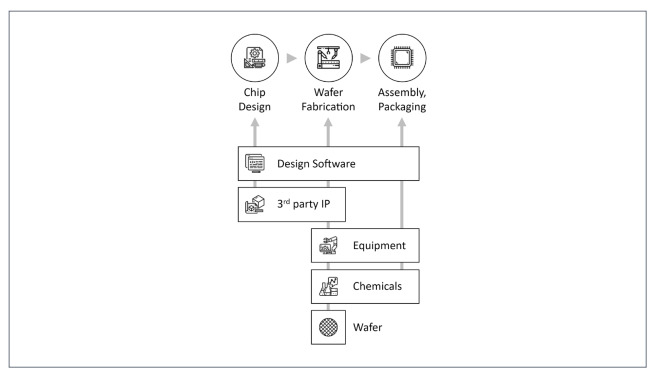
Partnerships have been an imperative - and a powerful engine - of specialization, which in turn unleashed further innovation
The dynamics of Research & Development and the immense investments required to stay ahead, define this very singular supply chain as a moving target
Hard to reconcile with 'top-down' strategic planning entities, the specialized firms collaborate up and down the chain in anticipation of the next technological breakthrough
The potential of global demand supports sizable investments of firms secure in their market reach
In context, planning by Chinese officials, focused on the three major components of the value chain, is facing two hurdles - compounding one another
- Chip design, wafer fabrication and assembly packaging are entirely distinct challenges in terms of capital invested and human expertise
- But, at the same time, innovation flows in continuous interactions across the entire value chain, making progress in any component impossible to dissociate from the others
Chip design, deriving high revenue potential from relatively low capital lay-outs, have been a governmental focus for self-reliance, supported by the large domestic market (smartphones, network communication, cloud computing, IoT...)
Seemingly never-ending technological advances in wafer fabrication have been - and remain - roadblocks, rendering whatever progress made domestically if not obsolete at least out-of-date
Assembly packaging - and testing procedures - increase in complexity in step with advanced wafer fabrications and constrain Chinese production capacity in Assembly at the higher end, denting the country's otherwise strong market position in the segment
Although out-of-date in the semiconductor universe (2018), the chart of 'China Advantage' in the IC supply chain is informative
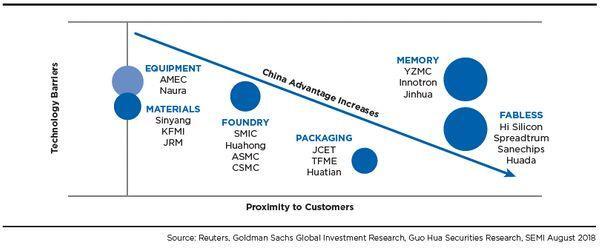
Domestic supply chains for memory chips are operational - production and exports at highly competitive prices are likely to be on a fast track
Chinese design expertise of Integrated Circuits is not disputed, but limitations in the production of high end 'logic' chips attest to the clout of top-of-range manufacturing equipment, more specifically the chokehold of EUV systems produced by ASML
Because the dual use - civilian and military - of such advanced logic chips has gained in urgency with AI applications and military priorities, Chinese authorities will concentrate on breaking the logjam by any means possible
With a sense of urgency, generous subsidies, expert knowledge nurtured domestically, know-how and intellectual property attracted from overseas, and collaboration with chip fabrication facilities (foundries) are some of the venues on which China's "Science & Technology" ecosystem will draw
Time will tell if the US regulatory push in curtailing Chinese technological proficiency is a fence or a sieve...
Prepared to double down with another volley of rules, the American Administration is conveying more doubts than confidence, as will be discussed in the forthcoming 'Reverse CFIUS - Holding the Barricades ?"