
in 350 words
Reports on the impact of tariffs on the American Economy come a dime a dozen but…
- Can tariff receipts be flaunted as 'free money' ?
- Is their impact on consumer prices the non-event celebrated by some commentators ?
Inflation, expected to creep into consumer prices, remains subdued for now
The impact of tariffs has been blunted by the relatively small share of international trade in U.S. GDP (12.5%)
With the slow diffusion of price increases throughout the supply chains, potential price increases have not run their course yet…give it a few more months
However, who will actually foot the bill ?
A certainty
The sum collected by way of tariffs, currently estimated at $400/ $500 billion a year, will be paid for
The end consumer is likely to carry a big part of the bill, such as a 2/3 share of the tariff receipts, which amounts to $270 billion /$330 billion….
…and potentially an 11% to 13% increase of individual income taxes (currently budgeted at $2.5 trillion)
…raising a sensible question : considering the cost of tariffs, levied in large part on the consumers, what is this taxation for?
The U.S. and the global economy
Country economic weights, in % of GDP and on the basis of “Purchasing Power Parity” (PPP) of the currencies, have shifted around the world, as the most populous countries, foremost China and India, fast-tracked their economic growth
In nominal terms, the U.S. accounts for approx. 27.5% share of global GDP
On PPP basis, the U.S. share is just 14.75% of the world GDP, bringing America’s major competitors in the picture
In this world, the U.S. GDP keeps growing but in relative terms, measured in buying power, giant emerging economies in Asia, China and India on the fore, grow faster and gain in share of the global economy
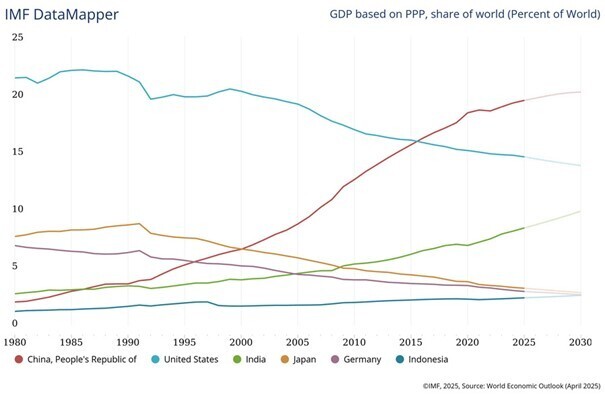
China GDP data are said to be underestimated (in PPP) but, even so, projected at 19.7% of world GDP, its economy has surpassed the U.S. in 2015
This is Mr. Trump’s world view, firing his hope to rebuild American dominance on the back of a revival in manufacturing goods
Services, never entering trade negotiations, are doing fine with a U.S. trade surplus of $267 billion (32% over imports)
Behind high tariff walls, and supported by revived consumer dynamism, Mr. Trump’s Administration puts the finishing touches to an economic renaissance, a carbon copy of….the 1980’s with a mighty industry and geopolitical dominance
In a follow-up report, Tariffs - the U.S. and the World, the attempted reversal of decades-old trends will by put under the microscope