
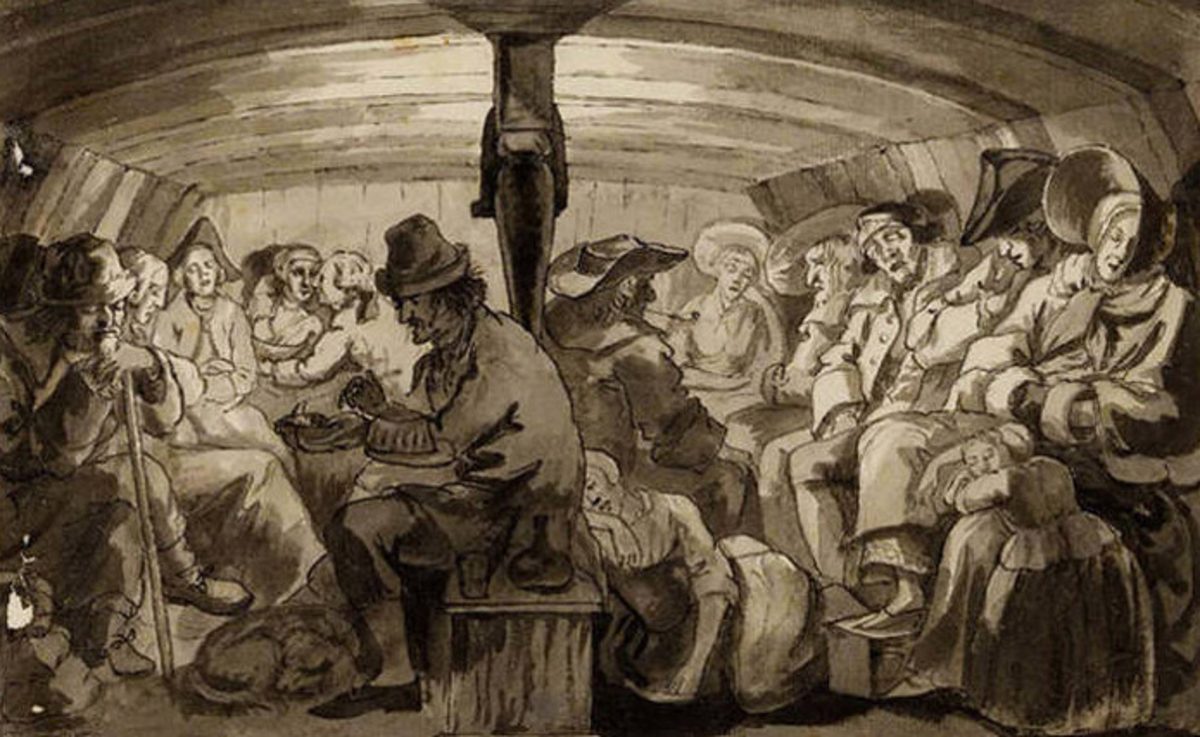
The Seventeenth Century - or at least its first 75 years - have been called 'Golden' in the Northern Netherlands for good reason
The extraordinary economic growth, the magnificence of riches and the flowering of the arts were admirable, inspiring wonder and envy across Western Europe
“Golden” indeed was the global political, economic and financial prowess of a nation of 1.5 million in 1600 which awed its much larger competitors on the world scene, England (4 to 5 million) and France (18.5 to 20 million)
As had been the case for Italian bankers dominating Northern trade in the 14th century and for the economic and political rise of Antwerp from 1450, a host of factors - both favorable and quite negative one's - interact in a thunderous tsunami ...before engineering their own fall
Rather than a vain attempt to "explain" a remarkable development and the enduring success in its stead, an understanding of the factors without which there would have been no golden age at all has its own merit
In the Dutch Golden Age, a few critical and powerful circumstances did indeed make history, as I will argue
By seizing the moment with the massive arrival of talented immigrants and by engaging in infrastructure works to facilitate their integration, the Dutch defined the means to warrant great ambitions
The engines of audacious economic expansion were well into place, up and running until the 1670's (if not longer...)
All the more compelling is the fact that these factors, familiar but hard to manage collectively, remain foundational of any great economic success in human society, even (and especially) today
Immigration - a growth engine
With immigrants fleeing intolerance and willful persecution, the major continental powers, Spain and France, unwittingly set the Dutch Provinces on track to achieve greatness
The Spanish Reconquest in the last quarter of the sixteenth century - in an effort to suppress the Dutch rebellion - forced 100 000 immigrants out of the Southern Netherlands (present day Belgium, Luxemburg, and the French departments Nord and Pas-de-Calais)
Many left for England or the Protestant German states, but the majority went to the Northern Dutch Provinces
The influx of a very large group of educated, skillful and often wealthy people, culturally quite close to their Northern brethren, has undoubtedly been a tremendous social and economic boost in the relatively small Dutch community
From 1585, with the Fall of rebellious Antwerp to the Spanish troops, and in the following decades, the Provinces were going to benefit from a steady stream of talented arrivals, an indirect consequence from the Spanish king's determination to tighten his grip
Equally consequential in the late Sixteenth Century was the second wave of approx. 200 000 refugees, French Protestants, Huguenots, who fled France after the revocation in 1685 of the Edict of Nantes, which ended religious tolerance for French Protestants and making the religion illegal
Besides departures for England and Prussia, an estimated 50 to 60 000 migrated to the Provinces - bringing their expertise in specialized trades and crafts which the French kingdom would not easily replace (if ever...), a remarkable example of self-inflicted wounds
A smaller group of immigrants of a few thousand Portuguese Sephardic Jews arrived in the first decades of the seventeenth century who, although officially Roman Catholics, had been persecuted by the Inquisition as 'conversos'
Well educated and often affluent, these families were readily accepted in Amsterdam and often took on dominant social positions, as would be the case for Spinoza's father, who became an important merchant, supported by the banking network of his father in-law
Less welcome were the 10 000 very poor Ashkenazi Jews which fled pogroms from Eastern Europe between 1635 and 1750, whose presence fostered anti-semitism in Dutch society
A telling indicator - Amsterdam's population growth
16th century religious conflicts, forcing minorities out of their homelands, defined the wave of arrivals in the Northern Dutch Provinces over a relatively short period, from late 16th through late 17th Century
However, economic opportunities in a thriving society must have been the magnet and successfully integration, diffused throughout Dutch society, had a notable impact on the country's global trade
Counting an estimated 54 000 people in 1600, Amsterdam's dramatic expansion as trading hub for European and global trade is reflected by doubling its population in 20 years, by 1622 (105 000) and reaching 175 000 by 1650
As described by intoxcatingspaces.org, the teaming city comes to life around trade in every social class
- The Amsterdam financial market and the city’s commercial infrastructure (insurance, banking, solicitors and notaries, the stock exchange, auctions, the judicial system, etc) are adapted to the needs of commerce.
- A wealthy elite of merchants, investors, and public servants control and provide regular work to a middle class of artisans and shopkeepers, and irregular work to the labouring and maritime lower classes.
- Much employment is connected to the shipping and mercantile industries: shipwrights and carpenters, sail- and mast-makers, rope-makers, coopers, dockworkers, and so on.
- Women operate a significant proportion of the public houses, lodgings, and pawnshops. They work as fences, as crimps or recruiters for the East India Company (VOC), and as prostitutes and procuresses.
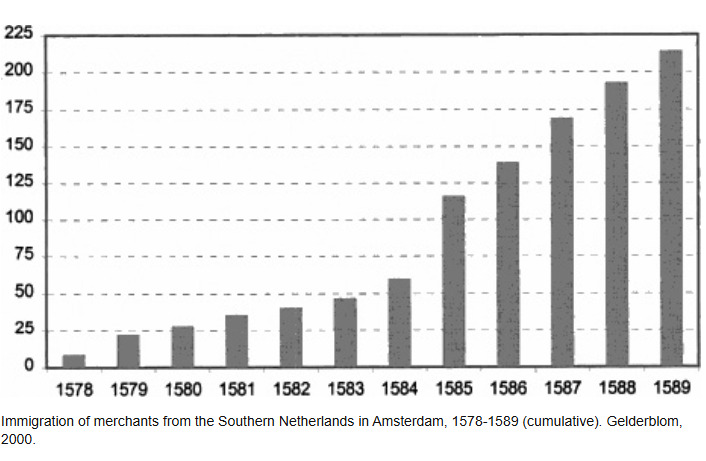
The estimated percentage of inhabitants of the Dutch Provinces born abroad - representing just 2% in 1550 - jolted to 9% in 1600, before dropping back to 5% over the seventeenth century
Urban expansion and infrastructures
Contemporary travel accounts reported with foreboding on the high number of 'strangers' in the streets and the variety of faiths, a 'Babel' of religions rather than of languages, particularly in the coastal province of Holland
In Dutch towns, demographics of 'all nations' are indeed striking, as Peter Heyleyn writes in his Comographie (1657), which was 'an attempt to describe in meticulous detail every aspect of the known world in 1652'
In the early 1600s, 40% of Amsterdam's inhabitants were foreign-born, and 55% in close-by towns of Haarlem and Leiden
Despite protests about unfair wage competition, integration of the newcomers, its magnitude notwithstanding, went smoothly, in part out of pragmatism, and even more so because of high demand for labor
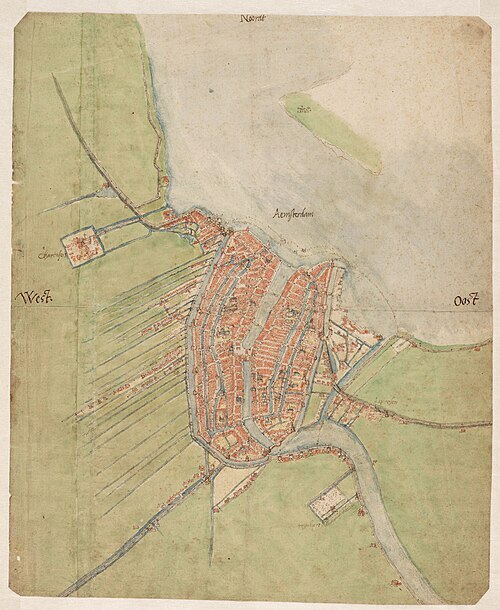
Transformation of the Dutch cities went apace, marking cityscapes to this day, witness the spectacular transformation of Amsterdam
The 1550 map, drawn by Jacop van Deventer, of the city as a well-situated regional trading center, comes across as almost naïve with the knowledge of Amsterdam's destiny, in less than a century...
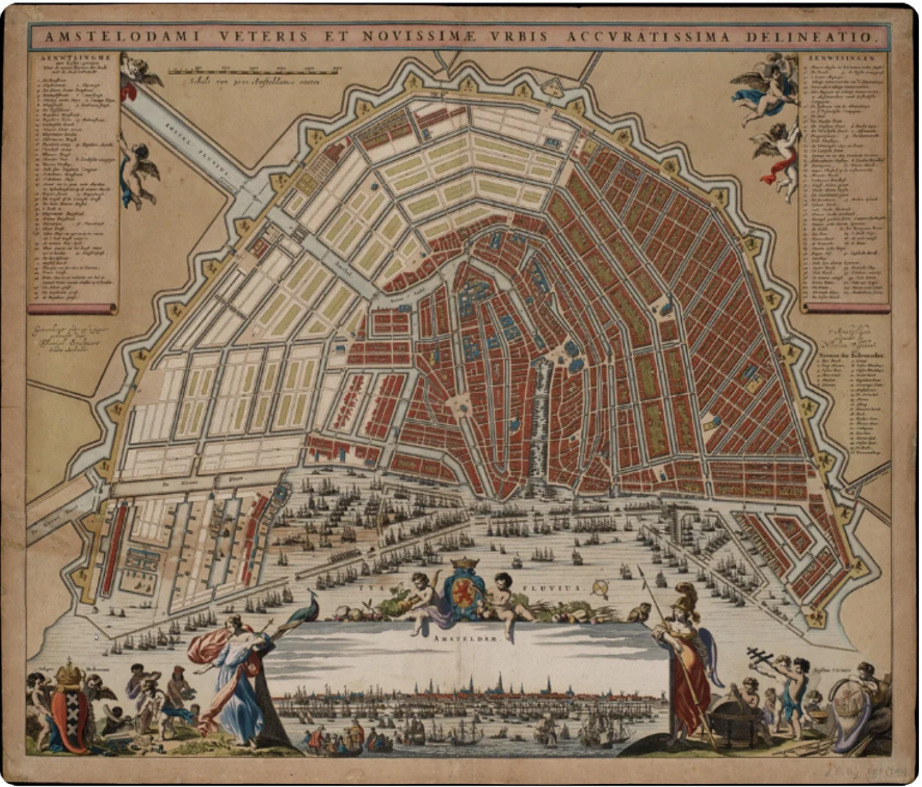
Built around the old heart of town at the end of the 16th and beginning of the 17th century, the crescent-shaped rings of manmade waterways, called Grachtengordel in Dutch, stand for Amsterdam's massive urban expansion to accommodate the giant influx of foreigners
Fortuitously, Amsterdam entrepôts (warehouses) quickly spread across the same locations with central storages for goods, enabling the city to function as a global trading hub, storing,, and re-exporting commodities
And infrastructure works did not stop at the city gates...
The network of canals underscores and contributed to the intense economic activity, spread widely across the coastal Provinces, linking the main Dutch cities along the coast
Unjustly forgotten today, and unfortunately less admired, the waterways were the preferred means of personal travel as well as for bulk transportation, connecting 39 cities and valued for punctuality and comfort, in any weather...
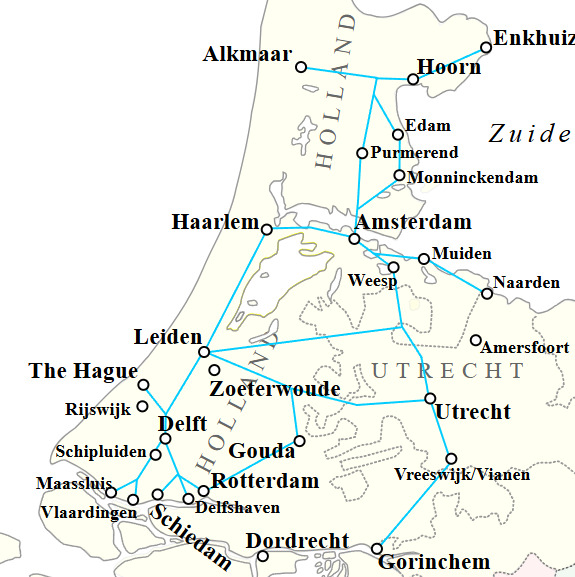
As described on the 'Essential Vermeer' site,
"During the seventeenth century, approximately 400 miles of straight canals were constructed to accommodate horse-drawn barges for passengers. The horse-drawn trekschuit (horse-drawn towboat) was so efficient that one could travel from Delft to Rotterdam in an hour and forty-five minutes, with departures every hour....
Each day there were nine canal barges running from The Hague to Leiden and back; the Delft-Leiden service (which passed by The Hague) carried 170,000 passengers annually during the 1660s...."
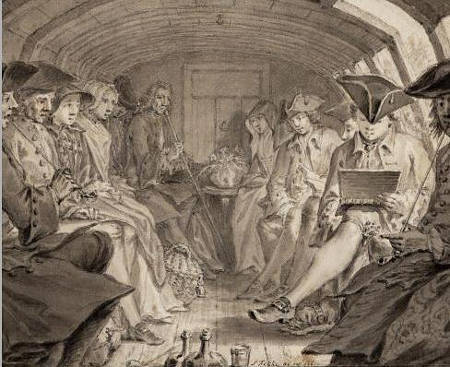
By 1760 still the same transportation, a full century after trekschuiten had come to dominate...with just different fashion statements...
The network of 'trekschuiten' for personal transport would only start closing down after 1850...rendered obsolete by steam locomotives and by steam tramways in the cities
Extended across the province of Holland as well as up north - in the provinces of Friesland and Groningen - the construction of waterways reflects the economic potential of the most populous and most advanced Provinces
"To be suitable as a towed canal, existing waterways had to be deepened and straightened. In some cases, a new canal had to be dug. A towpath was laid on one side, which needed a solid foundation.
The construction of a towed canal required extensive negotiations with owners of adjacent parcels, which often led to delays. Many owners were unhappy ..."
Intense inter-city travel in a mostly urbanized country bears the subtitle of industry specialization and volume productivity, taken together a very modern ambience in this early-capitalistic society...
Inventing a social life
More than just a response to economic necessity, infrastructure investments, housing in the cities, employment for any talent at every level of expertise, and cheap public transportation across the Provinces, were foundational in creating a public social life on (fairly) democratic terms
Bidding a pragmatic and tolerant welcome to gifted (and preferably moneyed) foreigners, the Dutch featured a society of traders, rocked by the waves and the tide of the entire world but holding firm to its compass
The Provinces, never really inclined to self-doubt, came closer to the 'land of opportunity' than the aristocracies and absolute European powers could have fathomed at the time
Many of the immigrants arriving in Holland might have preferred other destinations - from England to German States - but that is where the jobs, well-paid and abundant, could be found
The Province of Holland, the engine of the Age, was more urbanized than almost anywhere in Europe, or even the world and, more importantly, urbanization was not exclusively focused on Amsterdam
Unlike Paris or London, with large populations drawn from across France and England, leaving behind mostly backward agriculture in sparsely populated regions, Holland, especially Holland, was different
By 1700, two-thirds of the people of the Province lived in towns, an exceptional degree of urbanization, as the average for the Seven Provinces (one third urban) was already unusually large
Already in 1650, urbanization had created dense network of social and economic relations between a dozen of medium sized towns of more than 500 000 people, surpassing Paris (430 000) and London (400 000)
International trade, on the scale managed out of the Provinces, from the Baltics (grains from the Eastern Great Plains), across Southern Europe and the Mediterranean, and going global (with the East Asia Company from 1603), boosted industry and specialization
Ships were mass-produced north of Amsterdam, in de Zaan region, in turn requiring sawmills propelled by wind (1 000 mills in de Zaan alone, in its heyday) and much the same connection can be found with the grains imported from the Baltics and crushed by some of the thousands of windmills spread across the country
Construction, both private and for public purposes, followed apace, as cities expanded urban territory – the housing stock trebled in the 50 years to 1630, mostly built by carpenters and stone-masons, while architects designed the new prestigious public buildings, townhalls, weighing houses and town gates
Most spectacular, over-the-top, was the construction of a new Amsterdam townhall, by Jacob van Campen, a monumental celebration of the city’s success
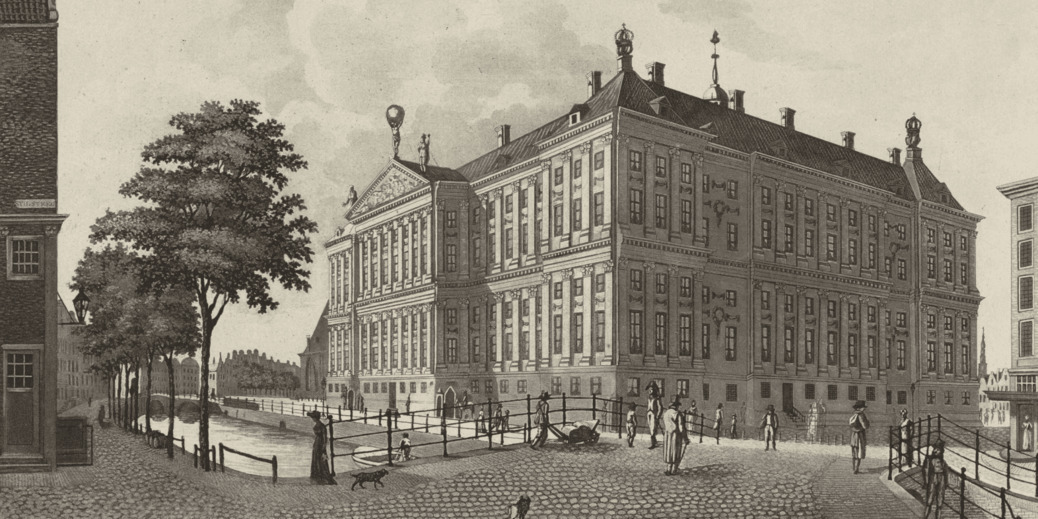
For a long time, the Town Hall of Amsterdam was one of the largest buildings in Europe. The façade is 79 meters wide and 55 meters high to the top of the tower.
A huge amount of sandstone and marble were brought in from abroad to coat the façades and interiors. Exactly 13,659 wooden poles, made from Norwegian spruce, were driven into Amsterdam’s soft ground to carry the weight of the building
Already during construction, the building was called ‘the Eighth Wonder of the World’ and the Google Arts and Culture site (including a virtual tour) does not make light of the hyperbole...
A strong State, Holland, and proudly autonomous Provinces
In this note, I described the Dutch Republic in the 1600's as a 'melting pot' avant-la-lettre, centuries before European immigrants crossed the Atlantic for a new life in America
How such a small country could welcome migrants doubling or trebling the population of their modest towns in the space of just two generations, should leave anyone with a sense of wonder
As is so often the case, Dutch society discovered an unsuspected potential in its institutions, sovereign provinces and cities holding on to their ancient privileges, in the fierce love of political freedom and in the rejection of religious persecution
Prosperity has been like a fountainhead, flowing across this densely populated Republic, urban without being centralized, distributing wealth unequally but not entirely unfairly, propelled by the dynamism of its powerful State, the Province of Holland
Holland was the undisputed source of the Provinces good fortune, generating 60% of the Republic's revenue and shouldering 90% of its debt
However, in balance with strongly-held convictions of regional autonomy, backed by the towns proud of their traditions in the other six Provinces, the economic strength of the province of Holland did not end up in centralization, but in mutual enrichment and specialization
Centralization was to come...later when the Dutch cities, buried in debt, were left with little choice in the wake of the French invasion of 1795
This institutional development was still unimaginably far in the future, when Amsterdam set its mark - and exercised pragmatic power - over the value of the currency the guilder, shared in all seven provinces which each held issuance rights
A new institution was going to lay the groundwork of would be called in a later age 'a Central Bank' - and this institution, the Wisselbank ('Exchange Bank'), will be the subject of my forthcoming note "Make the Dutch Provinces great !"