
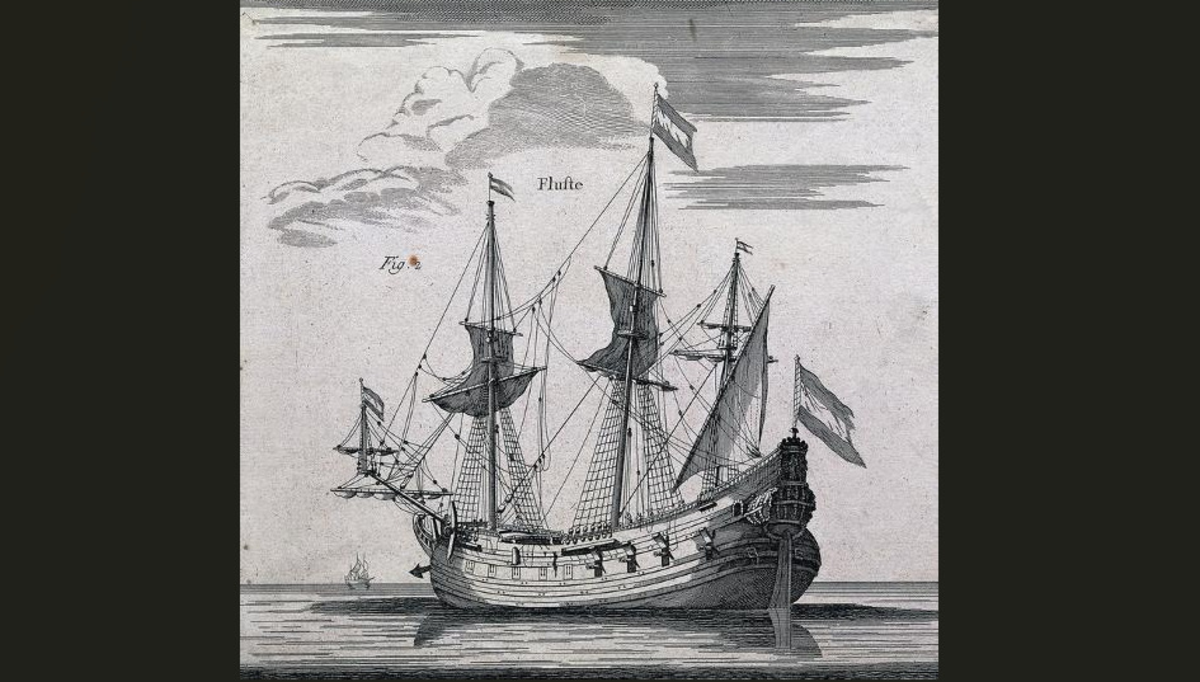
The sea was always looming behind the horizon, hostile and invasive, well before the Dutch developed a sense of collective being
The sea forged a national character grounded in technical expertise (the shipbuilding), food supply necessities (the fisheries), obduracy (confronted with wild storms and floods) and physical courage (sailing away on those flimsy contraptions), and most of all, a character grounded in a sense of opportunity born of a deep understanding of the sea's vastness
The Dutch whalers, dying far from home and laid to rest in shallow graves int the north-western Spitsbergen, with their woolen caps against the harshest cold still covering their heads, tell this story of resilience, pushing beyond the limits of the infinite sea
Interpreting history
In "Holland - the 1600's and Promises of Great Wealth", I listed the many factors on which the Dutch relied
From geography and favored trading routes to confident outlook, faith and audacity, all contributed positively to Northern Holland's spectacular expansion over less than a century, but anyone would be hard pressed to describe these assets as 'unique'
In the confusing jumble of events, opportunistic combinations may come about by sheer chance or by human choice, singled-out as rare and unique moments and often bordering potential disasters
The passage of time is not a harmonious flow of circumstances occurring in succession
Breakthroughs are like halting, tentative stutters, reframing the future in fortuitous, meandering streams
In interpreting the past, we grasp for historical timeframes, seemingly obvious with the benefit of hindsight
However, with our 'chopping and slicing' of history, we cannot pretend to hold up a 'distant mirror' of times we cannot know, of sensibilities we cannot conceive and of challenges, real or imagined, we cannot reenact
Inspired by our partial and biased understanding of the past, we do hope to draw a credible projection of our own near future, with its ruptures, pitfalls and opportunities
Breakout
Since the Late Middle Ages, shipping is one of the most dynamic sectors of the pre-industrial age in the Northern Provinces
Key to trade and human interaction, shipping evolved in small steps, over centuries, as progress in technology permitted
A breakthrough in shipping around 1550 changed everything - as a result of technological changes in the building of ships and increased efficiency of the network of shipping routes and port facilities
The resulting productivity spurt, lasting somewhat less than a century, was the driver bringing together all the potent aspects favoring the Dutch Provinces
The display of wealth from the early 1600's, the flourishing arts, the standard of living of an emerging middle class and the innovative spirit sprouting in every corner of the economy awed visitors to the Provinces and mystified England and France, Europe's largest countries
The cleanliness of the cities, the confident demeanor of the women, in their households and out on the streets, and the economic weight of a well-compensated class of traders, real estate builders and ship carpenters, seemed to be holding the middle ground between an earthly paradise and an unknown planet
Whether inspiring wonder or jealousy, the success ot the Dutch Provinces, well on the way to become the dominant global power by the 1650's, was misunderstood and for this reason, hard to imitate
What did make the difference, as I will argue, is the growth potential generated by bringing all the advantages together, by innovating in every economic activity and by reinvesting persistently and stubornly the profits derived from the businesses
By generating the momentum of a self-reinforcing flywheel, growth accelerated exponentially in the first 75 years of the century
The last article of this "Golden" series will focus on the most advanced feature of the Dutch economy, a monetary policy which offered safety and stability - a magnet bar none for international capital pouring into Amsterdam's financial market - which in turn financed the global reach of the Dutch East India Company, the undisputed behemoth of its time
In the early Medieval Age, the Vikings went unchallenged in their raids with the technological marvels of the longships, streamlined for speed and able to reverse course without turning in narrow rivers, by symmetrical design (by pointed stern and bow)
By the 15th century, caravels, and later galleons, were deep-hulled and sturdy vessels, pioneered by Spain and Portugal for intercontinental voyage and exploration
Then, the time came for the Dutch innovative shipping designs, not for raids and not (at least directly) for exploration but in unchallenged support of international trade
Without better ships and more efficient use of those capital goods, the Dutch advantages of location, of far-flung trade and of an educated population would have been left to wallow and to wilt
Shipping was the key to everything - to trade in the Baltics, to immensely profitable colonial ventures of the Dutch East india Company (VOC) and, later in the century, to whaling in inhospitable Greenland or Spitzbergen ...
Shipping would be the source of great wealth, allowing all the great strengths of the Dutch Provinces to play out to economic advantage
Trade, a sense of possiblity....
Trade has been closely intertwined for centuries with the shipbuiding technology and standardization, allowing mass manufacturing of ships
The 'most substantial' mother trade - grain from the Baltics
By the late 16th century, agriculture, the basis and originally strongest segment of the Dutch economy, could not keep up in the traditional way
With migrations from the Southern (Spanish) Netherlands by the end of the 16th and in the 17th centuries, and urbanization along the seaboard, the sector experimented with an early 'agricultural revolution'
Bulk produce was out, specialization was in
Special attention to quality animal husbandry made the Northern provinces a natural destination for cattle from Denmark and Nothern Germany - for local fattening and slaughter before re-export
Complemented by imports of staples from the Baltics, specialization (meat and dairy products, and market gardening to supply the cities with vegetables) would durably define Dutch agriculture
Furthermore, traditional grain deliveries out of the South (France and Walloon provinces) had become erratic and subject to crop failures caused by the poor weather conditions of the 'Little Ice Age'
As the trade grew in importance, grain and other Baltic products such as tar, hemp, flax, and wood supported re-exports to England, France, Spain and Portugal via Amsterdam
Windmills - to crush the grain - become a flourishing industry segment in its own right - attracting investments from well-to-do Dutchmen - peaking at 9 000 / 10 000 mills during the century
Entrepôt to the world
Positioning itself as entrepôt for international trade, cutting out the middlemen of the Hanseatic era and regulating market prices to its advantage, the necessity to feed West European populations would be a sweet spot in the early 17th Century
With multiple famines haunting France and Germany, capped by the Great Famine of 1693-1694, which in France alone killed an estimated 1.3 to 2 million people, the role of Amsterdam as staple market for Northern Europe, storing and redistributing essentials, grew exponentially
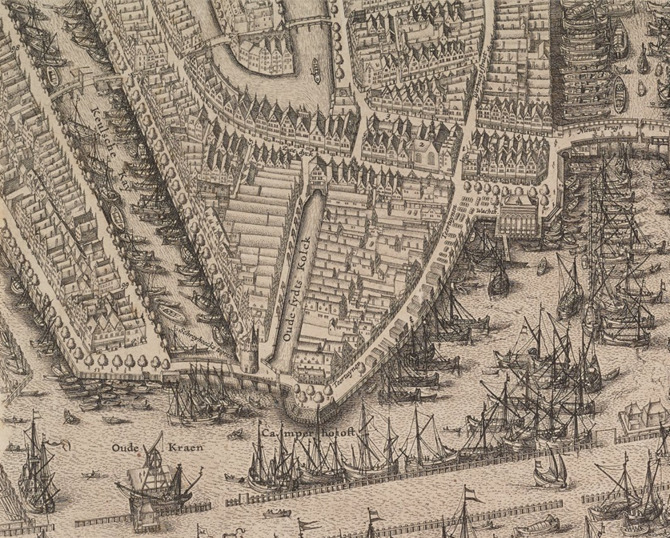
The Balthasar Florisz van Berckenrode’s map of Amsterdam (1625) shows every house and the quasi-industrial quantity of entrepôts for stockage and transshipment, located in endless rows along the canals
To balance the large trade flows in grain imports out of the Baltics as early as the 1550's, herring, already an essential staple food in the Dutch Provinces, soon became a solid export feature, in large demand
As additional balast for the ships sailing to the Baltics as well as to address local demand, the Dutch developed manufacturing industries in semi-finished products such as construction material in floor tiles, roof tiles, and bricks...
Only the decline of European population by the end of the century, remaining depressed for a few decades, alternatives to Baltic grain (such as Italian rice) and improved Western European grain crops brought an end to the 'bonanza'
The not so humble herring
Herring fisheries in the early days of the 13th Century were small-scale enterprises from Holland and Zeeland, off the Dutch and English coasts, most active in the winter months when the supply of fresh meat was lowest
The fish was delivered fresh or slightly salted in the ports to be sold directly on the local markets or to the curers
As demand grew in line with the rapid urbanization in Flanders and in Holland, the opportunity to move further North in the rich herring shoals beckoned
To facilitate longer voyages into the herring-rich North-Atlantic, along the coasts of Scotland and further North, onboard fish processing - readying the catch for export upon return to port - was 'industrialized' in the early 15th with the adaptation of existing ships into 'herring busses', floating factories with wide and flat decks for salting and packing, and large holds for nets and barrels
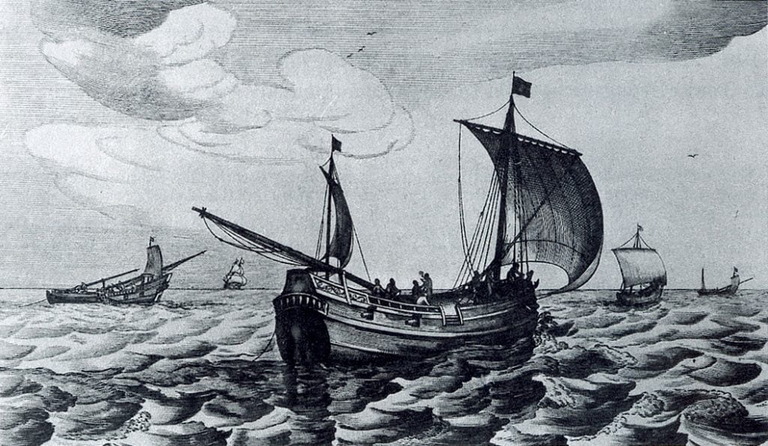
According to the Rigby's 'Herripedia' (!), generally, the 'busses' were capable of carrying up to thirty five "lasts", although some could carry considerably more. With 13,200 fish to the last, weighing approximately two tons, we’re talking a lot of herring....
At its peak, in 1620, Rigby estimates the fleet of herring busses at around 2,000 vessels working the British coastline
Over 250 years, reaching its zenith in the first half of the 17th century, the industry was said to count 500 busses on average with catches of 33,000 metric tons per year in its heyday, involving up to 20% of the population (maybe 300 000 people in fishing, processing, trade and shipbuilding)
Immensely profitable, the bus was perceived at the time to be central to the miraculous growth of Holland's economic power
The herring fisheries generated the equivalent of an estimated 30 metric tons of silver yearly by 1630 - which would amount to approx. $70 million at current silver prices and over four times as much ($350 million) in purchasing power - comparing favorably to the 140 metric tons of silver Spain extracted from the Americas
Whaling - Courage, opportunism and finance
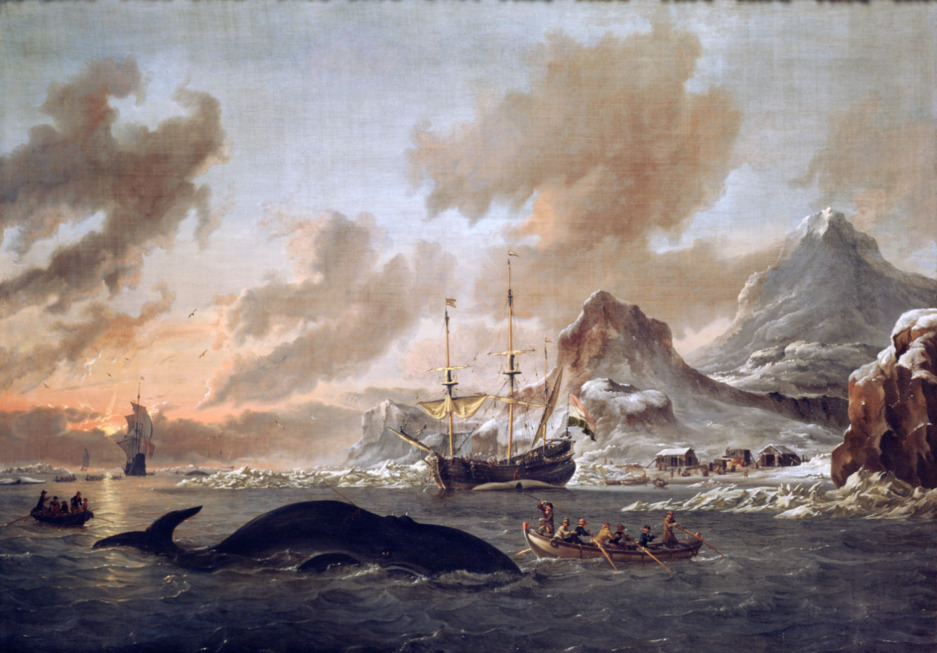
Never allowing an opportunity to lie fallow, the Dutch traders identified whales as floating treasure chests - and interference on the traditional hunting grounds of English fisheries of Spitsbergen undoubtedly was an attractive provocation of a familiar enemy
Whales had the misfortune of holding in their flanks unique - and before the petrol-driven age irreplaceable - commodities such as train oil, the primary product of the hunt - a clean-burning lamp oil - spermaceti a waxy substance ideal for high quality candles, or whale bones, a natural plastic of strong, flexible plates that some whales use to filter food from seawater (transformed by the fashion industry in corsets and stiffened collars)
In northwestern Spitsbergen, with their heydays in the 1630s, the shore stations were seasonal settlements, divided between England and Holland, of at most a few hundred men
Moving with the seasonal whaling campaigns, the stations operated as 'whale oil factories', needed to process the whale and to boil the blubber (fat) down into oil, used as lamp oil, to make soap and as lubrication
Reaching its peak between 1670 and 1750 , the number of Dutch whalers active in the Arctic was quite volatile, between 100 boats in the smallest campaigns and 300 at occasional peaks
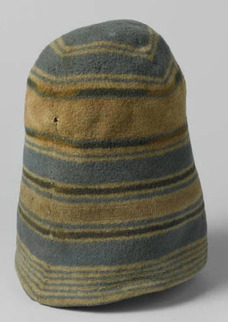
"The seamen were bundled up against the severe cold and could only be recognized by the colours and patterns of their caps. Presumably this is the reason why the caps went with them into their graves...."Source - Rijksmuseum
With crews of less than 40, industry employment rarely reached more than four thousand
Flexibility and opportunism in whale hunt campaigns may have been the norm, depending on the availability for rental of 'fluyts' - the ships specialized in bulk transport of the vast Dutch international cargo network
Financing of a campaign - covering cost of rent, crews and insurance - could be, and often was, supported by a joint venture, dividing the risky enterprise between partners, indicative of the sophistication of the Amsterdam markets by mid-17th century
Profitability, considering the risks of missing out on whales, excessively icy weather conditions and even piracy, was not exceptional at 27% and the entire industry, dragged down by poor performers, did worse (11%)
From a trader's perspective, highly valued whale-derived products could complement the sale of oilseeds (such as flax, sesame or sunflower) and fish, making sense of the enterprise
Golden wealth - A matter of scale
The opportunities to trade and the markets for fish were bound to evolve with consumer demand
In a sense, sedate affairs requiring business acumen and hard work, within anyone's grasp, the same opportunities, and the same markets, were for the taking by willful entrepreneurs in competition with the Dutch
There was no forthcoming reason why England did not manage to push the Dutch out of the herring shoals close to their coasts and did not take over the trade routes the Dutch travelled so successfully
Competition was real, but with a difference - the Dutch in the 17th Century were operating on a different and, for the age, immense scale, putting new entrants at a very profound disadvantage
In agriculture, in fisheries or in global trade, the Dutch economy thrived on - for the age - unusually deep specialization, from the shipbuilding to the milling to the Amsterdam entrepôts, all deployed by the thousands, and feeding hundreds of expanding trade flows with better and more diverse products
This flywheel of economic success is an early experiment of growth, destined to be perfected in the following centuries, by the English (19th century), by America (20th century) and by the Chinese to this day
As early 'explorers', the Dutch did benefit from a unique 'sauce' - to be discussed in my follow-up note A Golden Age - Make the Dutch Provinces Great ! prepared for publication in a few weeks