
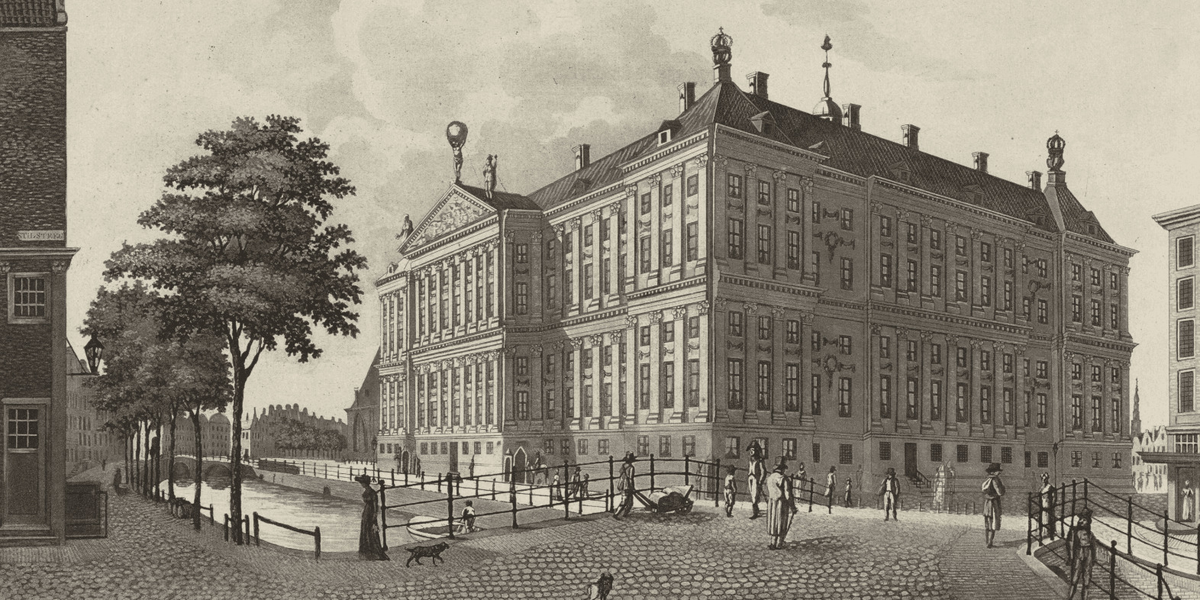
In my series about the Dutch 'Golden Age', I painted spectacular economic growth, a unique sense of commercial and industrial opportunity, and remarkable level-headed foresight in managing massive social transformations brought about by waves of immigration of unheard size and by the enrichment of the few (not the many...)
Holland - the 1600's and Promises of Great Wealth
The Dutch Provinces and the Sea
A Golden Age - Holland's Power by the Numbers
All these aspects of the Dutch early 17th Century are true
But, astride the 16th Century wars of Reformation and the deeply troubling 17th Century wars to follow (ominously entitled the Thirty Year's war 1618-1648 for want of a better title) tearing German States apart, claiming the deaths of 4.5 million (and maybe twice as much) and causing population declines up to 50% in parts of Germany, Dutch 'Gold' is truly uncomprehensible
The Dutch could not stand aside, and their involvement in wars by land and by sea laid out their stakes as emerging major Continental power
The Dutch Republic managed to hold off what would be a final reckoning for three quarters of a century, until 1672, a year called 'Rampjaar' - the year of Disaster - breaking decisively Holland's extraordinary record, an act of violence of which the Province of Holland, and the country, would not truly recover
Aloof ... and at the heart of the contest
How the Republic engineered its 'aloofness' of Continental wars lends itself to many interpretations
Rejecting ideological 'grandstanding' in the religious conflicts which roiled them in the 16th Century, the Dutch ruling classes would wisely err on the side of caution by welcoming every creed and faith in the country, a deliberate policy amongst conflicted European states
Ever pragmatic in global affairs, the commercial interests of the dominant 'Regenten' could keep military unpleasantness at arms' length by financing mercenary armies...
...at least for a (long) while, before the military command (by the Prince of Orange) would nurture temptations of a different order, taking on a life of its own
In the early 'Golden' years, around 1600, the Revolt against Spanish overlords (another 'no-name' war claiming even longer duration, the Eighty Years' War 1568-1648) may well have underscored that, going up against one of Europe's dominant and very rich powers, Spain, demanded not just armies but strong economic growth to finance the resistance
The need for stability in the midst of military turbulence to engineer economic dynamism was a paradox - and a riddle
The Regenten of Amsterdam were going to offer an answer to this riddle in - for the age - spectacular fashion, by encouraging monetary stability
The answer of the Regenten would turn out to be a most unusual financial institution, the Wisselbank or 'Bank of Exchange' - in 1609
Evolving beyond the intention of its architects, the Wisselbank will contribute to make the Dutch Province great...if only for a time
Growing relentlessly, the Dutch economy of the first 75 years of the 17th Century hacked a distinctive path through the shrubs and bone-dry stalks of European guilds and Estate Classes (ranking the Clergy, the Nobility and the Commons)
Unencumbered by feudal traditions, defining its national identity against absolutism (of the Spanish Crown or of the French 'Sun King'), the Dutch clean break with ingrained European social structures projected what would become 'modern capitalism'
Never self-agrandizing or radical, the social formula in the Provinces uncovered a way of life which remained egalitarian by nature and communitarian by spirit
Arguably, the traders, the ship- and windmill-builders of the late 16th Century were the proverbially 'right-men-in-the-right-place' with endemic and severe food shortages across Europe caused by the 'Little Ice Age', wars and epidemics (such as typhus, dysentery, and bubonic plague)
Almost uniquely in Continental Europe, the Northern Netherlands mitigated poor harvests with Amsterdam's pivotal role in international grain trade
In the European scrimmage fought between States and the contests setting city against city, to secure basic food supplies and to stay away from rummaging armies, nothing certainly came easily
The winds of (monetary) change
One force putting all European economies on the back foot, probably not well understood in its tentacular influence reaching deep into individual lives and ripping apart the relative stability of the early 1500's, was inflation
The comparison between consumer prices in Germany, France, United Kingdom and the Netherlands (1500-1700) offers a unique perspective
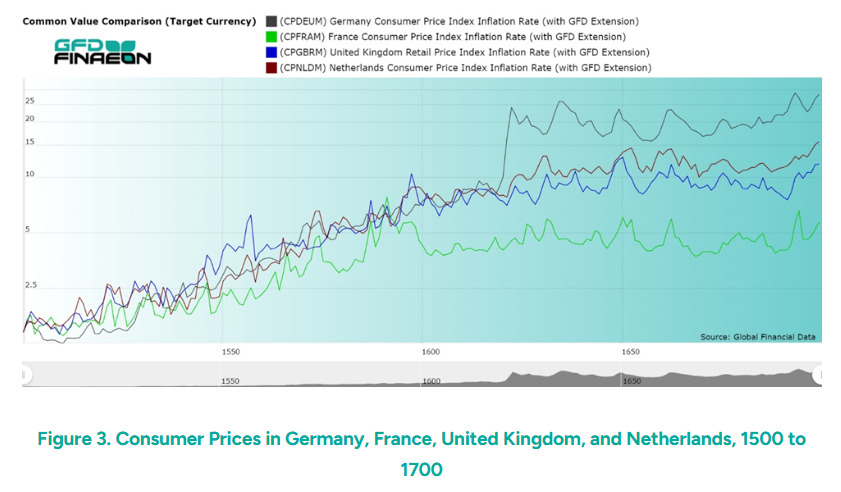
In the run-up to 1550, nothing much seems to happen and price fluctuations will reflect the dependency across Europe of annual harvests in an agricultural world
By mid-16th Century, everything changes - prices double in the space of 25 years and double again before 1600 ...and Spain's discovery of abundant silver mines is the agent bringing discomfort and opportunity
With the discovery of massive silver deposits at Potosí (Bolivia) in 1545 and Zacatecas (Mexico) in 1546, and technological advance (processing lower grade ore by mercury amalgamation), Spain's silver imports upended the European monetary systems
Massive, in the space of 50 years (the Potosi mines peaked in 1592), Spain's imports are estimated to have reached 25 000 tons by 1600
After 1600, European economies diverged - France seemingly less exposed in financial isolation for the entire 17th Century and Germany, at the other extreme, bearing the toll of the Thirty Year's War with blow-out inflation (before stabilizing at a high level with the Peace of Westphalia (1648)
Unsurprisingly, the Dutch and the English, in direct economic competition, moved in pairs...until the infamous Year of Disaster (1672) blew out the Dutch inflation
Potosi and Spain's riches had hit the European financial systems like an asteroid
Wholly unprepared to such an occurrence, many European sovereigns knew all about how to spend money (on wars, on ...Versailles) but the Dutch (and probably the English, owing to their emerging banking system) saw things in terms of capital investments
Make the Dutch Provinces great ...!
With their peculiar governance, guaranteeing wide autonomy, each of the Seven Provinces had the right to issue coinage, with the predictable consequence, confusion and unreliability
The Dutch traders had grown critical of those domestic exchange arrangements, dating back from the medieval money changers checking coins for finesse and weight, one trade at a time
A flood of dubious 'guilders', the common currency, issued independently by right in each of the Seven Provinces and 'clipped' for convenience of the issuers, made for awkward transactions, even local and between trusted parties
Sensing the potential growth of international markets and of volume trades, the 'Regenten' of the Amsterdam city council, directly involved in global trade themselves, went for transparency and credibility
This would be the premise under which the Council created the 'Bank of Exchange' (Wisselbank) as a neutral repository of value in 1609
Deposits could be withdrawn in properly weighted guilders, but soon the depositary receipts, issued by the Bank, mutated in a 'parallel' currency, especially for larger and international payments, called "bank money"
The "bank money" commanded a premium, accounting for the Wisselbank's hard guarantee in silver weight and fineness, consistently valued and transferable by bookkeeping entries
By statute, acting as repository providing security and reliability, the Wisselbank could not grant loans backed by its metal holdings, setting the Amsterdam institution apart from commercial banks (which did not exist in the Dutch Provinces at the time)
The soundness of the Wisselbank's reserve guarantee was successfully tested in 1672 by its ability to pay out cash guilders requested by receipt-holders - during the Disaster Year of invasions by the armies of France, supported by the Electorate of Cologne and by the English naval blockade
This reliability, in juncture with the emergence of the Seven Provinces as major player in trade, transformed the Bank - and Amsterdam - in a hub of global finance in the 17th Century, with international traders doing business by transferring balances to each other in 'bank money'
Credibility of the Dutch guilder would be squandered much later, by the 18th Century, as the Provinces lost their competitive edge and the Bank violated its own statutes with unsecured lending to the Dutch East India Company (VOC) and to the city of Amsterdam
Transparency and credibility
Financial transactions in an age of uncertainty hark back to traditional markers of reliability
The value of the currency, the guilder, in grams of gold and silver, over the course of the century (1600-1700) dropped by a third in gold and by just 10% in silver (a parallel with modern debasement of the U.S. dollar over just 50 years will not be attempted...)
Cash coin guilders were treated like commodities whose substance defined their worth and credibility of the Wisselbank certificates, 100% backed by the deposited metal, was incontrovertible
On a European Continent where monetary debasement financed perpetual wars and wonderful art, Dutch tight-fisted caution stood out - with Amsterdam soon to become a magnet for international finance
Credit was available to traders in the form of short-term loans, and the narrow spread between the interest on such lending and on safe public debt suggests that risk was tightly and precisely controlled
Taking place without intermediation (by deposit banks), commercial lending was reputation-based and did not exceed 6-12 months, covering deferred payments of specified commodity transactions (and repeated transactions)
Soon enough, financial innovation of the Amsterdam stock market and the oversized influence of the VOC (the massive Dutch East India Company trading company) supported a dynamic bill market, making borrowing on collateral of securities standard practice
By 1620, bills of short-term paper floated by public offices had extended the size of this market for collateral even further
The active and very liquid short-term credit market would remain dominant until early in the 20th Century
Deposit banks, which normally service financial credit over time and across sectors, did not take off and would remain largely absent in the 'revolutionary conservatism' of Dutch finance
Presumably, the tightness of spreads and the segmentation of the financial system by type of business, cut down the advantages deposit banks could have offered
With its central position in the payment system, the Wisselbank vacuumed the deposits other intermediaries could have collected, curtailing the business of deposits banks
Banking in the Dutch Republic decidedly took on the early features of investment banks, building on Amsterdam's strong trading networks and expanding into powerful financial institutions
This was so with the Clifford and the Pels families, expanding traditional trading activities into investment banking, taking off after the pivotal 'Year of Disaster' (1672), as the Wisselbank was losing its grip...
Andries Pels (1655-1731) inherited a number of warehouses ('entrepôts') from his father and expanded his trading activities and, in 1707, founded the firm Andries Pels & Sons, the largest merchant bank of the first half of the 18th century
The English-born Clifford family, successful traders in Amsterdam by 1650, became powerful bankers by the late seventeenth century
- George Clifford (1623-1680) originally from Lincolnshire (northern England) was living in Amsterdam by1634 to become a successful trader with Maryland and Barbados (the later generating more trade than all the other English colonies combined by 1660)
- His son (1657-1727) represented the Bank of England and by the early eighteenth century, his bank had the largest account at the Bank of Amsterdam, arranging loans to East European governments...
- Clifford III (1685-1760) was one of the directors of the Dutch East India Company
An accidental super-power
The internal drivers which led the Seven Provinces of the Northern Netherlands to economic dominance in Northern Europe ultimately came short in Amsterdam's flight to glory
Setting aside the uncontested global power exercised by the East India Company (VOC) in South-East Asia in the 17th Century, the Republic's influence started to flag after the military catastrophes of 1672, compounded by natural disasters at the end of the century, resulting in starvations and massive population losses...seizing up the grain export markets
Taking a very long view, the Dutch economic success and its many supporting factors had much to do with the backwardness of its export markets, deeply rooted in tradition, fragmented, poorly financed and governed by whim
The Dutch 'competitive' advantage bloomed in the fight against a much more powerful and infinitely rich opponent, Spain
As the strain of the 'Eighty Year's War' evaporated by the Treaty of Münster (1648) recognizing the sovereignty of the Republic, and with the emergence of an autocratic power, bent on military conquest, Louis XIV of France, the Republic was confronted with a new world order
The challenge - and the fight for independence from Spain - had given meaning to all the economic and financial decisions, successful beyond their proponents' dreams
By 1650, the fight for independence was won, the challenge gone, and the Republic found itself in the even more dangerous juncture of giving new meaning to a fraying social fabric, torn between extreme wealth and poverty
I believe that the pragmatism of the governing 'Regenten' could not be less prepared to address such a complex issue, after riding the wave of the Golden years
Throughout history, nations have tried to identify in a vital struggle against an opponent
With victory comes the hard part, where the Republic had to find a novel purpose within itself, by taking a long view for a shared effort - and failed...
Accidental in its achievements, the Dutch Republic would prove to be haphazard - and accidental - in its hope to maintain its super-power status
If such a conundrum sounds familiar...it is
And today's global hegemon, the U.S. is struggling in its attempt to define a new challenge from within the country, after victory in the Cold War