

The Japanese currency has been in pivotal position to provide the liquidity funding global finance
Two reasons drove this special, unusual, position for decades
The country holds one of the world's largest pools of household savings, estimated at around $14 trillion in financial assets, with a significant portion (over 50%) traditionally kept in low-yield cash and deposits, confident in the record of past deflation
Interest rates have been near zero since the early 2000’s and formally set in negative territory at -0.1% between 2016 and 2024 to stimulate the economy
To hold steady, the conjuncture of high savings and very low interest rates assumed implicitly very low inflation (even deflation as between mid-2020 and mid-2021) and a stable yen
An equilibrium between subdued inflation and household savings growing reliably could be achieved for a long time …. but this balancing act is getting strained
A new era beckons with the Bank of Japan's decision, last Friday December 19, 2025, to increase its benchmark interest by 0.25% to 0.75%
Seemingly a very small step, in fact a sea-change for Japanese domestic and, even more significantly, for global financial markets
A hope for Japan and a huge gamble for the global financial liquidity, as I explain
The mammoth Government debt (263% of GDP) stems from decades of persistent fiscal deficits and near-zero economic growth, linked to repeated stimulus programs and the highly unfavorable demographics of a fast-aging society
With a large measure of control over the bond yield curve, the Bank of Japan (BoJ), owning more than 50% of the bond market, kept a lid on bond yields as interest expenses would have had the potential to bankrupt the budget
Simulus did not spill over in inflation because Japanese households did not consume at scale but added more savings to savings (money velocity fell accordingly by 29% since 2000)
Growing household savings became an unfailing source of low-interest liquidity on the global financial markets
Inflation anticipations took time to feed through but all is not well...
Prolonged economic stagnation, low productivity and weak growth were compounded by the massive capital outflows swamping financial markets with a supply of yen, putting downward pressure on the yen's value.
The weakening of the yen in U.S. dollars, over the past 15 years, in turn pressed inflation anticipations upward by driving prices of energy and basic materials, imports essential to Japan’s industrial supply chains
- Since 2010, the yen lost 40% of its value (from 93 yen to the $ in 2010 to 155 yen in 2025)
- Since Jan. 2022, the annual inflation rate went from 0.5% to 3%
This cannot go on and something (everything) has to break…
A challenge for Japan
Savers cannot be blinded forever to the slow melting of their nest egg (down 3% annually?)
Nor can the Japanese Treasury assume that cheap borrowing in support of the largest debt load in the world remains a fixture
Every party in this merry-go-around has to prepare for a reset
The BoJ has raised its short-term policy to 0.75% (from 0.5%) last week (December 19, 2025) which still leaves real rates (accounting for inflation) in negative territory but is a sea-change moment all the same
The government must be prepared to pay much higher rates – while interest and debt redemption already swallow 24% of total budgetary expenditures at those past low-low rates -what if rates double or triple?
- Every 1% increase in yield increase implies an additional cost of $26 billion
Inflation at consumer level, with staples such as rice up 23% from a year earlier, stokes discontent and has to be brought back under control
The new government led by Prime Minister Sanae Takaichi introduced a spending program of $118 billion (¥ 18.3 trillion) with subsidies for electricity and gas bills as well as cash handouts for households with children
Hope springs eternal...but a targeted equilibrium between the economic drivers is hardly secure
- Will the stimulus, weighing approx. 15% of the original budget, support growth and productivity?
- Is new debt issuance, limited at 60% of the stimulus package, as promised, reassuring bond markets?
- Will the upward inflationary trend stabilize around 3%?
Out of these three factors, only inflation is likely to stabilize...
- Artificial intelligence will weigh on service inflation
- Chinese overcapacity will bring the prices of Japanese industrial imports down
- Stimulus is likely, once again, to feed household savings, and not consumption
Weak equilibrium on the domestic Japanese market is the most probable outcome
The global economy would just move on, if Japan had expanded in isolation, with little concession to the outside world
The opposite is true
A challenge for the global financial markets
Japanese savings may not have done as much for domestic markets as hoped
However, global markets have relied on the yen-based markets, and on Japanese savings, to access cheap capital and Japanese financial institutions (banks and insurance) have invested their available deposits in foreign markets for higher return
Foreign yen-borrowers and Japanese investors on foreign markets have been impacting the Japanese currency in the same way, selling yens (borrowed or owned) and buying international assets – and driving the yen exchange rate down
All of which would be incidental if the actual numbers were not huge – and they are
Carry-trade ($1 to $2 trillion - BIS estimates)
Borrowing in favorable terms on the Japanese market to invest the leveraged proceeds in the U.S. and elsewhere is based on rate differentials (after discounting the cost of hedging the currency)
Mostly the precinct of hedge funds, carry-trades are large and especially volatile: tiny rate shifts may expose leveraged funds to substantial margin calls overnight
The exact size of the Japanese yen carry trade is difficult to measure, within range estimates between $1 trillion and $2 trillion
Insurance companies and banks ($3.5 trillion)
Committed over longer timeframes, the institutional investors are critical allocators, purchasing foreign governments bonds and investing in private businesses (stocks and CLOs)
Of special relevance are purchases of U.S. Treasuries, of which Japan has been consistently the largest foreign holder - $1.2 trillion (October 2025) – compared to China’s holdings of $688 billion
Among private business investments, CLO’s (collateralized loan obligations) stand out because businesses across the developed world have come to rely on Japanese facilities
- CLO’s are securities backed by a pool of loans taken out by firms with high levels of debt and typically a non-investment grade credit rating
Actual volume remains unknown with estimates assigning 20% of the global CLO market to Japanese investors.
Estimated at $1.3 trillion in total (Bank of America Research, December 31, 2024), with US CLO’s accounting for $930 billion, Japanese investors are allocating approx. $260 billion
An era of rising interest rates
Rising yield of the 30-year Japanese bond yields – from 0.52% (January 2022) to 3.35% (December 2025) – upend future allocations by Japanese financial institutions, with a reversal of investment streams to domestic markets
Large entities such as pension funds will not act overnight, but withdrawals from large holdings such as U.S. Treasuries ($1.2 trillion) are probably a certainty, as the spread (with US 30-year yields at 4.8%) evaporates after accounting for hedging costs
In similar fashion, but potentially very quickly because of inbred volatility, carry-trades are sensitive to yields over shorter maturities
- 6-months bill yields more than doubled over 12 months to 0.695%
- 1-month bond yield almost tripled in January 2025 to 0.35%, rising to 0.51% by year end
Although still attractive with growing carry-trades through 2025, volatility, linked to the amount of leverage used by borrowers, creates an additional element of uncertainty
The magnitude of those reversals reverberates in the huge sucking sound of liquidity leaving the global financial markets
- A 50% quick withdrawal of carry-trades could represent a $500-750 billion drawn out of the world stock and bond markets
- A 50 to 70% slow reversal in the foreign investments by Japanese institutions would weigh $1.75-2.5 trillion
Liquidity vanishes on an immense scale because the flood of cheap credit is no more
The tentative Japanese financial equilibrium becomes a global issue
A small question of control
The conundrum facing the Bank of Japan and the Japanese Treasury is existential
How to maintain the equilibrium under changing financial circumstances and escape the vortex of capital flight
With carefully managed rate increases by the BoJ - pre-announced and modest (with regard to actual inflation) - Japan's economy might hope to muddle through
- Selling part of the substantial BoJ bond holdings back into the market to meet institutional demand, to dampen the budgetary cost of interest yield
- Keeping the yen exchange rate stable around 150 to the dollar
Control over the domestic financial market forces - framing stability - seems within reach, during the all-important transition period ...
Stability of global financial markets, however, is not pre-ordained
In overleveraged markets, accustomed to mostly free credit, the withdrawal of liquidity at scale could be devastating
With Nvidia
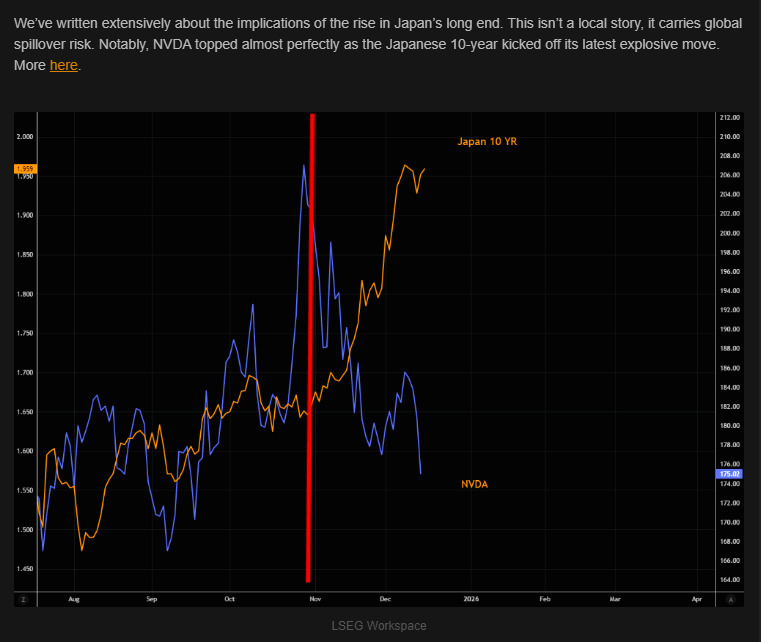
On markets where Japanese investments have been reliably available, foremost in U.S. Treasuries with $1.2 trillion invested as of October (on a total Treaury debt market of $30 trillion), their market share might be difficult to replace
With the avowed aim to keep interest expenditures down, the Federal Reserve might have no other option than to monetize part of U.S. debt to balance Japanese slow withdrawals and $2 trillion new US debt
The bridges and transfer mechanisms maintained by the U.S. monetary authorities to assert the dollar's power on global markets will be discussed shortly on Pininvest....
Concluding remarks
What to conclude of my premise that Japan's monetary and budgetary approach will succeed ?
Success may be modest but runaway capital flight does not seem to be on the cards, in my opinion
- both the Nikkei and the yen are expected to strengthen, after some turbulence
- Mr. Buffet's Berkshire foresight with investments in the Japanese trading houses is more relevant than ever, as I discussed in August '23
- With the carry trade reversal - to reimburse loans in yen - U.S. dollar-based assets must be sold and the dollar will be impacted negatively - the magnitude of the shift remains unknown
- Japanese financial institutions (banks and insurance cies) are likely to sell part of their U.S. dollar-priced assets (foremost U.S. Treasuries and stocks) - a trend to be monitored closely