

The current status of the yuan as 'managed' currency has been a roaring success, on China's terms
Around 30% of China's $6.2 trillion global trade in goods has been settled in yuan in 2025
After including bond purchases and foreign investment, the yuan’s share increases to 53%, overtaking China's U.S. dollar trade
However, in global trade finance and as a share of global currency reserves, the yuan's share remains small - 5.8% and 2.4% respectively - reflecting the firm grip of the monetary authorities on capital flows
To this day, the exchange rate of the yuan has stayed under control
The conviction that 'finance' needs to be 'the slave' and not "the master' of the real economy has been the modus operandi of China's domestic credit system
Strict government capital controls prevent free exchange of the yuan for foreign currency and trade, especially on the capital account, limiting capital outflows
The currency policy was deemed by China to be beneficial in the long run, insulating the financial system from global shocks and shielding exports from international capital flows which could pressure the exchange rate
In this context, President Xi Jinping’s comments, published in the Chinese Communist Party’s theoretical journal Qiushi in early 2026, calling for the yuan to become a global reserve currency, is a break with the past
By upending the regime of currency management, the Chinese president signals the currency's ambition in international investment and foreign exchange markets, on par with China's weight in global trade
The reversal from 'inconvertibility' to convertible reserve currency will probably be framed under specific conditions of exchangeability and usability, possibly contained within a region (such as South-East Asia)
However, there is no turning back
The strategic shift announced by the Chinese President highlights global ambitions as well as novel confidence in the yuan's lead role in the international monetary system, buttressed by its dominance over trade
Geopolitical opportunity may have prodded President Xi to seize the moment proactively, in gamesmanship countering the influence of the U.S. dollar
In the monetary dimension, I will argue that China's industrial power, and its surplus trade with the world, have become too immense to remain aloof of global financial markets
China - however reluctantly - is already part of this global market by virtue of its trade surplus - $1.2 trillion in 2025 - which is not being on-shored to the Chinese banking system (and into the central bank's foreign exchange reserves)
Perhaps 85% of the 2025 surplus is held in overseas accounts by State banks and by private Chinese entities, implying considerable sway with investments in foreign assets (including US stocks and European bonds) reaching $7.8 trillion to date
In terms of 'hard cash', it is not possible to project how holdings of such magnitude will unwind - with additional trillions of surplus dollars (and euros) projected for years to come
Preparing the stage for this high-stakes play, transition to a 'format' of convertibility will be consequential for the Chinese monetary system, racked by 'financialization' behind high walls and closed borders...
...but by financialization all the same
This is what this note will try to describe
Riding the Chinese bandwagon of M2
Out of context, it is hard to interpret the continuous rise of money supply (M2) in the Chinese economy but its implications cannot be ignored
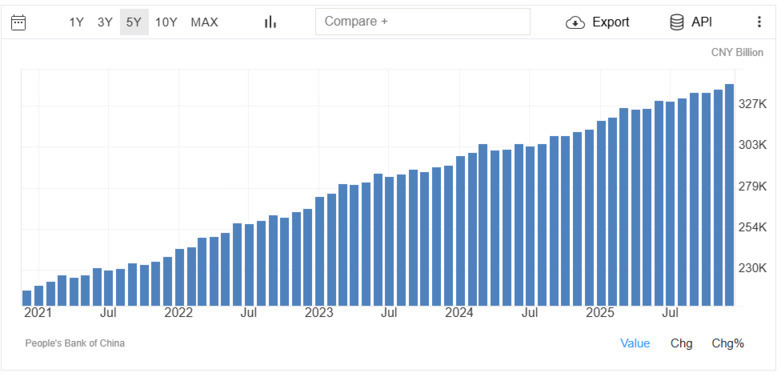
Broad money supply in China will top $50 trillion within the next few months and exceeds the combined money supply of the U.S. and the European Union, both at approx. $23 trillion
In consumer-oriented economies, massive increases in money supply will translate in price inflation as more cash chases a limited amount of goods
This has not yet been the case in China where domestic consumption represents less than 40% of GDP, compared to a U.S. consumer share of 69%
Inflation at consumer level remained subdued, even feeding into deflationary pressure in 2024-2025
High personal savings deposited on bank accounts, compensated at low interest rates, have facilitated new bank loans, fueling the cycle of debt and M2 growth
New loans initiated by the banking system — particularly those funding infrastructure and property in local governments — create additional deposits, thereby increasing M2 money supply in successive iterations
All was well, as long as the demand for domestic credit kept soaring...
Investment in real estate used to be the main gateway to allocate savings, supplemented by personal loans, but this growth engine has sputtered, grinding to a brutal halt with bankruptcies across the property sector, with no end in sight
Financialization at work
The M2-to-GDP ratio (approx. 266%) in China is extremely high, compared to the U.S. ratio (81%), and public debt (exceeding 160%, after including local government debt) is towering vs. U.S. public debt (120%)
Spinning as a transmission belt to ensure economic growth, M2 money supply appears to be slipping
With dwindling investment opportunities, allocation of China’s loans has become inefficient: accumulated at a year-on-year rate of 8.5% in 2025, M2 did not generate growth, tagged at just 5% year-on-year
The data, provided by the Chinese government, may, or may not, mirror economic facts and GDP growth – aligned with a mandated government target around 5% over the past years – has been disputed repeatedly
Lower true GDP growth would push the ratio of debt-to-GDP into the stratosphere, with even less debt efficiency to economic growth
Chinese monetization is surely as large as the available data suggests and the reluctance of public officials to launch a sizable new stimulus drive might betray awareness of public finance precarity, especially at the local level
Caught up in contradictions....
China's monetary system, walled off from the global financial networks, kept expanding untethered on its singular strengths
The growing balance of trade surplus (in foreign currencies, mainly US dollars) was mirrored by the widening monetary base (in yuan) as the Central Bank exchanged the foreign currencies for yuan
Yuan non-convertibility was the reliable 'building block' to secure control, with the entry of foreign trade receipts in the Chinese system at a predictable exchange rate
However, resilience foists singularities upon the monetary authorities, and not always by free choice
M2 broad money could be hitting a wall with the lack of productive investments, compounded by the real estate crisis and the frailty of indebted local governments
The disconnect between increases in M2 money supply and more subdued GDP growth is an all-weather signal of financialization
The rise of financial instruments, to witness the enormous volumes of trading on Chinese futures exchanges in silver, copper, aluminum, nickel, tin, and steel wire rod...unconnected with projected short-term usage, confirms a growing float of misallocated capital with no place to go
How to spend it ?
A short-term fix keeps the foreign currencies earned by the trade surplus ...invested on foreign markets and profitably so
The Central Bank appears unwilling to accumulate foreign reserves (accelerating the broad money supply in yuan) and concerned by out-of-control currency accumulation by the banking system (putting pressure on yuan revaluation)
In 2025, in a structural shift, two-thirds of the massive surplus of $1.2 trillion were held by state-linked lenders, companies and individuals outside the Chinese market
Increasing their overseas asset holdings by over $1 trillion in just the first nine months of 2025, Chinese investors will weigh on international asset markets, such as commodities in gold, silver and metals, as well as equity and bond markets
Longer term, hard questions need to be answered
Better said, how to allocate the monetary counterpart of China's trade surplus ?
How to allocate the currencies in the best interest of China's security and future international development ?
How to avoid locking sizable holdings on foreign markets, exposed to the risk of losses in case of large withdrawals, how to ignore geopolitical uncertainties ?
Foremost, how to avoid a sharp revaluation of the yuan under pressure of massive international trade earnings 'coming home', derailing the export of manufactured goods ?
Making the yuan great...
The 'trade route', settling China's cross-border in-bound and out-bound payments in yuan, already accounts for more than 50% of payments (2025 statistics, including bond purchases and international investments )
International trade transactions denominated in yuan, not just with China but between third-party countries, could be transformative
Not coincidently, the play-book which boosted the dollar's preeminence relied on Eurodollars, held outside the US domestic banking system, and contributing decisively to dollar dominance in international trade
As discussed in my note 'Yuan, taking the long view', the strategy bringing recognition of the currency on par with China's share of international trade is a work in progress
To bolster global usage of the currency, and reduce costs for Chinese companies, institutional progress has facilitated international transactions in yuan
At retail, UnionPay card network and Alipay digital payment services have already taken dominant position, challenging Visa
Wholesale, credit lines, loans and bond issues have been made available to foreign traders across the Chinese banking system
As of 2026, the Chinese Cross-border Interbank Payment System (CIPS), created in 2015, clears and settles the movement of cross-border transactions in yuan, complements the SWIFT global messaging network of financial instructions to facilitate (but not execute) transfers
With a difference....
CIPS moves yuan-traded funds directly between global banks and China while SWIFT messages instruction without interfering in the chain of correspondent banking relationships
By operating from a central hub, CIPS participants settle transactions between each other instantly while SWIFT messages are transferred between banks, with delays (and costs) but with the benefit of a truly global multi-currency system
Making the digital yuan greater still ?
Complex technological issues notwithstanding, the Chinese digital currency - e-CNY - is conceptually a perfect fit for the CIPS, consistent with its top-down distribution of role assignments
The digital yuan is issued centrally by the Central Bank and distributed by the Chinese banks for retail transactions in China and for cross-border payments
At retail, the e-yuan - interoperable with digital payment wallets such as Alipay and WeChat Pay - reports a cumulative transaction value of $2.37 trillion (11 months 2025) for 2.5 billion transactions
Taking structural innovation one step further as of January 1, 2026, with a framework likely to boost its adoption rate, the digital currency has transitioned from digital cash to digital deposit, paying interest and recorded in the banks as deposit liabilities
The new e-CNY retail framework advances in parallel with the wholesale digital currency infrastructure of the blockchain "Project m-Bridge", facilitating immediate settlement with other Central Bank digital currencies
While still 'experimental', involving the Central Banks of the United Arab Emirates, of Saudi Arabia, of Thailand and of Hong Kong, with 4000 transactions for $55.49 billion, the push for international yuan adoption is unmistakable
With the benefit of low transaction costs, speed and ease of payment, combined with potential access to credit lines, widening adoption of the Chinese currency seems preordained, surely for exports of goods (in the 'Global South') and probably for imports going forward (such as coal from Australia or oil from the Middle East)
What to make of this 'grand geo-monetary' game ?
The yuan has laid the groundwork since 2015 for a growing role not just in import-export with China, which is preordained, but also as payment vehicle between third countries, especially in the world's most populous region, South-East Asia
The share of the U.S. dollar, still the premier vehicle for international payments, will recede in global trade, especially if major energy exporters in the Middle East switch to dual pricing, breaking America's monopoly in the currency trade
If fragmentation is probable, Central Bank holdings worldwide will follow the trend, by diversifying their positions to reflect the reality of the trade flows, securing the position of the U.S. dollar with its major trading allies but much less so on a global basis
As for the euro...the call is out because much in the currency's 'work-in-progress relies on the promise of the European Central Bank, while the digital euro is expected to launch in ...2029
It is not possible to be conclusive but the world's leading currencies will prepare for a future of fragmentation