

At the June 24-26 NATO meeting in The Hague (Netherlands), contributions of the Alliance members to collective defense will be another golden opportunity of U.S. recriminations about free riding, not only of Spain, Italy or Canada, but of everyone else (Poland remaining the exception)
This is because paltry defense spendings as a percentage of GDP has been held up as demonstrable ‘proof’ of supposed European neglect
If only matters were so simple
Total European military expenditures are in fact quite large ($3.1 trillion since 2011) and the share of equipment substantial (at today's median 30% of total)
The promise of huge additional resources - to the tune of the €800 billion ($924 billion) ReArm Europe investment plan for upgrading Europe’s militaries - is whetting the appetite of the legacy military industry, one country at a time
The allocation of these resources by sovereign NATO members to their national industrial partners sidesteps the virtue of mass production of standardized military equipment and its role in winning a war
Between 1940 and 1945, the U.S. defense industry made the case and delivered the means of victory with huge quantities of standard weapon systems, planes, ships and anything else
That was then, what about today when a Munich conference report concluded in 2018 that Europe's defense relied on 6 times as many different weapon systems as the U.S. ?
A target of 2% of GDP – to be raised to 3.5% soon with an ultimate goal of 5% of GDP supposedly mirrors actual engagement in Europe, country by county
If only matters were so simple
For starters, Europe’s defense expenditures are in fact huge – punching $3.1 trillion cumulatively over 2011-2024, according to the SIPRI Military Expenditure Database, quoted by Adam Tooze
And even so...U.S. military expenditures over the same period - $10.5 trillion - puts the European effort in perspective, significant as it may be
While a majority of Alliance members align with the 2% target relative to GDP (set in 2014), Poland's hard commitment stands out amongst large countries (+52% increase in military expenditures in 2023 and aiming for 4.7% of GDP in 2025) and perennial laggards (Spain, Italy or Canada) are still trying to catch-up
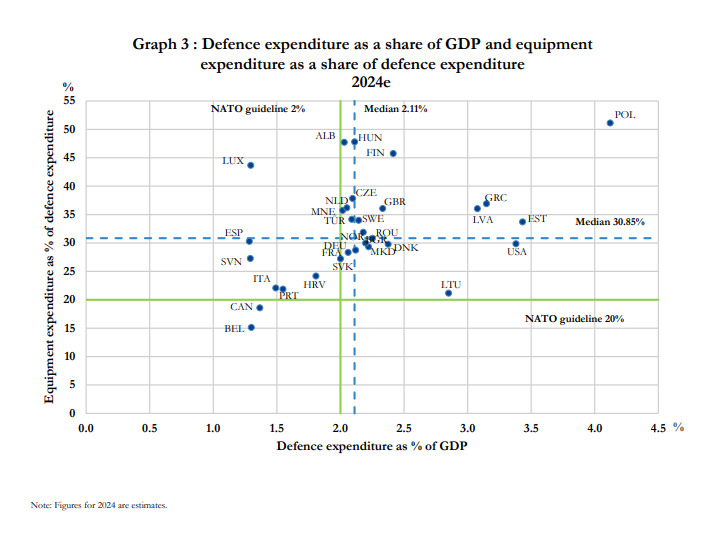
But again, matters are not so straightforward
The factor behind the large military expenditures is the big chunk of defense spendings going to salaries (due to 1.3-1.4 million military personnel), medical expenses and pensions, to name a few …
What really does matter is the share of investment in military equipment – a guideline set by NATO at 20% of total defense budgets
At the bottom of the ranking, Belgian investments were for a long time close to zero (3% of total as of 2014) … and the medical billings of the proverbial (and fortunate) ‘Belgian dentist’ in the country’s military budget stood out – but things change ….at a projected 15% of military expenditures, still well below NATO targets
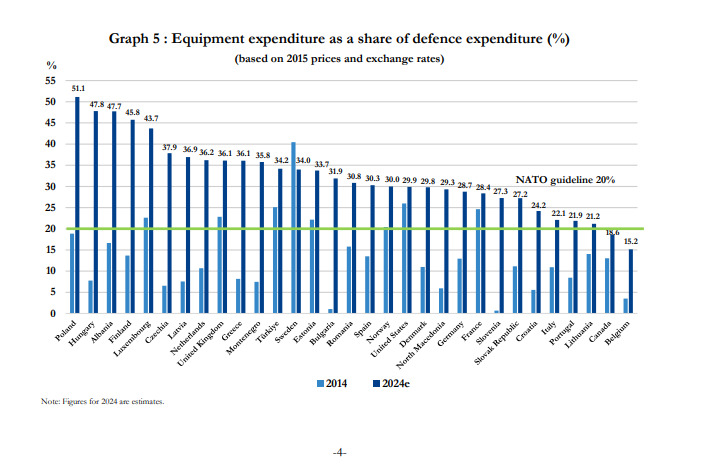
The good news is that the 20% NATO guideline has become obsolete - with median member expenditures at 30%
The bad news is that equipment expenditures are a hodge-podge of defensive systems, providing little clarity of overall consistency and efficiency
Adam Tooze suggests another ranking, devastating in terms of European military 'preparedness' – one of military expenditures (procurement) per soldier – estimated at $135 000 for an American military and going downhill from there for the UK and Germany (60% of U.S. level), France and Italy (35% of U.S. level)
What the invested cash actually buys
Whatever the merits of all these dollars, euros and cents, which are not always comparable, they do not even start to tell the story of European (and NATO) (un)preparedness, which is all about national pride and … national defense industries
One way to clarify the issue is to check what the invested cash actually buys and the comparisons illustrated by Mr. Tooze are not flattering for European defense industries
Prices swing far and wide
The most advanced German Leopard 2A8 battle tank is, at $29 million, close to twice as expensive as a U.S. MIA2 Abrams ($17.5 million) and almost 10 times more expensive than a Chinese Type 99A ($2.3 million)
Or self-propelled howitzers from Germany - such as the top of the range Panzerhaubitze 2000 - can be at $17 million 10 times more expensive than the US M109 ($1.6 million) while the French CAESAER ($5.8 million) is 3.5 times more expensive than the American model
Of course, apples and oranges are different and so are the weapons operating on the Ukraine battle field
The hard truth is unescapable – with a few exceptions, such as Rheinmetall’s large production capacity of 105 mm ammunition - the largest European defense "champions" have remained small on the international scale and even Rheinmetall ranked just 28th in the global armaments league in 2022...
The large European countries (France, Germany or Italy) have been protecting their national defense industries and avoid imports at all cost : less than 2% of equipment is imported by France, less than 4% for Germany and under 6% for Italy or the UK
The consequences are predictable – smallish defense contractors, fragmented R&D and costly ranges of different weapons systems
A 2018 study for the Munich Security Conference showed how Europe had 6 times as many different weapons systems as the U.S.
A final word about military preparedness
This briefing sets the stage for the massive challenge awaiting European nations decided to take the defense of the continent seriously – and they surely are
However, the most elemental, and most pervasive curse these nations will have to battle is the curse of legacy
Richard Overy in his 1995 “Why the Allies Won” makes the unusual case that the spectacular performance of U.S. industry in military production wrong-footed the German military industrial behemoth for one central reason
The Americans were unencumbered by legacy
As of 1940, America hardly had any defense industry but by 1942, after a deal of the Republican chiefs of industry with Democrat Franklin Roosevelt, the immense effort was in full swing
Henry Ford determined that the building of airplanes could not be conceptually different from cars, except for a change of magnitude and in complexity – the Willow Run plant which ended up employing 42 000 workers was born, producing one Liberator airplane every hour by 1944
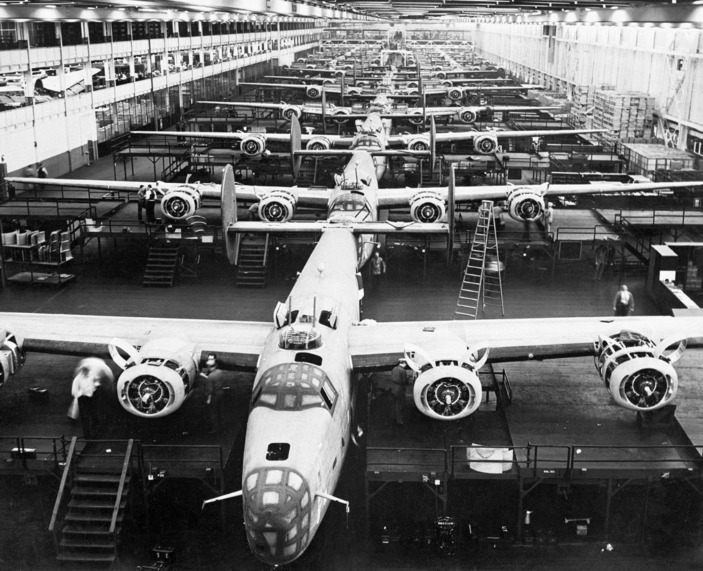
Mass production was repeated from every weapon system, including the Liberty ships to the tune of 2710 built in a standardized format between 1941 and 1945
The German defense industry, built up throughout the 1930's, could not be underestimated when the war broke out and its production capacity might actually have met America's potential until the end of 1942
But there was a difference - German engineers, in a never ending quest for perfection, focused on innovation, never hesitating to overhaul production lines at the expense of capacity runs, again and again
"Good enough" manufacturing processes just were not a German thing in any of their industries, and certainly not in military projects
German production of weapon systems started losing steam as the war dragged on; with the lack of qualified personnel and of material resources allocated more and more randomly, the lag became unsurmountable and, with too few tanks and planes spread across many fronts, the nightmare of Germany commanding officers became all too real
As NATO reports in annual "defense expenditures' overviews, standardization and mass production contributes decisively to any war effort - yesterday and today