

Jane Austen's 1813 novel weaves a tale around two very spontaneous feelings - one of Pride and the other of Prejudice - defined as human failings with a moral slant or just as 'first impressions' (the novel's original title) but, either way, recognized on distinct grounds
In discussing the U.S. trade policy, the contrast between "pride" and "prejudice" may clarify the options for the governments involved, following the announcement of tariffs by the U.S. on Canada and Mexico
Pride translates bluntly in across-the-board tariffs of 25% on Canadian and Mexican imports - setting aside oil imports - announced arbitrarily, without negotiations and in violation of binding USMCA (ex-NAFTA) treaty agreements
Pride finds its voice, frank and brash, in these tariff announcements, just because America can...
"Vanity and pride are different things, though the words are often used synonymously. A person may be proud without being vain. Pride relates more to our opinion of ourselves, vanity to what we would have others think of us" (Jane Austen)
Prejudice, endlessly repeated in porte-manteau phraseology of 'foreigners taking advantage of us, Americans', is a different matter entirely
With common sense - and hopefully with wisdom - prejudiced views of trade deficit will be set apart from the "pride" in hurting Allied economies, and getting away with it
Confusion between the two 'impressions' of pride and of prejudice portrays Mr. Trump's thinking, on a road the President should be left to travel alone
Prejudice in the complex understanding of what trade deficits exactly are will be discussed in a follow-up note
Fixation on trade deficits by the U.S. Administrations – effectively though less vocally during the Biden Presidency and with a show of muscle by the incoming Trump Administration – has been a constant before becoming a likely embarrassment
Blowing up – as of last Saturday - the revised ‘NAFTA’ trade (renegotiated by the first Trump Administration in 2020 under the appellation USMCA), the 25% import tax announced by the American president has deep consequences, not only in pure mechanical terms for Canada and Mexico but reputationally and worldwide
Canada
In practical terms, the 25% import tax will frame complex negotiations because of the vested interests of U.S. firms, strongly opposed to the measure, such as the U.S. oil refineries importing 4 million barrels/day from the Alberta province or the car industry relying on a supply chain spanning the three NAFTA-USMCA signatories
Although the Administration has been falling back on a lower 10% tax on oil imports to be implemented by mid-February, presumably leaving still more room for negotiations, the U.S. oil refineries (depending for 20% on Canadian oil), and especially the Midwest refineries dependent for 70% on Canadian imports, and geared to run the heavier crude oil grades from Canadian sands, will not let the matter stand
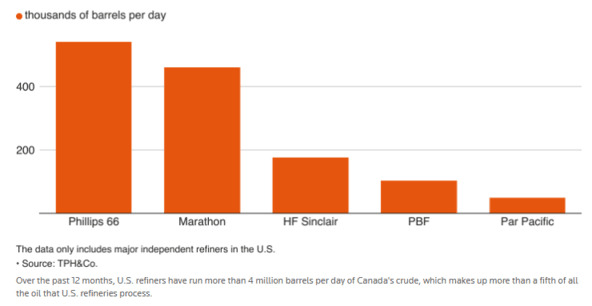
However, Canadian energy imports – oil more than half of total U.S. oil imports – and electricity bought at times to balance the U.S. grid in States along the border – represent just 1% of annual US electricity consumption
With so little leverage for Canadian authorities, it seems advisable to let US industrial interests run to the barricades
By the numbers, Canada's exports tell a very different story from the one advertised by the Trump administration
Based on 2022 OEC statistics, ex-crude oil and natural gas U.S. imports ($139.4 bn) which the U.S. energy market finds useful, Canada's Manufactured Goods import-export with the U.S. are equally balanced at $300 bn; Services U.S. import-export (travel, financial & business services) is very much in favor of the U.S. at $44.3 bn
Having agency, there can be no doubt that Canada (surely) and Mexico (very probably) will attempt to open negotiations, if only to gain clarity about actual purpose of the tariffs, by announcing 'countermeasures'
If indeed the Trump administration decides to burn the barn down, there will be little to gain and much to lose because this trade war is like no other, given the geographical proximity – the key factor in international trade – and the geopolitical common interest
For Canada, it might be advisable to ignore the American entreaties entirely and let U.S. companies, such as American oil refineries, automotive manufacturers and producers of consumer non-durables (spirits from Kentucky or orange juice from Florida...) do the legwork
As a side note, it is unclear why Canada should foot the bill (announced at $1.4 bn) for borders the U.S. appear unable to patrol ... while fentanyl, a deady synthetic opioid, said to be produced in the country (though in much lower volume than in Mexico) should indeed be addressed most strongly, if it is not, as asserted by the American President
Besides the serious fentanyl issue, U.S. trade with Mexico adds many levels of complexity, putting the country in a much weaker position, quite distinct from the Canadian outlook
Mexico
Paul Krugman, in a recent note on Mexico-U.S. trade, highlights that, before NAFTA went into effect in 1994), U.S. tariffs on Mexican products were already very low — around 3 percent – and that Mexico had given up on a trade strategy protecting the domestic market by ‘opening-up’ to international trade with drastic tariff reductions between 1985 and 1988
The point Krugman is making is that although the Mexican exports did increase from a low base with Mexico’s new trade strategy, after 1988, it was not reduced tariff rates which boosted trade between the two countries under the NAFTA agreement
It was the legal security guaranteed by the treaty which really drove trade to new heights
The treaty provided context – a framework entrepreneurs could engage with under the reasonable assumption that the legal protection would outlast the long-term planning of the complex supply chains relying on international trade
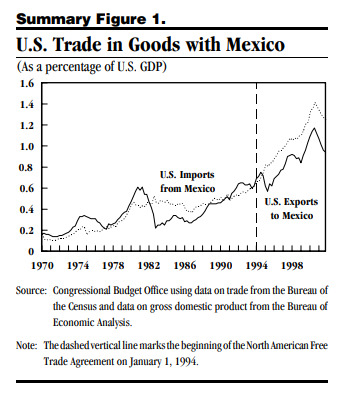
The most spectacular outcome of the treaty has been just such a tightly knitted supply chain redefining the American auto industry as a common endeavor with car components shuttling multiple times back and forth across the borders
And the car industry is not alone – the strength of the 'maquiladoras' in Mexico are there to prove it - operating on behalf of US (and international) firms under contract manufacturing agreements since the late 1950's
Maquiladoras are manufacturing in exactly the same way and to the same standards as the foreign company with the equipment, tooling, and processes relocated by the foreign company - importing on a duty- or tariff- free basis the components to be engineered and assembled for re-export
It remains to be seen if - and to what extent - this duty-free arrangement is now up for review and chances are their most vocal advocates will, as for Canadian energy, be U.S. manufacturers
The trade relations between the U.S. and Mexico are an exemplary case of great supply chain complexity developed over decades and relying on trusting relations between international partners
The production of car parts is a symbol of deep integration between the countries, with Mexico importing 49.4% of all auto parts from the U.S. In turn, Mexico exports 86.9% of its auto parts production to the U.S., according to the International Trade Administration.
In fact, the maquiladora model is likely to hold – and its great benefits for U.S. firms should guarantee this much
However, exposure of car manufacturers operating in Canada and in Mexico, exporting approx. 4 million vehicles to the U.S. according to S&P Global Mobility - of which 1.4 million light vehicles from Canada and 2.6 million from Mexico – cannot be minimized
While the 25% tariff will scramble the supply chains, all the car manufacturers will not be equally exposed
This dire prognosis – estimating the tariff impact at $6,250 to the cost of a mid-range vehicle – happens to hit, perhaps not coincidentally, foreign manufacturers especially hard
Almost half of the vehicles sold on the U.S. market by Volkswagen (43%) are produced in Mexico, followed by Nissan 27% and Stellantis 23%
American manufacturer come next with GM (22%) and Ford (15%), with perhaps more options of relocation to U.S. facilities, if compelled to do so...
A higher order?
NAFTA-USMCA is a treaty – and its revision by the Trump Administration is a recent event (5 years ago) which should make changes awkward, proving its negotiators to be incompetent and short-sighted
In effect, a treaty is a commitment to abide by a set of rules accepted by all signatories
By shredding the treaty, the American Administration will make life difficult for countries counted as allies, which is quite regrettable by itself, but it is the shredding of credibility of America which may have more durable consequences
Defined in moral terms, international credibility might be weighed against purposes of a higher order, cemented by ‘national interest’
Such a consideration could indeed upend normative decision making
However, such an ‘interest’ would need to be extremely strong to nix previous commitments because of the legal security a treaty provides, a guarantee on which a large number of stakeholders have come to rely - a very high bar indeed
Sifting through political grandstanding, obligatory in the current Canadian run-up to elections, and almost as compulsory for the recently elected President of Mexico, Mrs Sheinbaum, issues of national concern for the U.S. stand out
- the fentanyl crisis
- Chinese manuacturers circumventing U.S. tariffs by way of Mexican production facilities
Whether either concern exposes national U.S. security is debatable and the tariffs to address those concerns by maximum pressure on neigboring economies seem misdirected (to say the least)
The fentanyl crisis
- Synthetic opioids (mainly fentanyl) caused 83 000 deaths in 2022 in the U.S., down from 2021 by 3 000 deaths (a hollow success) - out of total drug-related deaths of 108 000
- The U.S. has been struggling with the issue for years - during the first Trump Administration and under President Biden - and the effectivenes of these policies should be evaluated domestically
- Focus on the imports of the 'precursors', the constituents of opioids, from China has led to clear commitments from the Chinese leadership, but diversion to manufacturing sites aroud South-East Asia should not surprise anyone
- Gangs manufacturing and distributing the vastly profitable opioids are said to operate mainly out of Mexico and in a limited way out of Canada - but most probably directly in the U.S. as well
- Mexico has been rolling back the defiant attitude of former president Lopez Obrador - who undermined the American DEA (Drug Enforcement Agency) cooperation with Mexican elite police units - and left his party exposed to accusations of campaign contributions by the gangs
- The task confronting the Mexican government is immense - according to DEA Congressional testimony, the powerful Sinaloa Cartel and Jalisco New Generation Cartel (CJNG) have more than 45,000 members, associates, facilitators and brokers in some 100 countries.
Ms Sheinbaum and the new DEA chief, Derek Maltz, a 28-year DEA veteran, have their work cut out The urgency of the crisis is unquestionable - only deep and trusting collective efforts between allies will book successes in this never-ending battle
Chinese manufacturing in Mexico.
Circumvention of U.S. tariffs by Chinese manufacturers operating out of Mexico, little discussed by the Trump Administration (and mostly ignored by the media), is part of a more general trend, with Chinese manufacturing facilities around South-East Asia (Vietnam, Malaysia, Indonesia...)
- Chinese foreign direct investment (FDI) in Mexico reached a 13-year high in 2023, with capital expenditure surging to US$5.6 billion, up from US$267 million in 2018, a multiplier of 20 in the space of 5 years
- Chinese build-up has concentrated particularly in automotive parts (70% of total 2023 FDI) : $3.5 billion was allocated to automotive original equipment manufacturing (OEM) and to electronics assembly
Mexican authorities have announced - and implemented - stringent controls on Chinese imports
What more can be done is unclear - and might not be necessary if the break-up of the USMCA treaty, depriving Chinese manufacturers of the incentive to operate in Mexico, is final
The overview of the tariff war engaged by the Trump Administration points to
- deft footwork required on the part of the Canadian government, caught up amidst the debris of the now-defunct USMC treaty, since there is no U.S. deficit in Manufactured Goods (setting oil imports aside) and a U.S. positive balance in Services - and fentanyl volumes out of Canada remain small
- very grave consequences for Mexico, improperly aligned with Canada's tariffs while the impact on its economy will be abysmal
No words are strong enough to describe the potential break-down of the Mexico's success of the last 30 years, if the loss of the U.S. market becomes fact - with the predictable consequence of many more immigrants attempting to reach the U.S. in desperation. Returns from the U.S. to Mexico outpaced immigration since 2007, which was a high point with 11.7 million Mexican people in the U.S.. falling by more than 1 million to 10.7 million people as of 2022. That may change, soon