

According to the Cambridge Dictionary, 'reading the runes' is 'to understand what will happen in the future, by looking at what is happening now'
The 'sound values' of the runes, which are letters of Germanic alphabets from the 1st and the 2d century AD, were identified with concepts, such as 'joy', 'good year' or 'possession'...
Hardly fortune-tellers, the runes-readers aimed to gain insights into potential outcomes, by understanding different perspectives on a situation
The U.S. Treasuries Yield Curve is no different…
By seeking to understand different perspectives on the state of the economy and of the federal budget, it is the ultimate ‘truth teller’ highlighting the fickleness of "truth" over time
A most promising window into the future, updated daily, courtesy of the "bond vigilantes", the all-powerful market arbiters, the Yield Curve confronts official policies with hard-nosed expectations
The curve is a combination of what is known today – the short-term yield guidance by the Federal Reserve – with near-future anticipations and long-term anxieties
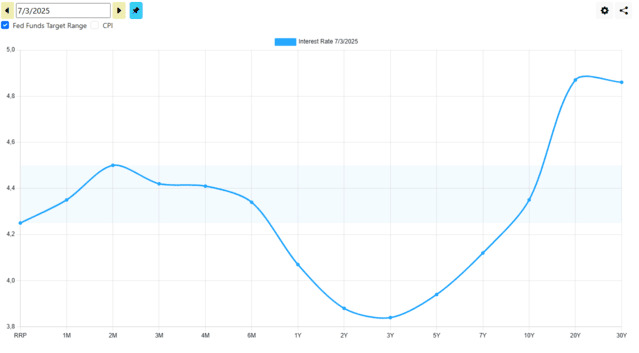
Short-, mid- and long-term Treasury yields are part of a moving scenario written today, and every day going forward
Interest rates - a target for the Fed and a cost for the budget
The Federal Reserve has held firm against pressure from Mr. Trump to lower rates
- The Fed is ambivalent about inflationary impact of the Administration’s tariff policy, which may or may not show up at retail in the current third quarter
- The strength of the labor market, adding close to 150 000 jobs in June, makes stimulative lower rates look premature
- Possible negative impact on growth because of economic uncertainty, entertained by the Trump Administration’s erratic policies, could kindle inflationary trends, opening the door for stagflation
Mr. Trump, taking the other side of the argument, vaunts the merits of lower rates to boost consumer choices and lower mortgage rates, which would be supportive for house construction
Most urgently, lower rates would alleviate the heady interest rate payments on ballooning federal government debt …
Total debt held by the public of approximately $30 trillion is close to 100% of U.S. GDP (est. at $30.5 trillion)
A 0.01% reduction in interest rates (one basis point) from average rate on total marketable debt of 3.362% would save approx. $2.9 billion – source U.S. Congress
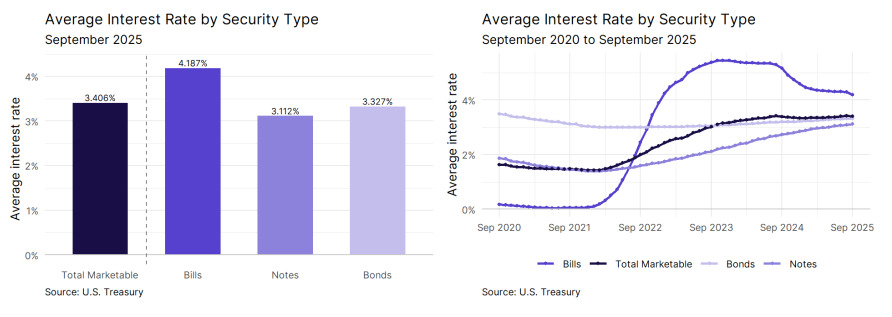
The yield on T-bills (maturing in less than 52 weeks) which carry the lowest risk has in fact been the driver of the rise in average interest rate for the last 3 years
The trend of interest expense on national debt implies staggering interest costs, even if current rates hold (they may) and if debt does not increase (it will)
Interest expense on national debt
2021 - : $562 billion – average interest rate : 1.605%
2024 - $1.13 trillion – rate : 3.324%
2025 (Oct. 24 -June) - $921 billion – rate : 3.294%
2025 (Oct.24-August) - $1.13 trillion - rate 3.372% - rising from $1.02 trillion - rate 3.352% at the end of July (over 10 months)
2025 (full year by Sept. 30) - $1.22 trillion- rate 3.363%
During June '25, debt expense increased by $145 billion and average rate increased as well to 3.375% - for July '25, debt expense increased by $81 billion and average rate decreased to 3.352% - for August '25, debt expense increased by $92 billion while rates increased again to 3.372% - for September '25, debt expense increased by $9 billion while rates dropped to 3.363% -
In the latest release, as of September 2025, increase over 12 months computes at $4.14 million per minute
Interest on federal debt will - assuming a moderately lower interest rate - absorb 25% of annual tax revenue in 2025
Because interest expense is turning into the central issue of federal debt management, the difference between federal debt held by the public (the most commonly used metric) and total federal debt (including intra-governmental debt which the government owes to itself) matters
Requiring an understanding of the exact terms, the Treasury Department communiqué, is summarized by CNBC
- With government red ink swelling throughout the year, last month saw a surplus of just over $27 billion, following a $316 billion deficit in May.
- Net interest on the $36 trillion national debt totaled $84 billion in June, down slightly from May but still higher than any other category with the exception of Social Security
- For the year, net interest — what Treasury pays on the debt it issues minus what it earns on investments — is at $749 billion
- Total interest payments are projected at $1.2 trillion for the full fiscal year
This may be confusing : the June budgetary surplus, in fact due to calendar adjustments, touts tariff duties, 'national debt' includes intra-governmental debt (such as Treasuries held by the Social Security Trust), and interest expenses net of interest earned on investments downplay this critical issue, the interest due on publicly held debt
The yield curve, slumping in intermediate rates (1-to-5-year maturities) ends up being ‘inverted’ – with short maturity (and less risky) yields higher than intermediate (and in theory riskier) bonds by approx. 0.5%
Expectations for rate cuts by two rate cuts of 0.25% in the second half of 2025 are running high, optimistically cast in the (sand)stone of intermediate yields
However, the new budget bill passed by Congress asks for some respect
The Big Bill of July 4th, Beautiful or not ?
The Administration, and Mr. Trump himself, seem to signal mounting awareness of debt unsustainability
In Bridgewater founder Ray Dalio's telling,
- "The bill is expected to lead to spending of about $7 trillion a year with inflows of about $5 trillion a year
- The current debt [approx. $30 trillion] is now about 6x inflows [tax revenues] and 100% of GDP
- Over ten years (2034), the debt will rise to about 7.5x inflows and 130% of GDP
- That will increase interest payments to $2 trillion"
Today, the bond market still gives the Trump Administration the benefit of the doubt with stable long maturity bonds – most exposed to uncertainty regarding long term inflation risk and weak growth
Yields around 4.5% remain consistent with inflationary expectations (2.5%) and projected growth (2%), and the 1% differential between two- or three-year maturities and 10- or 20-year maturities is not unusual
But for how long ?
What seemingly reflects unease is the high precautionary demand of the intermediate two- or three-year maturities, pushing yields down, to avoid being locked in at the short end when (if) the Fed decides to lower its guidance drastically
How trillions of additional deficit dollars, resulting from the recently adopted fiscal package, will impact the bond market remains an open question swirling with uncertainty
The sheer volume of new debt generated by the federal deficit ($1.9 trillion) and the debt maturing within the next 12 months to be refinanced ($9.2 trillion – 32% of public notes outstanding) has everyone grappling for responses when (not if…) the bond market rebels and Treasury auctions fail
The unusual and very large June 3 Treasury buy-back of $10 billion short-to-intermediate bonds (yielding 4.4%) financed by the issuance of 2-to-5-year maturities (yielding 4%) might portend things to come
- With its willingness to intervene to smooth the curve, the Fed might be signaling even stronger control, going forward, over the planned large T-bill auctions at the short end
- How the auctions - and demand (mostly by the money market investors) - develop over the summer will outline the Fed's tactics
- Lower rates cannot be decided before the market's actual demand for debt, especially at the short end, is firmly established
- Credibility of the Fed's control over the yields at the short end could become a deciding factor
- Intermediate and long-term bond holders are exposed to rising yields (and lower bond prices) by contagion as the tsunami of Treasuries (refinancing and new) hits the market
Interpretations abound…
The most reasonable assumption has the bond market adopts a 'wait-and-see' position amidst many moving pieces
- Does the U.S. market plan to hunker, mostly on its own, behind protective tariff barriers with a diminishing ownership of Treasuries by foreign investors, perhaps a manner of 'global grand restructuring' envisioned by Treasury Secretary Bessent ?
- On the contrary, will the bond market regain its footing after one, or two rate cuts, largely pre-announced by the Fed, and will the yield curve normalize, leaving the investor mix of domestic and foreign sources mostly unchanged ?
Thinking the unthinkable might be a good place to start, as will be discussed in our follow-up note "U.S. Public Debt - Bringing down the house ?"