
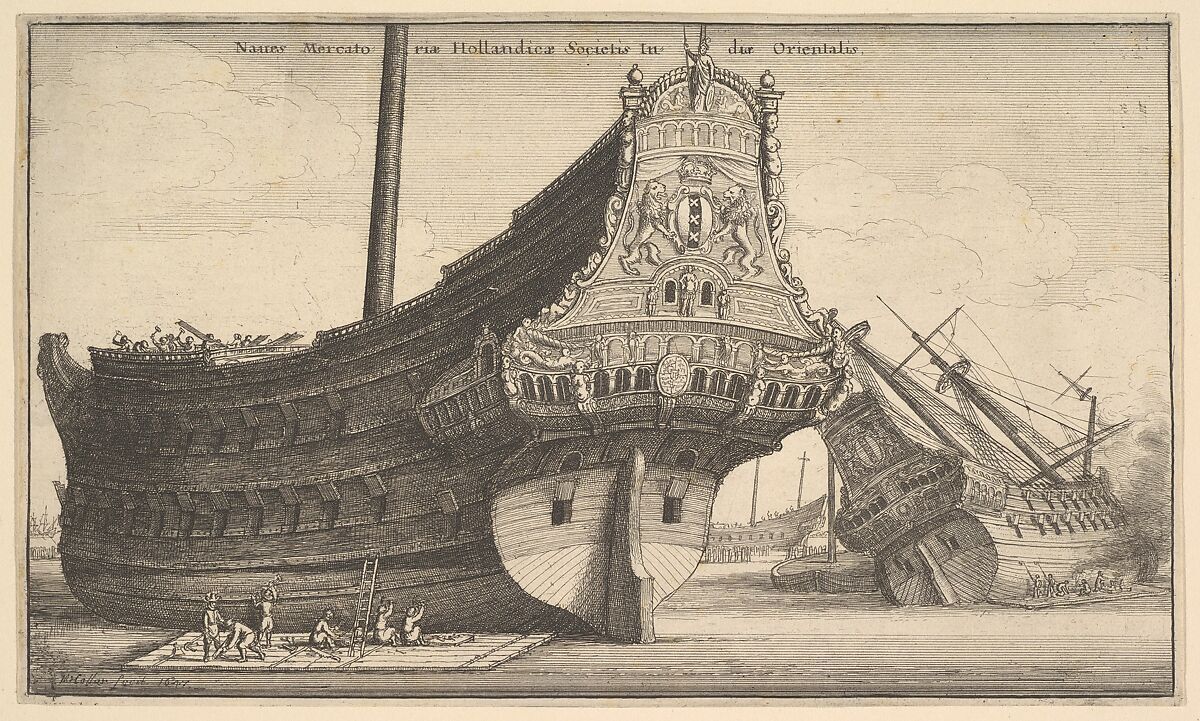
The Dutch Golden Age has been branded as 'pre-capitalist' by historians
It is true that the turmoil of the late 16th - 17th Century and the Dutch Revolt against Spain's dominance over the Low Countries spanning 80 years (1568-1748) have taken center stage as a turning point in European history
The sequence of events - setting a dramatic pace with the opening act of iconoclastic fury (Beeldenstorm of 1566), the early Uprisings against Spain (1568–1572), the Twelve Years' Truce with Spain (1609–1621) and finally the 1648 Peace of Münster, officially granting the Dutch Republic independence - defined markers of religious and political history
Any sequence of facts, taken apart from the social and political setting, is just one interpretation of the causality linking one with another, over a timespan palatable to our human understanding of scale
I will argue that, while true, this scope of events is still somehow constrained
The all-important drivers of economic achievements of the Dutch Republic remained unappreciated, during the Eighty Years war and, more significantly still, in the following decades
Enter Adam Smith
The long sweep of influential concepts - born early and traveling over long cycles, unobserved and unassumed - becomes self-evident late in the day, under the guidance of a powerful thinker
Distant events - and even the more recent past - can then be re-interpreted and familiar facts are discovered anew in the light of novel ideas
This is how Adam Smith may have relied on the fleeting memoirs of early 17th Century Dutch entrepreneurs and traders
The foundation of Dutch abundance has surely been opportunistic and pragmatic - the economic and financial achievements of the Republic certainly were tangible and addictive
The Golden Age had been waiting for Adam Smith's Wealth of Nations, some 150 years later (in 1776), to explain its own success
Articulating his thinking around the 'division of labor' to improve productivity, Smith stated what was destined to be accepted as common sense
- Specialized producers initiate a cycle of innovation and enrichment of the community.... provided the addressable market is large enough to generate sufficient demand
- International trade is the spark and the engine supporting the outreach of those specialized producers ... provided price discovery is efficient and reliable
My entire series on the Golden Age can be read like 'chapter and verse' of the principles expounded by Adam Smith
Holland - the 1600's and Promises of Great Wealth
The Dutch Provinces and the Sea
A Golden Age - Holland's Power by the Numbers
A Golden Age - Make the Dutch Provinces Great !
The networks of information, spun around Amsterdam after 1600 and on a global scale, would, for a time, secure the dominance of the Provinces on the European theater
Sticking to their natural pragmatism, the Dutch traders devised an inspired answer to the unifying challenge of their commercial endeavors, price discovery in international exchange
Ships and trading posts
In my introductory presentation of the series dedicated to the Dutch Golden Century of the 1700's, Claes Visscher's "Leo Belgicus'" map explains matter-of-factly, and without the benefit of hindsight, the source of Dutch prosperity - t'Lants Welvaert in words etched above ship riggings and structures, silhouetted on the horizon...
Trade would be global, bringing riches to the Dutch and power to the Provinces
Urban extension (t'Vergrooten der Steden, with scaffolding around new city gates), commerce (Coophandel, with traders assisting the loading of merchandise on a ship), rich and peaceful agriculture (t'Vredich Lantbouwen) and, last but not least, security for safe passage (t'Veylich Reyden - with seemingly relaxed traders on horseback) are the engines of individual contentment
By 1611, prosperity speaks of a society of modest affluence, confident in hard earned success and still unaware of the wild riches to befall the next generation
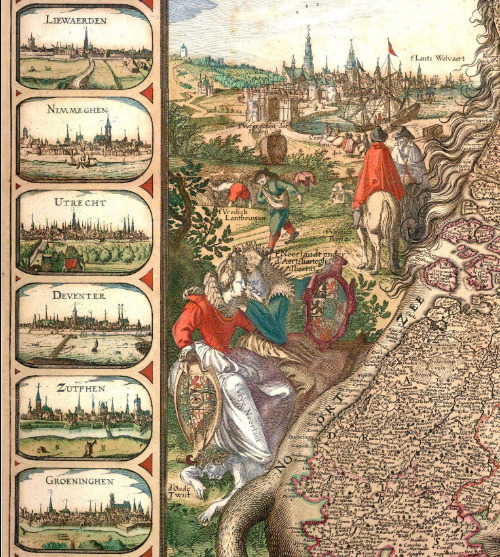
published in 1611 during the Twelve Years' Truce
Claes Visscher, the publisher of this famous map, pictures the reliance of Dutch prosperity on international trade with a shipping network, hinted at by the riggings on the horizon, catering on a global scale
By chance, by opportunism, familiarity with the wide and open sea lapping its Western shores, and thanks to a good measure of luck, Dutch traders were (very) early proponents of Adam Smith's Wealth of Nations, published 150 years later
The Seven Provinces, with Amsterdam in the lead, built infrastructure, canals and warehouses, constructed ships by the hundreds and entire fields of windmills, north of Amsterdam, to assist with mechanical energy, and, with insightful focus on quality control, raised the bar, and the grade, of the livestock produced on Dutch soil
In a word, the Dutch economy specialized and the more the Provinces specialized, the wider they cast their net of trade posts, in true 'Smithian' fashion
Antwerp was abandoned in the war with Spain, La Rochelle came next, and Lisbon, and posts around the Mediterranean sea, and the drive of the Dutch East India Company (VOC) brought the great riches as well as influence across Asia
All of this blooming economic revival, emerging from the stasis of the Middle Ages, occurred at incredible speed
As early as 1609, the VOC already anchored their operations at Hirodo (Japan) and, following the expulsion of the Portuguese in 1639, the Company represented the sole European nation permitted to trade with Japan, isolated on the island of Dejima, off Nagasaki
An invaluable monopoly ... and so it remained for 220 years ...the central conduit for foreign trade and cultural exchange with Japan during the isolationist Edo period (1600–1869), and the only Japanese territory open to Westerners
Cash flows, inflation and capital investments
Absent from Claes Visscher's map, invisible and ever present, money was the powerful driver of Dutch prosperity, the "lubricant" making the Dutch economy run smoothly
Improbably, but realistically, it must be assumed that money could not be just a facilitator of traditional barter between two parties any longer
Stretching far and wide across the globe, as far as trade allowed, the Dutch currency, the guilder, was tentatively entering the Modern Age, a premise of trust and a assertion of power
In my 'Golden Age - Make the Dutch Provinces Great', one force putting all European economies on the back foot, probably not well understood in its tentacular influence reaching deep into individual lives and ripping apart the relative stability of the early 1500's, was inflation
Potosi silver and Spain's riches had hit the European financial systems like an asteroid
The comparison between consumer prices in Germany, France, United Kingdom and the Netherlands (1500-1700) offers a unique perspective
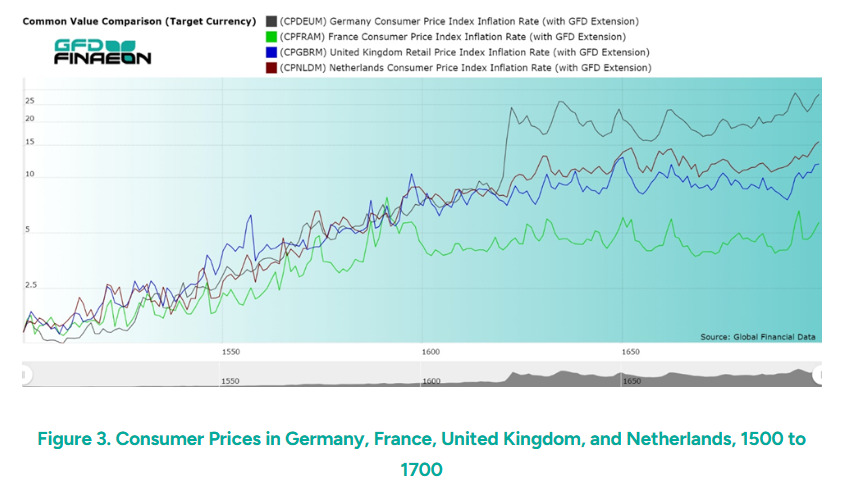
After 1600, European economies diverged - France seemingly less exposed in financial isolation for the entire 17th Century and Germany, at the other extreme, bearing the toll of the Thirty Year's War with blow-out inflation (before stabilizing at a high level with the Peace of Westphalia (1648)
Unsurprisingly, the Dutch and the English, in direct economic competition, moved in pairs...until the infamous Year of Disaster (1672) blew out the Dutch inflation
Wholly unprepared for the dynamics of inflation, many European sovereigns just knew how to borrow and how to spend money (on wars, on ...Versailles)
The Dutch (and probably the English, owing to their emerging banking system) saw things in terms of capital investments
Rather than 'pre-capitalist', which is a bit dismissive of the unusual achievements of the Golden Century in Holland, financial tooling underlying Holland's expansion as a major trading power is 'early capitalist' in my view
Many features are present - a Central Banking institution, a stock exchange, stocks and trade in public debt, futures...
One feature of modern capitalism is glaringly absent....
Established by a resolution and ordinance of the Amsterdam City Council in 1609, the Central Bank of Amsterdam was emphatically forbidden to generate liquidity by opening lines of credit to its customers
Created to stabilize chaotic exchange rates, and manage the hundreds of different local and foreign coins in circulation, the Bank functioned as a public deposit and transfer institution, not as a lender
Trust, foundational in early modern capitalism
Management of financial cash flows in the early 1600's was 'pre-capitalist' in intention, but 'early-modern' in practice
The mandate of the Amsterdam Bank - helpfully called Exchange Bank - was quite sensible in 1609
Instead of relying on money changers, weighing the content of silver or of gold of any coin coming across their counters, a central authority would do so, guaranteeing safe transactions in the process
Putting its credibility on the line, the Bank committed to hold on to the metal and deliver a paper receipt, representing the holding with a Bank guarantee of its truthfulness
And in time of crisis, the Bank did in fact prove true to its word with the ability to return the metal to the holders of the paper money ...
Failing to extend its charge to every transaction, in the face of stubborn resistance of the money changers, the Bank obligated all large transactions to rely on 'bank money' paper
Sensible in a world emerging from the Middle Ages, crowded by dubious coins rarely consistent with their stated face value, these Central Bank rulings could suffice
Transactions occurred for the most part between individuals (or families) and ventures were, mostly, initiated over short horizons
Risk was for the contractual parties to evaluate, but the backing of the Central Bank with trustworthy 'bank paper', representing coin deposits, was surely alleviating monetary uncertainty
This is how commercial ventures were launched and ships were rented on international routes
Costs could be calculated with great precision, and insurance of successful completion was soon included
In the accounting books of whale fisheries in The Dutch Provinces and the Sea, interest rates of the ventures appear to remain quite low, certainly considering the uncertainty of successful campaigns
Life could have gone on - and effectively so - on a local scale as a model version of 'pre-capitalism'
This was not to be
Circumstantial factors powered trust in the guarantees offered by the Amsterdam Bank to incredible - and probably not quite anticipated- heights
Trust in the currency, the gateway to greatness
The East-India Company (VOC) was a chartered joint-stock company, established in 1602, and its huge economic success in South-East Asian trade, set the Provinces on a course of capitalistic enterprise
Equally circumstantial were the Spanish transatlantic silver fleets which reached their peak between 1580 and 1620, flooding European markets and leashing continent-wide inflation...
By luck, with pragmatism and faith in the legal process, the Dutch were perhaps better prepared than emerging continental powers such as France
Credibility of the currency - and independence of the Republic - turned Amsterdam into a financial powerhouse
Unwittingly, the constraint the Central Bank had set for itself not to engage in debt became the powerful draw of international monetary flows
The liquidity required by the expanding international ventures of Amsterdam would be provided, in abundance, by foreign finance
The theoretical framework may not have entered consideration but, ever practical, the traders of Amsterdam and of the VOC surely knew how to take advantage
Trust in the payment system turned out to be central and unique to the Dutch economic achievements, but only for a time....
Under duress, faltering under continental assaults, over-ambitious enterprises even for the mighty VOC, and protectionism by the English and the French, the Bank of Amsterdam started to violate its own charter
In lending millions of guilders to the Municipality of Amsterdam and to the VOC, out of necessity and in the hope to keep the show on the road, the Regents were just human
The Regents were about to discover that trust, once lost, cannot be so easily regained (if at all)
The Dutch experience may echo our contemporary geopolitics - power can be credible for a while, as it would be for the Regents of Amsterdam
Trust however is the sole driver of success in the long term, as any Dutch trader would have known
Circumstances have been beneficial in the Golden Age of Holland
Next to trust, an equally indispensable dimension of trade will be the subject of my forthcoming note, 'price discovery' in a troubled, dangerous and mysterious new and global world