

Our series on the Automotive Supply Chains argued - back in 2022 and 2023 - for a nuanced approach to the mounting tide of Chinese car imports
Doing nothing and stay the course was never an option, but today, nobody gets even passing grades :
Not the EU Commission where regulatory power seems to be the preserve of the Green lobby, not the German car giants who have the most to lose, not the trade-unions, obstinate in their rejection of a changing world and certainly not the Chinese who abused their growing power in the industry, as if there were no tomorrow (there will be one...)
Predictably, things have gotten worse...
Legacy car giants face a double whammy
- Tariffs are upending supply chains around the world, adding costs as plants are reconfigured; production will not be global anymore but segmented and constrained to target markets
- Exposure to China’s automotive competitive challenge (discussed back in 2018 !) has grown from 'manageable' to probably unsurmountable in less than 5 years
Sales will suffer and in Europe, the risks could become existential in the automotive heartland, Germany
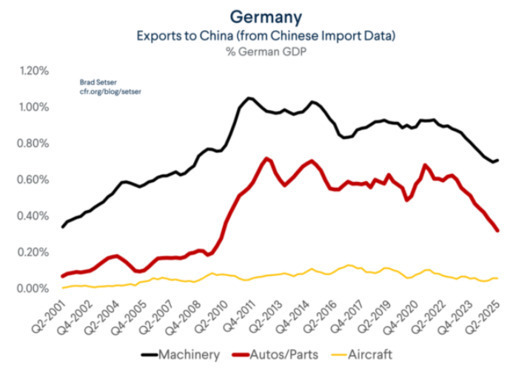
Two straightforward questions lay out the magnitude of the challenge
- The world's largest car market, China, is essentially lost for importers such as Mercedes
, BMW or Porsche - 40% of these companies' global sales (and profit) were made in China - what now ? - China is successfully managing the transition from ICE (legacy internal combustion engines) to electrical vehicles (EVs) and hybrid (BEVs) - the rest of the world is late (Europe) or has thrown in the towel all together (U.S.) - what to do as China's manufacturing goes into overdrive ?
Business models, which have been bread and butter of car companies, cementing their reputation and their brands, focused on quality, style, service and technological dominance
Not one of the legacy makers' distinctive features holds against the communication platforms 'on wheels' invented by forward-looking firms as Xiaomi
The stage is set - act one is easy to anticipate (tariffs and more tariffs) - but what about act two and the finale ?
Hope springs eternal
Imports of legacy carmakers into the world's largest market, China, are fast becoming a quaint idea
The dismantling of proud industries always remains a long drawn-out and unhealthy process, hurting, intentionally or not, the unprepared and the most exposed - not the owners of brands, assembling the cars, but the car parts providers, higher up in the supply chain
However much the stakeholders will resist, as occurred recently in Germany's Volkswagen plants, three of which the firm wished urgently to close, before backing-down on the united front of trade-unions and regional poiliticians, facts are like sandpaper, wearing down resistance relentlessly over time
Hard facts
- In 2024, global car sales totaled 74.6 million (Internal Combustion ICEs + EVs) with 31% for China (23 million cars)
- The 2024 EV sales reached 17.1 million units with 11 million units for China (65%) and 3 million units for Europe
From a competitive standpoint
- China Internal Combustion sales - at 12 million units in 2024 - are falling off a cliff (from approx. 20 million units in 2021) while production capacity in China remains high at approx. 40 million units, before probable plant closures
- China EV sales are displacing the Internal Combustion Engines (ICE) and, at 11 million units, come close to 50% of total domestic sales - production capacity, at an estimated 20 million units at the end of 2024 is growing - to reach 25 million units by end 2025
What the near future (2025/2026/2027) portends...
More than 50% of the Chinese domestic sales will be dominated by EVs, reaching an estimated 13 to 15 million units - freeing an export capacity of approx. 10 million units by early 2026
With ICE sales dropping by 2 to 4 million units (assuming total annual sales of cars in China at a stable 25 million units), only 8 to 10 million ICEs will be sold domestically - freeing an export capacity of at least 20 million ICE units (assuming some plants will be closed, which seems inevitable)
Those 6 million vehicles exported in 2024 were just for starters....
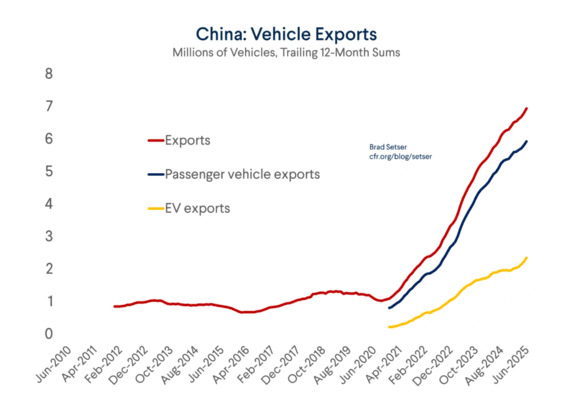
Potentially, by 2025/2026/2027, 30 million cars (20 million ICEs and 10 million EVs) could be exported annually from China, 30 to 40% of global sales worldwide (depending on estimates)
- With approx. global car sales (incl. China) of 75 to 90 million units (no one seems quite sure), those 30 million cars available for export cannot be qualified as 'overcapacity' but as a determined (more adequatemly called 'brutal') export strategy
- China exports in 2024 reached almost 6 million units (of which 4.5m were ICEs) and an effort to double (+ 6 million units) or triple (+12 million units) exports in short order (2025/2026) should be expected
- ICE car exports will surely be prioritized because the existing production capacity in China (30 million units ++) has nowhere else to go
- EV exports (1.3 million units in 2024) appear manageable with less urgency; capacity build-up is in the works (to reach 25 million units by year-end) and growth of the domestic market takes some pressure off the export targets, spread out through 2027
From the publicly available production and sales data, the interpretation is forthcoming - export warfare is breaking out on the global car markets and wars are not won with slingshots
Tariffs, a necessary evil and a dog-fight
Tariffs tend to be an assertion of sovereign power for each independent State (or by a Union in the case of Europe) but national decisions, one country at a time, are not just a recipe for total confusion but a guarantee for a 'lose-lose' outcome all around
Pros and cons of tariffs hardly need to be revisited - besides stating the obvious :
- Import barriers make sense only as part and parcel of an industrial strategy, prearranged with the stakeholders (employers, shareholders and employees)
- Stand-alone barriers, which they usually are, have the opposite effect by entertaining the illusion of productive value added to the national good, an illusion bound to dissipate
Caught in a lethal pincer between China's car export warfare and American tariff aggression, the car industry, in Europe, in Asia and in Latin America, are a 'test case' of all that can go wrong
All the same, car manufacturers remain unique around the world because, with large numbers of employees in the industry and upstream in the supply chain, their economic weight is enhanced by the symbolism of industrial success
This is why whatever option will be preferred in the global car industry, under duress of both China's export strategy and America's 'go-it-alone' policies, could provide guidance more broadly in any trade war, for any industry
The hardest questions need answers in the collective interest
- How to avoid a free-for-all dog fight in the remaining open markets, setting aside the U.S. and China, which are not by any measure 'open'
- How to coordinate trade between the countries operating in the World Trade Organization framework and those that do not
These 2 issues are contingent
- To maintain a reasonably open car market, aggression by China or by any other country tempted to dump its production capacity across the globe, should not be tolerated
- All the countries, exposed to the violations of WTO rules by the U.S. and China, which relish their economic dominance, need to decide on coordination
It may be too early to conclude that global trade agreements have already lost out to country deals to secure access to the US market or to the Chinese supply chains
New life may yet breathe in the one most essential principle of global trade, violated leisurely by the American administration, the most-favored-nation principle
What about the World Trade Organization's glowing successes in raising millions out of poverty ?
Political leaders who fancy themselves as power brokers are sowing the seeds of their own destruction, because their power policies are short sighted, transactional and ultimately manipulative
What about the test of time ?