

On a wild ride to respond to vocal environmental concerns about global warming and the future of the planet, Europe focuses on the CO₂ emissions of individual transportation
Combustion engines indeed are a critical factor of pollution, especially in large cities and in the most populous regions of the continent
However, in its breathless quest, Europe has been reluctant to discuss openly and transparently the costs of the radical overhaul of its most important car industry
Industrial planning has taken a backseat to rash political arbitrage
Predictably, the future of universal transport electrification shines brightest in countries with the smallest percentage of car-related jobs, casting doubt on the unity of purpose within the European Single Market
Benefits seem to be taken for granted while the priority given to vehicle electrification over other major sources of pollution has not been explained
The costs related to the complex transition of the automotive industry are immense and the legacy European manufacturers are left footing the bill, with predictable consequences on the price of the new vehicles produced in European plants
Human costs, in job losses, are another black hole, even though the large automakers probably hope to ease out excess personnel over time, with early retirements and other inducements…
Maybe so, but the numbers involved are staggering – a 30 to 40% job loss on the factory floor over time seeming a realistic assumption, electrical vehicles being much simpler to assemble, amounting to the immediate loss of 150/200 000 positions across Europe, with more to come
What is further left unspoken is the heavy toll on the vast car part manufacturing industry, a harsh reality for the thousands of combustible engine component makers with no fallback option – 200 000 decent jobs on the block in the short term (many more at later dates...)
As for the thousands of garages, it is a service industry which will lose its custom at a rapid clip as electrical vehicles which require little, if any repairs, become dominant, putting another 400 000 jobs in jeopardy – again over time but with certainty (along with the value of the businesses falling to zero)
However, there is even more reason to express concern about the short term ‘fix’ European politicians are implementing to respond to general excitement about the EV technological breakthrough spreading like wildfire
With Chinese imports of technically advanced EVs showing up on Europe’s doorstep today and following through in very short order (2023/2024), the delay required by legacy manufacturers to transition to EV mass production turns out to be an insuperable obstacle to protect their market share
By the time the European car makers are ready to market a full line-up, China’s imports will have cemented their own market share, brand recognition and distribution networks, all with generous subsidies of the European countries (and their tax payers) – securing maybe 20 to 30% of EV sales
Then what…?
CO₂ transport emissions by the numbers
As critical factor of pollution worldwide, combustion engines (passenger transport) are responsible of close to half the global transportation emissions, and represent 12% to 14% of the grand total of worldwide CO₂ emissions
Prodded by broad support in the European Parliament, the European Commission has implemented ambitious plans and its focus, as a rule-setter, has been on CO₂ transportation emission for a reason...
Since 1990, gas emission by the EU transportation segment - about one third of total EU emissions - has increased by 33% or 185 Mt (million tons)
The other segments (industry and buildings) - which represent about two thirds of total emissions - have decreased by 32% and this favorable outcome is at risk of being blunted if the trend on surging transportation emissions is not reversed
However....
In the November 2021 note - Transportation, a Green Nirvana - it was argued that as a global phenomenon, climate change was sitting uncomfortably with regional - even continent-size - strategies...
2019 WRI data have been a roll call of CO₂ transport emissions (in million tons - Mt) by the world’s largest or most populous or most environmentally damaging economies, and the European Union is the third heaviest contributor globally
- U.S. 1 762 Mt CO₂ emissions
- China 917 Mt
- EU 800 Mt
When adjusted for population, transport CO₂ emissions (in million tons) look very different
| Pop. (millions) | Emissions (Mt) | tons/person | |
|---|---|---|---|
| U.S. | 330 | 1762 | 5,34 |
| Canada | 38 | 176 | 4,63 |
| EU (1) | 448 | 800 | 1,79 |
| Russia | 144 | 258 | 1,79 |
| Japan | 125 | 204 | 1.63 |
| Brazil | 212 | 192 | 0.91 |
| China | 1400 | 917 | 0,66 |
| India | 1400 | 305 | 0,22 |
| (1) European Union + UK | |||
| Transport CO₂ emission - World Resources '19 | |||
The U.S. and Canada are conspicuous outliers - at triple the emissions of Western Europeans - and growing at approx. 1.5% per year (2016/2018)
The EU and Japan could be seen in a pivot range but only Japan actually reduced its emissions by more than 1% per year (2016/2018)
The BRICs (Brazil, Russia, India and China) have all grown their yearly CO₂ emissions between 4% a year (China) and 2.4% (India) with the exception of Brazil which reduced slightly its output
And there is worse to come in a global perspective....
If China manages to restrain and adjust consumer transportation demand with stringent regulations, other populous Asian countries may not prove as capable....
Indonesia (population 273 million) is a case in point - with emissions of 154 Mt (2019 data) - growing more than 7% per year - a trend indicative of future emission growth in the Philippines (pop. 110 million) or Malaysia (pop. 32 million) and of Pakistan's (pop. 220 million) or India's immense global impact
The demographics leave no room for doubt
Economic growth in these emerging markets is favoring a rising middle-class, pulling ever larger car ridership in its wake
Increase in CO₂ emissions in emerging markets could easily exceed whatever reduction in emission developed markets might ultimately achieve
The trend is undisputable - just considering global emissions of some of the world's largest nations
- India's global CO₂ emissions (est. at 2.9 GtCO₂ in 2022) are surpassing the entire European Union (2.8 2.9 GtCO₂) for the first time
- Indonesia's total greenhouse gas emissions (kt of CO2 equivalent) are on a relentless upward track even though its current per capita energy CO2 emissions are only 2 tons, half the global average (World Bank data)
As far as individual transportation is concerned, a blow-out of CO₂ emissions triggered by much increased car ridership is preordained, unless affordable and practical solutions (disconnected from unreliable power grids) are made available
Industrial solutions lowering significantly the current level of car emissions at affordable prices in emerging markets will contribute to limit global environmental havoc in large measure
It may be time to abandon the comfort - and technological exclusivity - of full transport electrification by supporting solutions combining EVs with the most advanced ICE motorizations in the car line-ups
Old certainties, new convictions
Market penetration of electrical vehicles has been extraordinary, swamping carefully laid-out plans globally (in China as well as in Europe)
Global passenger electric vehicle (EV) sales in Q4 2022 rose by 53% year-on-year to bring the 2022 total to over 10.2 million EV units, according to the latest research from Counterpoint
Driving the transition, 16 European governments and Canada (as well as Singapore, California and New York) intend to phase out new ICE automobile sales and registrations of new light-duty ICE vehicles between 2025 (Norway) and 2040 (France and Spain)
However, it would be rash to conclude that the demise of ICE motorization is preordained
Quoting a January 2023 by Aranca Investment Research
"In 2021, the worldwide internal combustion engine (ICE) market was approximately worth USD 58,514.15 billion and is predicted to reach USD 93,615.18 billion by 2029, showing tremendous growth at a yearly average (CAGR) of 6.05% between 2022 and 2029
It is likely to expand further as demand for passenger and commercial vehicles rise in both established and emerging markets
Electric powertrains are increasingly coupled with ICE to enhance vehicle fuel efficiency, which is driving industry development. The demand for ICE is growing exponentially in industries such as agriculture, construction, mining, and power generation. The global lack of EV infrastructure availability is partly responsible for the ICE market's growth"
To wit, the legacy car makers are of two minds
According to Aranca, Ford, General Motors, Jaguar/Land Rover, Daimler (Mercedes), Volvo and China's BYD pledged to phase out sales of new ICE cars and vans by 2040 worldwide and by 2035 in “leading markets”
BMW, Toyota, Volkswagen, Stellantis and the Renault-Nissan-Mitsubishi have voiced carefully worded concerns about going 'full EV' - In their shared views, deadlines announcements are too hasty...
- Social consequences of line-ups excluding the more affordable ICE 'base car segment' cannot be ignored
- Deadlines are counterproductive as owners of older higher-polluting vehicles will be keeping them on the road far longer
Not coincidently, these car makers also share strong commitments to emerging markets - Toyota in South-East Asia and Africa, Renault in India and South-America and Volkswagen globally - expected to drive future growth
- As Chinese car makers tighten their hold on their domestic market, the country which powered Western car makers growth for so long, is losing its appeal
- Chinese car sales are still trending up on a structural basis, with increasing car ridership among middle-class households but for the main (if not sole) benefit of BYD, Geely and other local contenders
- Because the Chinese fleet is expected to top around 340 million within the next 10-15 years compared to 265 million now, the EV fraction in the fleet is also growing faster than in Europe or the US, hovering around 5% in 2022 and expected to reach just over 13% by 2025 (ING Research Feb. 2023)
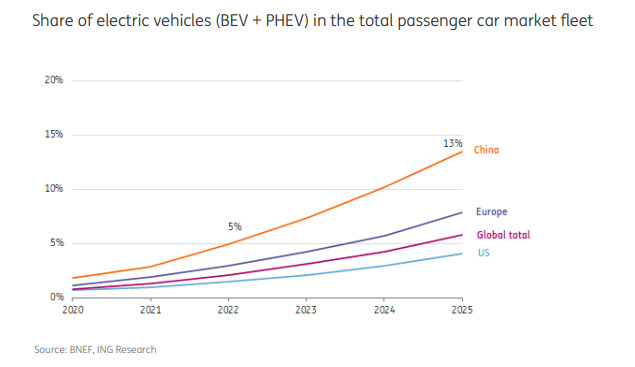
In conjunction with China's global EV power, European 'Green policies' seem to make light of their impact, reverberating down the entire automotive supply chain (Europe's most significant industrial jobs provider)
- With little growth prospects in China, and heated competition in emerging markets, the challenge to hold on to global market shares will be immense for legacy car makers
- Committed to large upfront investments in electrification (R&D, plants and equipment) to stay relevant, the European car makers can still expect price wars well before their full EV line-up is ready
- To slim employment over time with a gradual shift to EV production makes sense for car assembly plants, not so much for car part producers left with no product to fall back on - nor car repair shops losing traffic and revenue, come what may
Remaining difficult to manage, the transition should at least be predictable, all things being equal ...
However, equal all things are not
That sinking feeling
In the words of Stellantis
“The market is wide open to the Chinese”.
“We don’t want to have Chinese neighbors that sell at a loss in Europe and then put the automotive industry on their knees"
A case of shutting the barn door after the horse has bolted ?
The chart published by Gavekal suggests so much in no uncertain terms
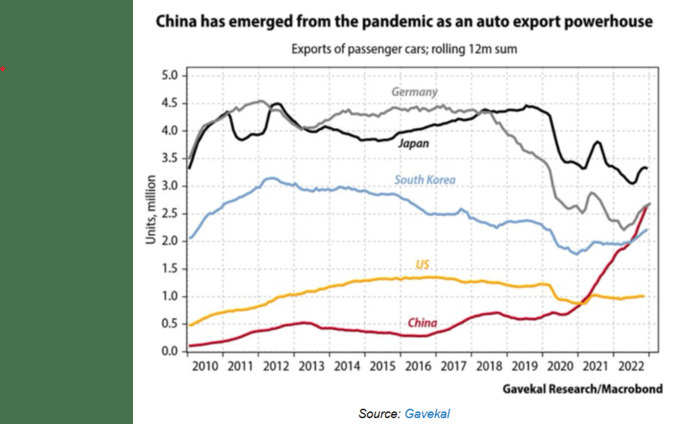
Long in the making, the projection of Chinese commercial power in the global automotive sector is unlikely to be side-tracked
The titles of our 2018 notes spoke for themselves
China, master of the (car) universe ? in July 2018 - arguing how the control gained by Chinese companies over the lithium-ion batteries production may turn out to be just as significant as China's impact on EV manufacturing worldwide
Cars in China - Twilight of the Gods ? in October 2018 - discussing exposure of the Western car industry's market share in China to surging domestic competition
Hailing from the Middle Kingdom - in October 2018 - insisting how an understanding of the China’s strategic EV choices for the industry’s future was essential
The questions raised in our concluding remarks at the time have found their answers
- Will Western manufacturers - operating in China - still be relevant to the Chinese car industry?
- Taking the long view, how transformative is China’s strategy of electrification and connectivity for the car industry?
- Ultimately, have the international production and quality standards of Western car manufacturers become the benchmark of State-controlled firms, a truly transformative event ?
In a nutshell, China's strategy of electrification has upended the legacy car industry and the motorization by internal combustion engine (ICE)
Down to the (electrical) wire
The top executives of the car industry have been pounding the table long enough and their proposals for industrial strategy call for a clear political stance
Presumably, no government wants to send the industrial combustion engines (ICE) to join horse buggies, somewhat wistfully and with just a bit of nostalgia...or do they ?
Risks to the European manufacturing hubs is real
- Chinese competition target Europe because of low import tariffs (10%) and governmental subsidies
- Cost advantages of cars manufactured in China are buttressed by plants running at full capacity and by attractive battery pricing (undercutting non-Chinese makers) - implying built-in price advantages at the mid- to low-end
- ...on top of supply chain integration, Chinese domestic market regulatory inducements in favor of EVs supporting demand, high quality rankings and dedicated transportation (maritime and rail freight) & distribution networks, discussed in our notes
Europe's industrial strength cannot be hemmed in by 'Green Diktat' nixing its automotive expertise in motorization
- The automotive supply chain will support future economic growth in times of "reshoring"
- R&D pursued in internal combustion and hybrids will be a springboard for global expansion wherever electrical grids are deficient
- Benefiting from a clear advantage in ICE expertise, the European car makers will give Chinese manufacturers a run for their money
The economics of the legacy car markers call for a balanced approach of motorization
- The industry has a global footprint - and competitively-priced ICE cars will in fact contribute to limit CO₂ emissions in growing emerging markets by tightening emission targets
- Hybrid motorization have shown potential and, although unfortunately half-hearted today, public support could boost more R&D in the future
- Affordable cars will be able to hold their own in the battle for market share waged in the mid-to-low volume end of the market, specifically in developed markets as well as in emerging countries
- Export markets are essential for car part manufacturers as the growing demand from assembly lines in emerging markets will balance volume loss in developed markets shifting to EV motorization
Considering the social cost of potential industrial job-losses in the sector, and the merits of hybrid engineering in countering Chinese car imports, compromise should not be as far away as it appears to be today
- As of March 28, a landmark law to end sales of new CO2-emitting cars in 2035 has been approved - with an exemption for sales of new cars running on e-fuels after 2035 requested by Germany
- France's vocal support of the law has been notable for its opposition to Germany's move to protect its industrial heartland - and for ignoring the reservation of both its major car makers, Stellantis
and Renault ....
Caught between environmental commitments and major social disruption, as the job losses in car parts industries sink in, the European Commission's ability to protect and to reconcile will be on trial
As governments know all too well, fine-tuned policies are not technocratic wish-lists...