
The last few months have upended the confident belief in international trade as a safe way to indefinite growth
Expansion of the global economy had supported this iron cast conviction –tomorrow would be no different, only better
The governments of developed countries promoted their success to the wider world with a bit of smugness but, on the whole, China’s rise sustained by boundless Western consumer demand, pulled the emerging markets along in the slip stream
World poverty fell notably since the 2000's
However, vaunted policies today lay in shambles, leaving politicians in disarray
The pandemic, war on the European continent and inflation are pushing the best laid-out governmental plans over the brink
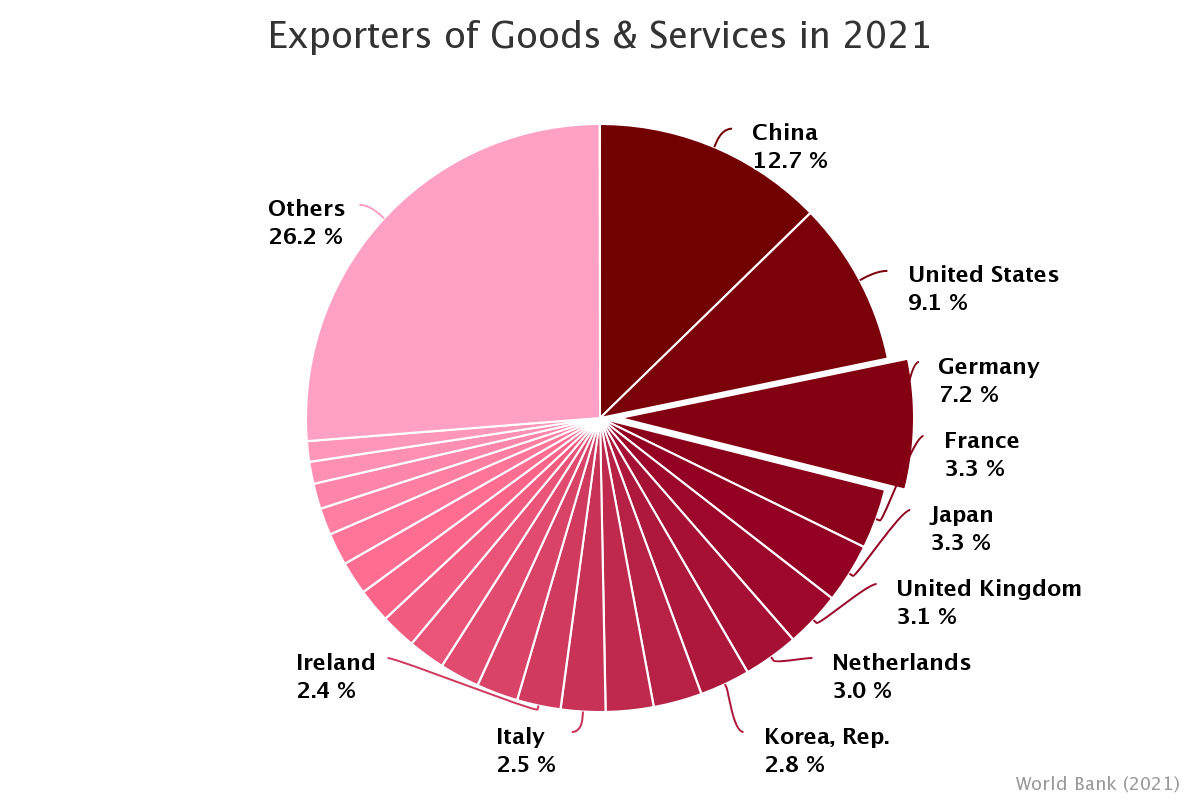
Aside from China and the US, the challenge facing Germany, third largest exporter followed by France and Japan (World Bank data 2021), is unique
Germany's international engagement is defined by very successful trade (foremost with China), peaceful coexistence (with Russia) and a strong domestic consensus
All three pillars are wobbly and there is no plan B
The tidal wave governments have had to confront – COVID pandemic, war in Ukraine and inflationary pressure – laid bare the frailty of deep-seated assumptions regarding globalization
Foundations, never to be questioned, turned out to shaky after all,
- In post-pandemic times, the workforce has been less willing to put up with questionable labor conditions
- Peace on the European continent has evaporated, and rearmament is an unhappy reality
- Inflation, unleashed by the energy crisis, ignites waves of popular discontentment, all the while bringing home the fact that ballooning public deficits have to be paid for, somehow
An urgent policy rethink by some of the largest and most influential nations on the globe is inevitable
But, aside from China and the US, the challenge facing Germany, third largest exporter followed by France and Japan, is unique
Germany’s success has been compelling
Standard bearer of global trade, its huge exports (shy of 50% of German GDP) are not the sure thing it was...
German industry, which bathed in universal admiration not so long ago, is trapped in universal concern
Financial rectitude – making balanced budgets an article of faith – is being drained in the name of industrial and household support
The defense of environmental policies is still principled but…coal-powered electricity is generated with abandon and the last two nuclear power stations are saved from the block, for now
Arguably, Germany might well regain its footing in export markets and recover from budgetary laxness, as the country has always managed to do
However, every tenet of the country’s powerful presence on the world markets has been shaken to the core by a fundamental shift
Energy availability, specifically reliance on Russian natural gas, has been a foundation of German industry (24% of GDP, ex-construction), powering large chemical concerns and the premium car manufacturers to achieve success on the international markets
Misplaced confidence and mistaken assumptions regarding ‘shared’ interests between the Russian exporter and the German importer are binary
- Either, after a very temporary blip, a time-tested stable relation with Russia will recover and trust will be rebuilt
- Or – in a slow moving trainwreck – Germany is compelled to reconsider every dimension of its economic success
The mirage of normality
Revival of a trusting partnership with Russia’s Gazprom is a mirage, floating out of everyone’s grasp
German Chancellor Scholz made unusually clear in a speech in the Bundestag three days after the Russian invasion that it was time for…Zeitenwende, a watershed, a historic shift...
Promising a new era of security and defense, Mr. Scholz spoke with confidence
Leaving unsaid the momentous consequences for the German economy, the Chancellor seemed to envision a return to normality in short order
This was not to be…
In this tidal change, Germany’s industrial backbone is more exposed by the brutal reversal of Russian energy policy than any other country
Fifty years of careful dialogue, initiated by Germany's Ostpolitik in 1972, with Russia’s gas exporter Gazprom, building trust and the closest mutually beneficial ties, have evaporated
The magnitude of the shift is putting the entire European Community on the backfoot
- The European Commission had been the diligent craftsman of an Energy policy which made the best of natural gas abundance to put its Russian provider in a straitjacket
- Long-term contracts, the traditional and very secure agreement format much favored by Gazprom, were losing out to spot market pricing
And there is no plan B in Brussels, besides stopgap measures to ensure gas availability during the winter of 2022
2023 and beyond - Eyes wide shut
Eyes wide shut, the title of Stanley Kubrick's 1999 erotic odyssey, is ultimately about the nature of seeing: what is hidden in plain sight and what we choose not to see

The fate of the European Commission, the EU executive branch, is no different
Energy prices are sky-high but, on the whole, governments will muddle through in 2022 by blunting their impact on consumers and businesses
Matters are getting much worse going into 2023 as it dawns on EU members that there may be little or no Russian gas at all to replenish the reserves depleted during the winter months
Keeping up the pretense of European solidarity, a fair but marginal commitment at best, all the countries at risk (at various degrees, everyone will be) have effectively drawn their own plans
Going cap in hand to solicit gas providers – Norway, Qatar, Algeria or Egypt – the governments, one by one, are facing the discomfort of a ‘sellers’ market’
- Long-term commitments are in, spot pricing is out – though current spots are presumably welcome benchmarks for the long term
- Flexibility of the global natural gas exporters is limited because of past commitments and capacity limitations – leaving eager European importers to struggle with insufficient supply to close the gap
As discussed in Europe – Running out of gas – a 100% increase in LNG shipments out of the US has been the balancing factor to cover the winter season of 2022, with unexpectedly high deliveries entirely driven by the European gas prices
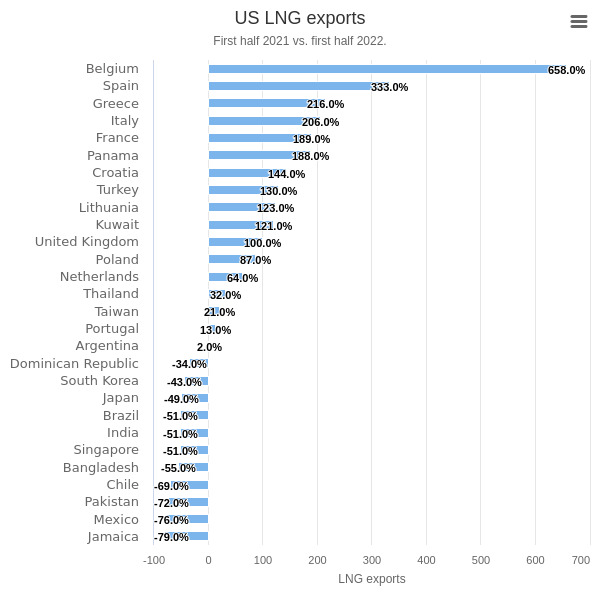
Pressure from the American Administration on Japan and South Korea to free contractual gas commitments for the benefit of Europe, and cancelled deliveries to emerging Asian markets (presumably against monetary compensation) have facilitated the surge
To expect a repeat scenario in 2023 appears to be a fool’s errand because Asian countries will demand the US gas shipments to which they are entitled by contract
Running for cover
Powerless, the European Commission witnesses the unraveling of its Energy Directives in real time
But the death by many cuts of the EU’s grand plan to level the Internal Market for fair competition on similar terms has one unintentional guilty party, Germany
The German energy giants had been safely ensconced behind long-term contracts with Gazprom up until the late 1990's
They were reluctant to adopt the principles of a competitive energy market which undermined their private agreements with Russia
German energy firms only resigned themselves to the inevitable when a smaller competitor, Wintershall, drawn in by the opportunity to market Russian gas in former 'East Germany', broke ranks in 1990 and established what would be a crucial partnership with Gazprom, Wingas
What was missed at the time, and with good reason, was a key assumption about pricing
- Russia was supposed to find solace in a carefully balanced mix of contracts and spot prices because, as lowest cost provider, its margins were in any case the larges
- Germany’s reliance on Russian gas guaranteed its vocal defense of Russian interests within the European Union
However, if price issues were superseded by geopolitical priorities, they could become irrelevant while Germany’s reliance on gas would remain, and in fact, could become even more relevant
….which is the course reversal President Putin chose late in the day
As of December 2019, Mr. Putin was still intervening personally in high-wire negotiations between Gazprom and Ukraine about gas transit fees, and did so on behalf of Ukraine, to preserve orderly gas flows through the entire pipeline network serving Europe, protecting Ukraine's transit rights for another five years
One needs to consider why Mr. Putin was willing to expose the energy sector to a downgrade on the international market
Forfeiting what had been his visionary support of the Russian energy sector as the most powerful leverage Russia could apply worldwide is perplexing…
…even if, as repeated ad nauseam, Mr. Putin underestimated Western resolve over Ukraine
More vital stakes must have come into play, leaving Mr. Putin in the grip of an overriding sense of urgency
Floundering through a bog of his own making, attrition on the Ukrainian battlefield, Mr. Putin has in fact put Germany – and Western Europe at large – on notice by nixing energy availability
These issues were discussed in Nordstream 2 - Going Head-to-Head - just before the start of the war, on Februray 1, 2022
The insights remain relevant, except for one thing....
...without plan B, an alternative to fall back on, Germany – and Europe at large – might well get the short end of the stick after all