
Sparking decades of debate, the novel “Heart of Darkness” by Polish-English author Joseph Conrad is credited by the great literary critic Harold Bloom with a "unique propensity for ambiguity"
The novel, published in 1899, tells the story of Charles Marlow, a sailor who takes on an assignment from a Belgian trading company as a ferry-boat captain in the African interior, and of his obsession with the successful ivory trader Kurtz working on a trading station far up the Congo River
Framed as critique of European colonial rule in Africa, the unstated setting of Heart of Darkness is the Congo Free State, private colony of Belgium's King Leopold II and one of the darkest pages of colonialism
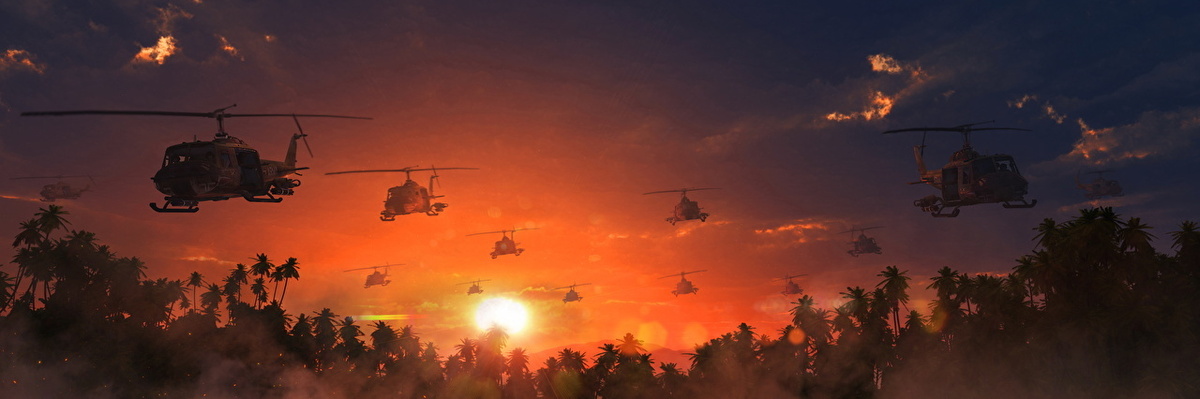
The indifferent reception by critics at its publication – while growing into one of the major texts of the 20th century Western literature – finds a singular echo in the mixed initial reviews of Apocalypse Now, directed by Francis Ford Coppola and released in 1979…, now considered one of the most influential films ever made
Loosely based on Darkness, Apocalypse tells another story of violence mandated by authorities, the U.S. Army in Vietnam, set against individual – and no less violent - resistance
The Congo River and Vietnam projected themes of State-sponsored violence and flawed morality in the reading of Conrad and of Coppola
And the ‘propensity for ambiguity’ observed by Harold Bloom – the power dynamics and the morality – seems destined to haunt the Western world one more time in Ukraine
Painted in various shades of 'moral crusade', the strong Ukrainian resistance to the Russian invasion may have enthused the Western media
However, the urgency of an exit strategy should not be obfuscated for the sake of an overriding sense of 'morality'
Leverage in coming to terms with Russian state-sponsored violence should be the order of the day...
If it can be argued that Russia under President Putin has already lost the war in Ukraine, it is because on every front, blowback is negative
- in real time on the battlefields and in the court of Western public opinion
- over time as the sanctions are taking down the scaffolding which entertained the illusion of an advanced economy
Rising in protest against the crimes and abuses committed by Russia’s armies, public opinion may be forgiven to disregard the darker episodes of its national history
Its sincerity cannot be doubted
The theory of terror
Terror unleashed against defenseless civilian population, which once again is put into practice in Ukraine, brings back forgotten memories ...
...especially of the German invasion of another neutral country, Belgium, in August 1914 when city after city was burned down and hundreds of civilians executed by the military –Andenne (211 executions on Aug.20-21) – Seilles (50 executions) – Tamines (384 executions – on Aug. 21) and on and on – Visé, Namur, Dinant....
The high point of unabated terror would be the burning of the University city of Louvain and the destruction of its famed Library founded in 1425, which included a unique collection of 750 medieval manuscripts and almost a thousand incunabula, sending shockwaves around the world
Clausewitz argued in his time that, since the object of war is to disarm the enemy “we must place him in a situation in which continuing the war is more oppressive to him than to surrender”
German General Staff may have been particularly apt in bringing terror to warfare to achieve victory in one short and decisive blow
The German army generals, who instructed extreme severity against the Belgium population in 1914 to compel their leaders to surrender, were hardly alone, looking no further than alleged American war crimes in Vietnam…
Quickly forgotten in the collective memory, the theory of terror seems forever destined to rear its head again for the sake of a quick and decisive blow
Certainty that the crimes deepen antagonism, stimulate resistance and end up lengthening wars seems to be discounted, again
And just as predictably, this scandalous course of warfare shocks international public opinion and stirs the most ambivalent governments into action – as surely today as a century ago
Principled resistance to acts of terror has been foretold - and ignored - time and again
Morality in a sense is lighting the cannon fuse...
..but then, the cannon just keeps firing
The power dynamics of Coppola’s Apocalypse Now may be just as unstoppable in Ukraine
By underwriting morality in terms of raw power, the question raised with immediacy is straightforward...
How many militaries and civilians have to die on either side, how many tank battalions have to be destroyed and how many lives have to be wrecked before reaching a breaking point ?
There is a possibility – much discussed in the media – of even more extreme terror on the part of Russia with tactical nuclear bombing, a first on the European continent
The complex interaction between power dynamics, which could support the bombing in a Russian perspective, and broadly understood morality, which definitely does not, makes such a dramatic raising of stakes unlikely
Alternatively, a low grind, a mutually destructive stand-off between Russian and Ukrainian armies, seems preordained
The brutal cost of violence
State-sponsored violence has been given a free rein in the conflict
In the defense of moral principles, Russia invaded Ukraine to 'free' the country of a supposedly fascist regime and in the name of moral principles, Ukraine has presented itself in the shining armor of 'democracy'
Both assertions remain dubious - false as far as Russian propaganda goes, imperfect as far as Ukraine's democratic credentials are concerned
Morality, however flawed, provides cover for the violence unleashed on the battlefield
For Ukraine, the goal is unquestionably the liberation of its national territory, leaving little room for negotiation
- Western weapon deliveries provide the means to that end
- The moral connotations of the crusade keep public opinion on side
The blood shed in battle and the sacrifices of the civilian population could back Western governments into enduring support, to achieve military goals now and for reconstruction later
For Russia, goals have been shifting, not only on the battlefield but, in the broadest sense, on the geopolitical plane and in Russian society
- The dreadful performance of the Russian army has implications well beyond the Ukrainian theater of operations
- China's wager on Russia’s global power to achieve a delicate balance might be in doubt
Self-inflicted wounds to Russia's deep-seated belief in its messianic destiny have to be healed....somehow
The search for leverage to achieve an enduring peace may be elusive but the value of a potential settlement is growing by the day, for the combattants and non-combattant forces as well
The chances of Leveraging Peace will be discussed in our follow-up note