
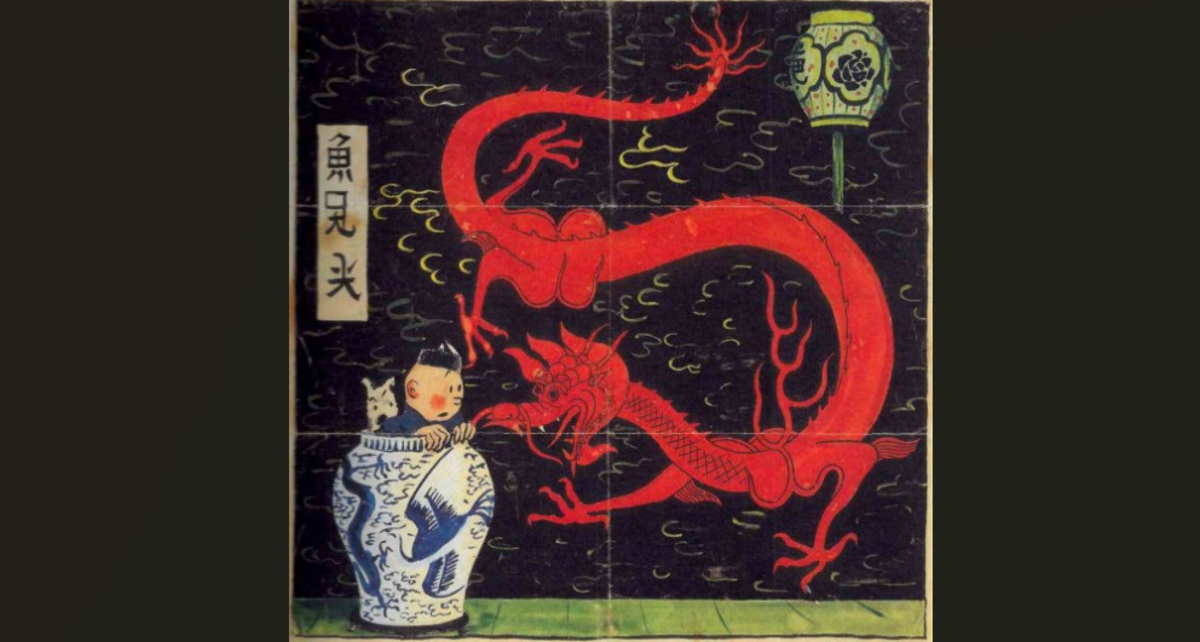
Hergé was a Belgian cartoonist (1907-1983), author of the comics series ‘the Adventures of Tintin, reporter’, in 24 albums which, from 1930 on, paint life experiences with the honest innocence of an outsider…
Goodwill is laid on thick – this is after all uncomplicated entertainment and the young readers are ever present in Hergé’s mind - and the scenarios stick to events just outlandish enough to intrigue, interwoven with snippets of contemporary news reels
Readers would have identified easily with the young reporter and share in his adventures, just like Hergé intended
Tintin’s enduring 20th Century popularity offers a panorama of changing perceptions of reality, sometimes shockingly provocative (blatant racism in ‘Congo’ or antisemitism in the 1941 ‘the Shooting Star’ staging a character named Blumenstein), often miraculous and delightful (Cigars of the Pharaoh – 1934) and then again surprisingly oblivious of hard times (no less than for 5 albums published between 1939 and 1945)
Hergé was not shy in describing himself as an ordinary artisan, dedicated to his craft, not so different from the man in the street, simply getting on with his life, comfortable with shared beliefs of right and wrong, and blanking out wars and revolutionary upheavals, just too terrible to apprehend
Tintin never has the benefit of hindsight, but simply "reports" what he sees when he happens to come along; his story line is like a a news reel, unspooling Twentieth Century real world events for a cartoonish observer, sympathetic and uncritical and ultimately uninvolved
The making of an artist
Created in a rush to support the launch of a youth-oriented supplement to the Belgian conservative daily “Le Vingtième Siècle” (‘The Twentieth Century’), Tintin saw the light of day, innocently enough as heir of ‘Totor’, a boy scout created, appropriately enough, by Hergé for a "boy scout magazine"
Successful from the start with the serialized ‘Soviet’ adventure of Tintin (1929-1930), capped by the ‘return’ of a real-life Tintin at the Brussels train station welcomed by a crowd of young supporters, Hergé’s strong scenarios of the first albums mirrored the preconceptions of the journal’s conservative readership, focusing on Soviet abuses (1929-1930), colonial do-gooding (‘Congo’ – 1930-1931) and capitalism’s dubious merits (‘America’ – 1931-1932)
With the dismissal of the deeply conservative secular priest, Norbert Wallez, who directed the journal from 1924 to 1933, for his fascist excesses, the journal recovered a more main stream catholic conservative readership
Challenged by the Vingtième’s political realignment, Hergé was about to anchor the true identity of Tintin, destined to become a cultural phenomenon and coming into his own in ‘Ligne Claire’ drawings
Within the first minute of a 1960 interview, Hergé nails what made the Tintin character unique, endearing and…ageless
‘Ligne Claire’
Hergé described his style in retrospect as aimed at drawing characters with a lightness, a transparency and a lack of weight – and Tintin's persona mirrored this ambition
“Ligne Claire” is the answer, for ever associated with Hergé who pioneered the style in Europe
With consistently clear lines of uniform thickness, delineating all elements within a panel, Ligne Claire’s shading is minimal, resulting in flat, unmodulated colors, contrast is subdued, and cast shadows are often illuminated
Characters, while often cartoonish in proportion, are juxtaposed with detailed and realistic backgrounds
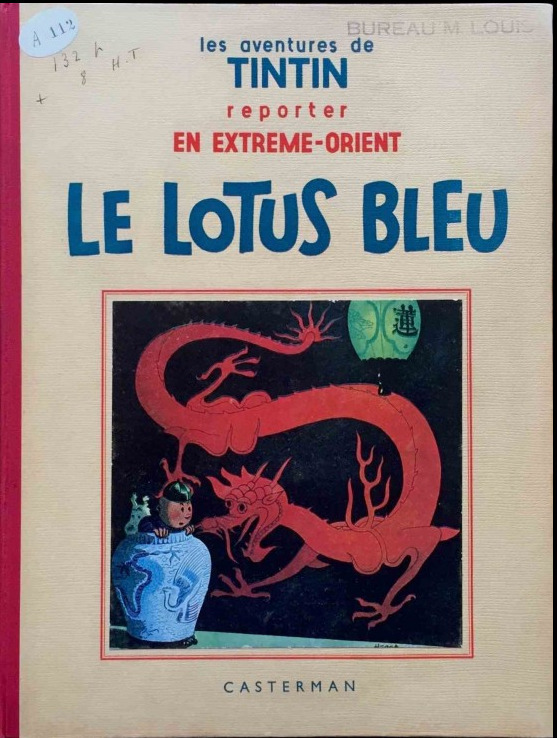
In ‘The Blue Lotus’ – a first with introduction of color prints for albums in 1936 – Tintin’s ‘Ligne Claire’ was coming into its own
With color printing opening new venues for the cover and large plates in the albums, Hergé haggled for the three-color process (mixing the three primary colors – red, green and blue) to settle finally for inline flexo printing where different color stations work sequentially (in-line) over carefully drawn black outlines (the black plate) to build the final image on proof (a tintin.com article illustrates the process)
Rapid-fire letter exchanges with Casterman, the editor, for the cover set Hergé on course for his visionary artwork: “the three-color process seemed to me to be more easily achieved by a drawing that created, through shadows and gradients, a very mysterious, even slightly shady atmosphere, which would have struck the children”
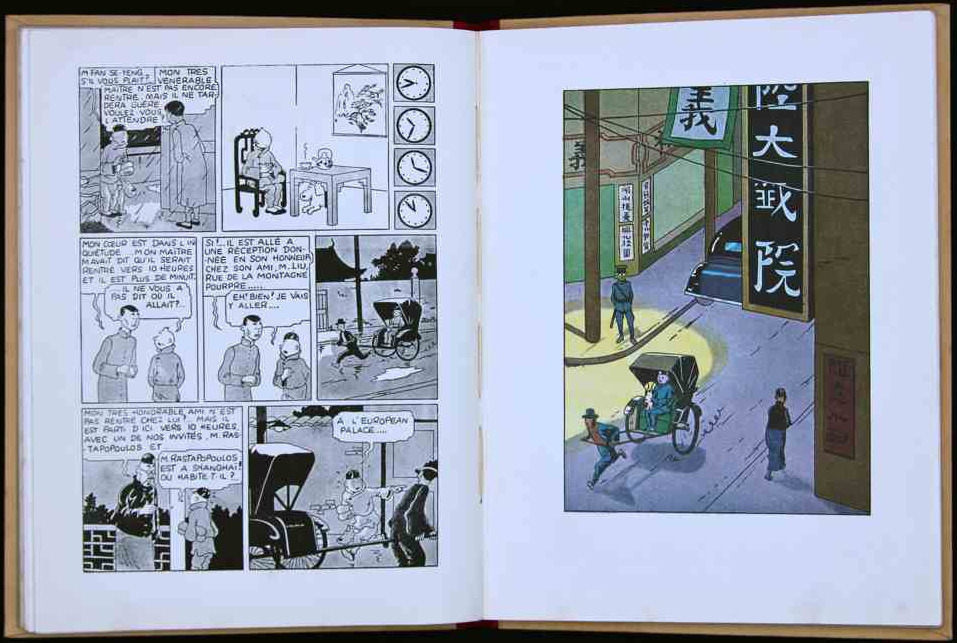
The Blue Lotus (1934-1935)
Poetic, dreamy at times, the album is a high point against which all the future albums would be measured
Very much engaged in events which occurred just 3 years earlier, Hergé puts Tintin on the scene of the floods of the Yang Tse (causing the deaths of between 150 000 and 200 000 people) and of the bombing of the South Manchurian railway, belonging to a Japanese company (referred to as the Mukden Incident)
The moving rendering of life in Shanghai and the critical portrayal of Japan’s imperial power grab in Manchuria from 1931 on came about under unique circumstances
In the preparatory work for his ‘Lotus’ album, Hergé uncovered a lot more than he might have expected in the network of the Catholic Church, still present at the ‘Vingtième Siècle’ journal
At the Benedictine Sint-Andries Abbey of Bruges, the monks’ intellectual life revolved around the teachings of Pope Benedict XV (1854-1922), who in his 1919 Apostolic Letter Maximum illud, strongly advocated for the development of a competent and respected native (local) clergy in mission territories outside Europe
Missionary in China for 20 years, before being send back to Europe in 1920 by his Lazarist superiors for being too close to Chinese demands, Father Vincent Lebbe (1877-1940) was central to the advocacy
With the foundation of a society supporting Chinese students in Belgium, Father Lebbe linked different actors within the Catholic hierarchy, all committed to a Catholic Church in China, led by highly capable Chinese monks
Men like Abbot Léon Gosset, chaplain to the Chinese students at the University of Leuven, dom Edouard Neut and dom Célestin Lou Tseng-tsian (born in Shanghai, diplomat and member of the government of the Chinese Republic after the 1911 revolution before entering Sint-Andries Abbey) showed great interest in Hergé’s contacts with one of those students, Tchang Tchong-jen, in 1934

Tchang Tchon-jen, born the same year as Hergé (1907) and a student-sculptor at the Royal Art Academy in Brussels, established a trusting friendship which blossomed around the Blue Lotus
Real life Tchang gave unique resonance to the Lotus
Hergé’s art brought to life his friend’s nostalgic longing for his homeland and the suffering of his people and carried a bold anti-imperialist message, quite provocative for the time
Rather sympathetic of the aggression by Japan, giving lip-service but no meaningful sanctions in their condemnation of Japan at the League of Nations in the 1931 invasion of Manchuria, Western powers were all too eager to protect the Unequal Treaties and their International Concessions, given an unvarnished account of criminality in Hergé’s rendering
Japan left the League in a huff by 1933...
As for the general public, deeply ignorant of China and the East in general, the Blue Lotus could have been enriching and humanizing…but the Lotus was actually way ahead of the times (the first print of 6000 albums took three years to sell out…)
Strolling through the Twentieth Century
When taking in the entire series of albums, readers today will get the impression of being regaled with a warped review of the Twentieth Century
Contemporary readers will feel uncomfortable with the often tone-deaf and blatant prejudice inspiring the early works – Tintin in the Land of the Soviets (1930), in the Congo (1931) or in America (1932)
Tintin's honest reporting of events as they occur in front of him, an innocent bystander, reflect faithfully public opinions in vogue at the time of publication
Arguably, Hergé is the pole-opposite of another favorite, a popular author with enthusisastic young readership, a full century earlier, Jules Verne (1818-1905)
While not precisely the visionary of modern technology he has been made out to be, Jules Verne observes the transformative potential of science
In Verne's novels, the inventor is heroic in his convictions – and tragic in his overreach
Glorious in his own terms, he takes the universe for witness, standing tall and unfaltering at the helm
Tintin, a child of the next 20th century, seems to personify the lightness, the transparency and the lack of weight of the 'Ligne Claire', emblematic of Hergé's style
Ageless, featureless except for the quiff, a hair tuft making him recognizable, Tintin leaves the stage to the background, Shanghai's dreamy cityscapes, Egyptian tombs or Peruvian jungle, and to sharply drawn characters whose idiosyncracies are refined from one album to the next
Tintin's soul does not need to be set in stone, his 'raison d'être' is to facilitate the expression of goodness in his friends and of vileness in his opponents
Because Tintin is a blank sheet, the trust of young readers the world over is preordained - they confide their aspirations to the young reporter lightly because he sets no challenge in return
Much like Hergé himself, the Tintin of some of the greatest albums has a keen eye for the world around him
Humble, withholding judgement about world events and filled with a sense of wonder, Hergé reports equinamously on a century of upheaval and of adventure
Keeping his head down, Hergé had to get on with life, like everybody else, but the sense of wonder which never left him has been a gift for Tintin's enduring popularity
No one really knows if the times of noisy, in-your-face, heroes, taking history for witness is gone for good
Keeping a watchful eye on the here-and-now, ready to step into the frame of adventures still to come, mildly amused by the antics of a Captain Haddock of our age, and paying attention to the inventiveness of our own Professors Calculus (there are quite a few...), there is no telling what Tintin will make of the 21st century