
in about 300 words...
Following the September 16 decision of the U.S. Federal Reserve to reduce rates by 0.25%, it may be the right time to draw attention on one of the most familiar unresolved issues, the irresistible rise of the cost of U.S. debt
Considering its ever rising size, U.S. debt could lose some of its attraction for U.S. Treasury lenders, about 32% of which are foreign entities and individuals
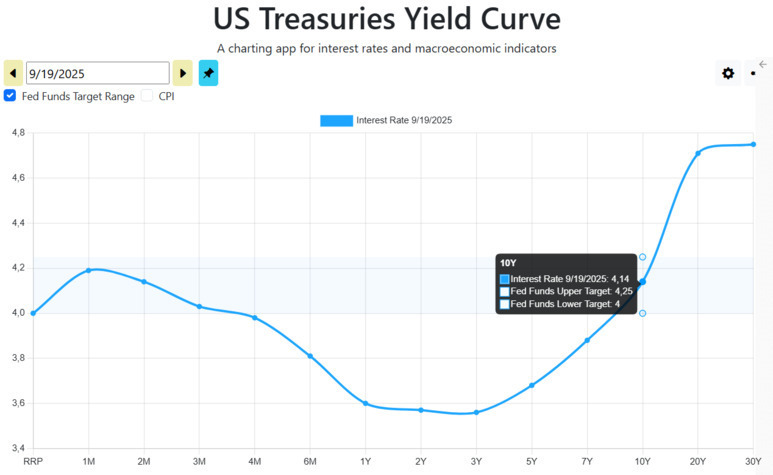
The yield curve might reflect this reticence to engage by steepening, with lower yielding Bills at the short end but higher yielding long maturity Bonds for 20-30 years…
U.S. federal debt is composed of marketable debt, held by the public ($30 trillion) and held by the government itself regarding Social Security ($7 trillion), in total an estimated 121% of a $30.5 trillion U.S. GDP
The size of debt may not matter as much as the interest expense on debt
Quick review of the numbers
- I projected interest expense to rise to $1.125 trillion over the budgetary period (12 months through September 30, 2025) and with just one month to go (definite number will be known by early October), the estimate is spot on
- At approx. 25% of budgetary receipts of an estimated $5 trillion (taxes, tariffs and duties), interest is dwarfed by only 2 categories (Social Security and Medicare)
Defense, which comes in at approx. $1 trillion, and ensures the country’s future security, falls below the current cost of past expenditures
Obviously, consequences cannot be understated
In financial context, the interest expense to be honored corresponds to approx. 60% of additional debt to be incurred over the next 12 months
More debt to pay for running interest expenses
Tariffs, currently estimated at $400/ $500 billion a year, would balance between 33% and 40% of the annual interest expense (based on $1.125 trillion)
The additional expense of tariffs is distributed along the supply chain and the end consumer is likely to carry at least 2/3 of the cost, $270 billion /$330 billion, which translates in an 11% to 13% increase of budgeted individual income taxes ($2.5 trillion)
Since this indirect taxation will be unevenly distributed between consumers, consequences remain unclear but in no case negligible
"Households live in the present" observes Yahoo Finance's Brett LoGiurato, Senior Editor.
In UMich latest unemployment survey, Joanne Hsu, director of of the UMich outlet, noted an interesting tidbit
"Trade policy remains highly salient to consumers, with about 60% of consumers providing unprompted comments about tariffs during interviews."
To go further, check my in-depth discussion U.S. Public Debt - Bringing down the house ?